Saturday, February 8, 2014

Puzzling Evidence - Chinese Cloisonne Beads from the Art Deco Era

Online auctions often describe Chinese cloisonné beads as dating to the “Deco” era - the years between the end of World War I and the end of World War II (approximately 1920s through 1940s).

What styles of cloisonné bead are actually characteristic of this period?  How does one tell the difference between beads from the 1930s and the 1970s?

In Robert Liu’s 1995 book Collectible Beads, pages 64 and 65 contain a reference to the collection of Dr. Joan C. Feast (1919-1996), possibly accumulated from 1935 onward and during the years she resided in San Francisco.  Here is a link featuring the photo and caption from the book.
Ornament Magazine
Recently I acquired a little baggie of cloisonné beads from an Arizona eBay seller, containing beads resembling some of the beads pictured in Dr. Liu’s book:
They are in pretty bad shape.  Some sort of repair seems to have been attempted with red and green enamels.

The damage to these beads seems typical of their use in designs that caused the beads to swing and clack together, chipping the enamel. 
Rich vintage Chinese charm bracelet featuring gemstones and cloisonne courtesy of eBay vendor tikiagogo6058.


A Life magazine photo of Helen Burton aboard the rescue ship Gripsholm in 1943 shows her wearing a necklace with dangling oval beads, although it’s not possible to tell if they are cloisonné, glass, porcelain, or stone.  She had spent the two years prior to this photo in a prison camp, so her necklace almost certainly dates from before the early 40s, and may have been a design she sold in her Camel Bell shop.
From My Piece of the Helen Burton Puzzle - A Progressive Revelation, by Donald Menzi
Some of the disc beads from the photo in Dr. Liu’s book have turned up in brass link belts, and the oval dragon beads appear in jewelry designs by Louis C. Mark and (possibly) the Miriam Haskell studio dating to the early 1940s. 
Courtesy of eBay vendor oncillakat.
Online auctions from Japan have listed dragon beads as kanzashi and sagemono, and TokyoJinja's lovely blog features a photo of a phoenix disc bead and two dragon beads in use on vintage obidome.  A 1930s-1940s time frame for the beads coincides with the period when Japan was active in China, setting up businesses, and - unfortunately - engaging in military incursions.  
Obidome courtesy of Etsy shop MagicDragon's Store.
Could the rectangular holes on many of these disc beads be a holdover from the style of counterweight used in the Qing court necklaces, which required rectangular holes to accommodate the flat cord?  The Qing dynasty ended in 1912, so by the late 1930s this style of pendant bead with a rectangular hole would have been 25 years out of production.  It seems more likely to me that these beads were created in the 1930s specifically for belts to coordinate with western clothing fashions of the era, as well as obidome and sagemono, and also produced with round holes for costume jewelry fashions then current.


The holes of the round and oval beads are large - 4 to 5mm - with rough metal edges.  The underlying metal appears to be copper, and is thin – the beads are lightweight.

The enamels and general style of the designs on the disc beads can all be matched up with similar round beads.
Belt picture courtesy of Etsy shop MagicDragon's Store.
Although the dragon beads and discs always display small crinkle clouds or spirals scattered around the background, the floral versions often – but not always - lack these motifs, a feature also observed on export vases that appear to date from the Deco era.  
Later vases always have their backgrounds filled in, the rows of clouds becoming more uniform and dense as the decades progressed and assembly line manufacture became dominant.  Spirals seem to drift out of fashion and disappear after the 1970s.

The enamel quality varies from OK to poor, and seems on a par with other small folk art cloisonné articles manufactured during the pre-World War II years, such as napkin rings, condiment sets, cigarette smoking sets with little matchboxes and shallow dishes for ashtrays. 

The repertoire of enamel colors is pretty basic – red, light green, a darker green, a bright lime green, pink, a light buttery yellow, turquoise and sky blue, royal blue, white, and black.  Small holes from gas escaping as the enamel was fired are common.   In defense of this limited palette and imperfect surface finish, it can be tricky to create recipes for enamels that will all melt at approximately the same temperature and do not require a separate firing for each and every color.  Likewise, the range of minerals available as glass colorants and the fineness to which they must be ground and washed is also a concern for small craft workshops on a budget, especially within the time frame of the global economic depression of the 1930s.

Openwork designs without background enamel are common.


An especially rare bead is one with an intricate and fine floral design done in a sort of reverse openwork - the background is enameled, but the cloisons are left unfilled, and then gilded.
Courtesy of Florence Foster, Beads With A Past


A bead of this reverse-openwork type in an extravagant 1930s charm necklace design.

Draughtsmanship skills vary from mediocre to artistic.  The floral designs are graceful and bold.  Oddly, the dragons often only have four toes, which made me wonder if these dragon beads were all the work of one person.  The phoenixes seem especially awkward, even when compared to the charming folk craft style of birds that appear on some of the cloisonné vases made for export during these decades.
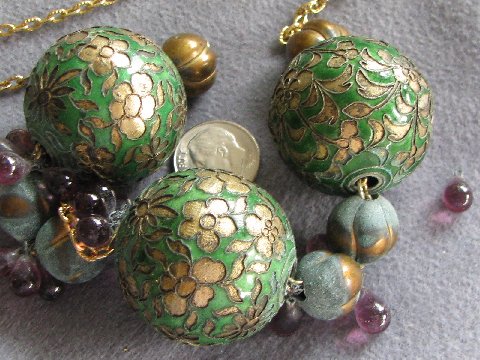


The evidence so far for Chinese cloisonne beads that might actually date from the Deco era is that they’re of comparatively large size, with big holes and comparatively casual workmanship. Their dramatic patterns and size, vibrant colors, and light weight give them considerable appeal, I think. 
Were these items the product of one cluster of workshops? Were other workshops of this era making finer beads?  Are all the more skillfully made Chinese cloisonné beads from later decades?
Floral beads with small holes, old enamel colors (including the bright lime green for the background)
Obidome beads - 1930s or 1970s?

UPDATE April 2014:

eBay seller wondollar found what seems likely to be a Louis Mark brooch design for Rice-Weiner, featuring a large cloisonne bead about 1 inch in diameter.  A Louis Mark brooch with an oriental theme has a patent of 1941, thus it seems probable this bead is Deco era Chinese.


UPDATE: An interesting bracelet featuring Czech brass work and imitation coral and lapis pressed glass combined with Chinese cloisonne 4-toed dragon beads:


Sunday, January 26, 2014

Puzzling Evidence - The "Lotus" Clasp is a Morning Glory

In a prior post I discussed a style of cloisonne box clasp with a mysterious flower design that, for want of a better idea, I named the "Lotus Clasp." [post since updated to reflect name change]


This just goes to show the hazards of being unfamiliar with artistic iconography from another part of the world, as an online auction recently listed  one of these clasps as a "morning glory."
Duh!  Of course!  

It seems to be an especial favorite of Japanese artists, whose rendering seems more typically to match that of the clasp - here's an example of a set of lovely Fitz and Floyd plates featuring the morning glory motif:
Courtesy of eBay vendor maggie-magnolia
Notice the little vine tendril - after wondering what that little brown worm-like thing on the cloisonne clasp could be, now I know.

The clasp typically seems to be a machine-stamped design, but here's an example featuring an actual hand-wired cloisonne box clasp:
Sold on eBay for $15 by eBay vendor vickysdesign917, who offers many other nice things at what seem like similarly affordable prices.
For comparison purposes, here are examples of cloisonne morning glories in Chinese and Japanese work:


Chinese

Japanese
Could this clasp design possibly be of Japanese, rather than Chinese, inspiration?
Puzzling evidence...

Update - Chinese morning glories with JingFa clouds in a very pretty design:
Courtesy of eBay vendor spikesstuff44

Wednesday, January 15, 2014

Puzzling Evidence - Mysterious Transparent Green and Amber Enamels

Collecting beads also leads to an interest in pendants, and so once upon a time I acquired a little cloisonné bottle pendant featuring what looks like a swan or phoenix, with little flowers as the background pattern on the other side.  It got placed in the box of beads and pendants that appear to be Kuo cloisonné products.


But then some other similar items began to appear, such as this nifty bottle featuring a pond of lotus flowers, with water lines as the background pattern.  The eBay vendor Money Penny Collectibles confirms that this was one of a collection of snuff bottles that was examined by noted Chinese art appraiser Lark Mason at an Antiques Roadshow event in Jacksonville, Florida. "All of the snuff bottles I showed him were from the 1800s ... with one potentially dating back to the late 1700s."


And then this little box, with a bird nearly identical to the bottle pendant, of which the seller, gramagramm on eBay, states, “The person I got this little box from told me that her sister brought it with her in the early 1950s from China.”


What to make of this puzzling evidence?

UPDATE:  My blog post for July 7, 2014 gives some possible answers with regard to the workshop that created these pieces.  Note especially the use of twisted wire to form some of the cloisons.

Monday, January 13, 2014

Puzzling Evidence - The Dot Artist of Cloisonne Beads

Photographing small jewelry items tends to focus your attention upon little details.  Thus, I noticed a pattern appearing in certain cloisonne beads, characterized by:
  • Tiny dots evenly spaced around the circumference
  • Very detailed flowers
  • Repetitive motifs in the flower petals, especially a trefoil shape that doesn't show up on other cloisonne beads
  • Careful and exact composition of the floral sprays - branches look like branches, leaves like leaves, buds like buds, instead of the often blobby look of mass-produced beads
  • Spirals and older-style clouds used for background motifs
  • Older style rather than the JingFa-style of flower bud
  • Strung with nicer gemstone beads and clasps
Writers on the production method of cloisonne are adamant about the time it takes to make a cloisonne object - nearly a week for a vase, for instance.  Nowadays so many things are made via machine or production line, I think we tend to forget that craftsmanship and artistry are often very time-consuming tasks.  Whoever this unknown and unsung bead artist was, carefully using tiny metal strips to draw tiny flowers upon tiny round objects, I think her skilled craftsmanship deserves some recognition.


Strung with wire and crimp beads, most likely not Chinese stringing

Loose beads used to create a stickpin
Update:  eBay vendor itmustbeit recently featured a very nice necklace of these beads, and granted permission to post a pic here:
The silver clasp looks more old-fashioned to me than similar clasps more commonly encountered
Update: Another nice necklace, this time with a morning glory clasp:
Smaller beads (12mm) but with a variety of colors and flowers and cute little butterflies. The background motifs are spirals on the dot beads.  The beads with the butterfly/daisy/buds combination lack dots, have tiny cloud-like motifs in the background.
eBay vendor Antiques of Northbrook (cellarbuy1) found another nice example of The Dot Artist's work:

RubyLane vendor Vintage Jewels, Antique Haven L.L.C. also has a spectacular necklace on offer:

UPDATE: Two more Dot Artist necklaces.  Both have filigree clasps stamped "Silver, Made in China."
This necklace appears to have been re-strung with new wire links.
 

And another spectacular example from France.  Note especially the chrysanthemum flower design, and the blossom and branch beads.


The remains of a necklace with cinnabar beads:
And rarest of all, a necklace with scroll patterns:

According to the 28" length given, these appear to be 15mm in size.

UPDATE: More necklaces by The Dot Artist:
The smallest Dot Artist beads I've found so far - 10mm.  There are three patterns going on here - tiny daisies, petaled flowers and leaves, and (near the clasp) tiny gourds and gourd blossoms.  
Compared with 12mm and 15mm beads.

Necklace was broken, I re-attached the pieces.  What I noticed about these beads is the older enamel color, the composition of the design, the older style carnelian beads, and the absence of JingFa clouds as background motifs - just spirals and those signature dots.

A long 30-inch necklace of 15mm beads with a morning glory clasp.  Again, older enamel colors.  Notice also the centers of the flowers, the various different designs on the beads, the blue petal "cap" on the bead lower center with the pink flower, the absence of JingFa clouds.


UPDATE: At last, someone with information as to where and when she purchased a Dot Artist necklace - Shanghai in the mid-1970s.  eBay vendor andcam1018 states, 

"I worked in the mainland China when it first opened to tourism and purchased many beautiful pieces.This beautiful blue cloisonne hand knotted necklace was purchased by me in the Shanghai China Friendship store in the mid 1970's.  It is a real master piece and looks gorgeous when worn.  It is 23 inches long and contains 40 cloisonne beads and one round clasp.  Each bead is handmade so none are identical."
Notice the Morning Glory clasp and the tiny gourd pattern on some of the beads.


Wednesday, January 8, 2014

张同禄 Zhang Tonglu and Robert Kuo - Two Innovative Careers in Chinese Cloisonne

In October of 1949, the Chinese civil war ended with the founding of the People's Republic of China.  Many members of the Nationalist party fled to the island of Formosa, now called Taiwan. One such person was a painter, who founded a cloisonne workshop.  His son, Robert Kuo, worked in the factory from his teenage years, learning the art of cloisonne.  In the 1970s Robert moved to Beverly Hills to establish his own atelier.  A lengthier post on Kuo cloisonne is coming up shortly.

Status Kuo by Finn Olaf-Jones

Meanwhile, Zhang Tonglu, also a painter, joined the Beijing Arts and Crafts Factory and also spent many hard years mastering the art of cloisonne.  Recently he was celebrated for his achievements.

Google Images for Zhang Tonglu

Informative article about Zhang Tonglu's career:
http://www.jtlzj.net/jingtailanjieshao/161.html

What struck me was the different path each artist pursued to grandeur in cloisonne - Robert Kuo to modern architectural pieces, Zhang Tonglu to baroque gilded and bejeweled splendor.


Tuesday, January 7, 2014

Puzzling Evidence - Chinese Cloisonne in 1933 Advertisement of N. Shure Co., Chicago

This was an eBay item too neat to pass up, so now it's mine; however, I bought it to share with you because documentation for vintage cloisonne is not all that common.

Here are a couple of pictures, so the details can be viewed more closely than in the scan.
Over the past months, I've seen pieces similar to all of these on eBay.


The little online currency inflation calculator I used determined that $15 in 1933 is the equivalent of about $270 today.

UPDATE: A catalog page one year later, 1934, shows a price increase for the 15 in. lotus pond vase, for example, had increased to $13.50. A correspondent provided pages from a later 1937 catalog, where the price of the 15 in. lotus pond vase dropped to $5.50.  
But then in another earlier? later? catalog page, the price has increased again to $23.  Perhaps the Shure Company, centered in Chicago, purchased a supply of vases for the 1933 World's Fair, and then struggled to unload them in subsequent years?