Saturday, November 2, 2013

Puzzling Evidence - The JingFa Cloud


Sifting through online auction items for Chinese cloisonné, I noticed a trend in the style of clouds used in the background.  From what I’ve learned about cloisonné production methods, these little background motifs are useful for stabilizing the enamel as it heats and melts, preventing it from dripping off the piece or clumping up into blobs. 

Let’s start with Lao Tian Li’s clouds – tight little rounded things with a central hump and two round wings. The curves are plump and evenly spaced with few noticeable flat spots, even in the central spirals.  They’re placed evenly and precisely, with all the curves going in the same direction.


On other pieces from the early 20th century the clouds may have tighter central spirals, flat spots in the center curl or top or bottom, be more unevenly applied, and sometimes have spirals going in opposite directions.  But they’re still tight, rounded little motifs.  I think of these as “crinkle clouds” because of the kinks between the wings and the central curve.


During the 1920s-40s production methods in some workshops seem to have gotten more hurried and stereotyped, and a longer (1-1.5cm) stretched cloud appears, with flattened top and bottom, applied with varying degrees of evenness and in just enough quantity to not overpower the design.  An easy motif to use for fitting between the parts of the main design, the larger size having the benefit of covering more ground with fewer wires.
Smoking set with winsome dragon, accompanying letter dated 1942, from ebay seller particularpicker
These all appear to be made by the same workshop, but have different base stamps.  1930s-1950s?

In other pieces, the clouds are shorter and so thickly and closely applied in neat horizontal rows that the background resembles lace or crochet.
The squared rims on these two vases seems to indicate a date 1930s-early 50s.

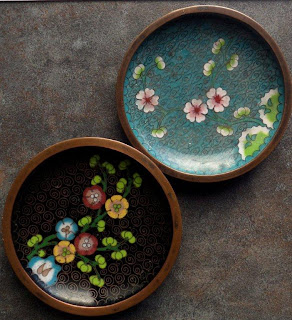
These small dishes show the "garden rock" base of the floral sprays displaying a similar comma leaf? bamboo shoot? motif to the green vase in the preceding picture.  The black dish displays a "peaked spiral" diaper (see further below), the turquoise dish the "crinkle cloud."

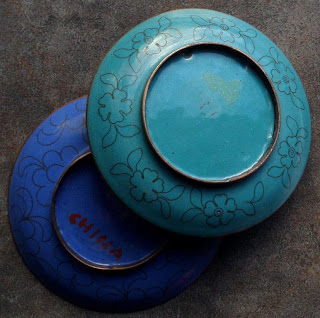
The backs of the small dishes, both showing a red "CHINA" mark indicating production pre-1950 (the mark on the turquoise enamel is very faint)

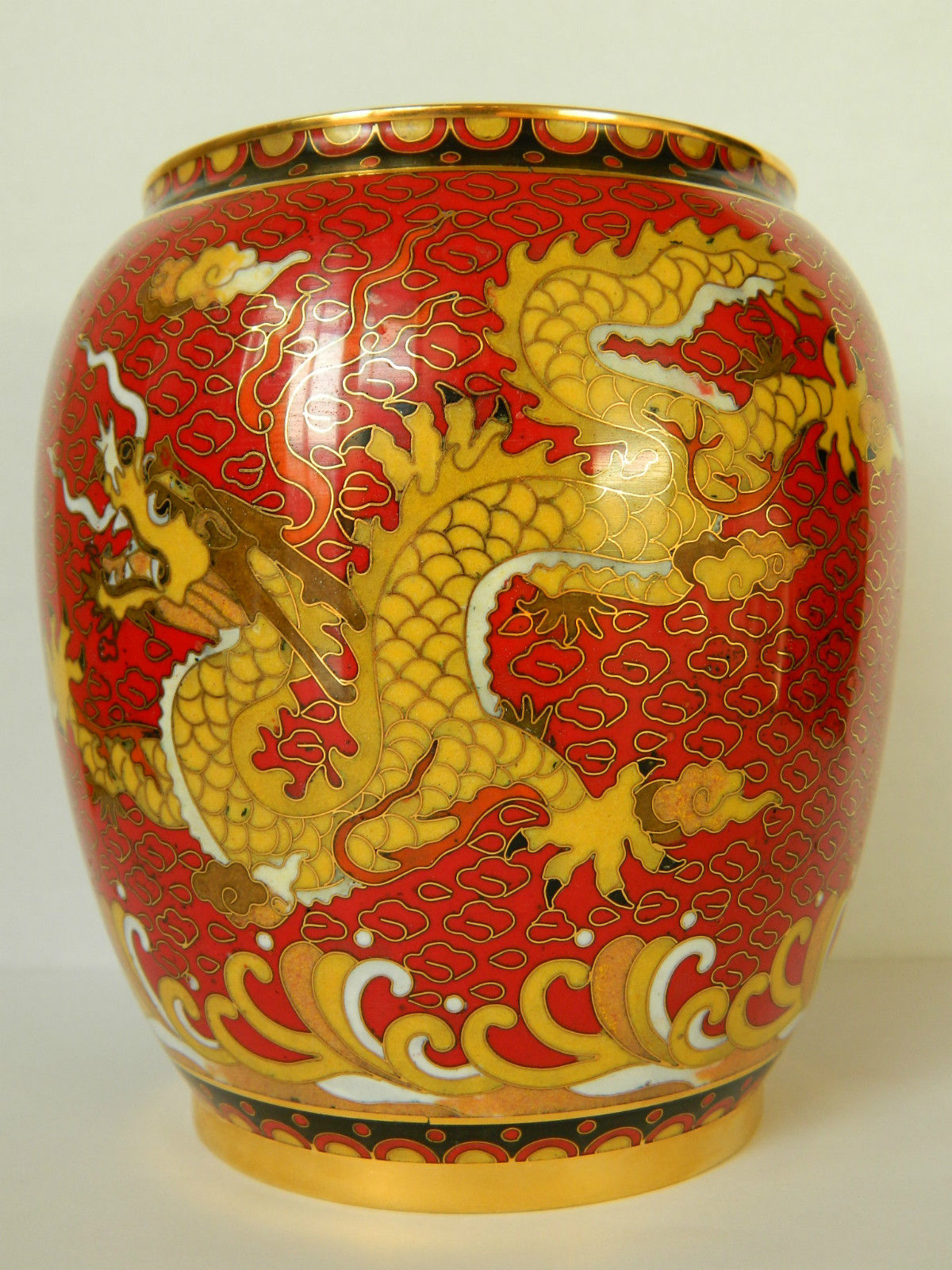
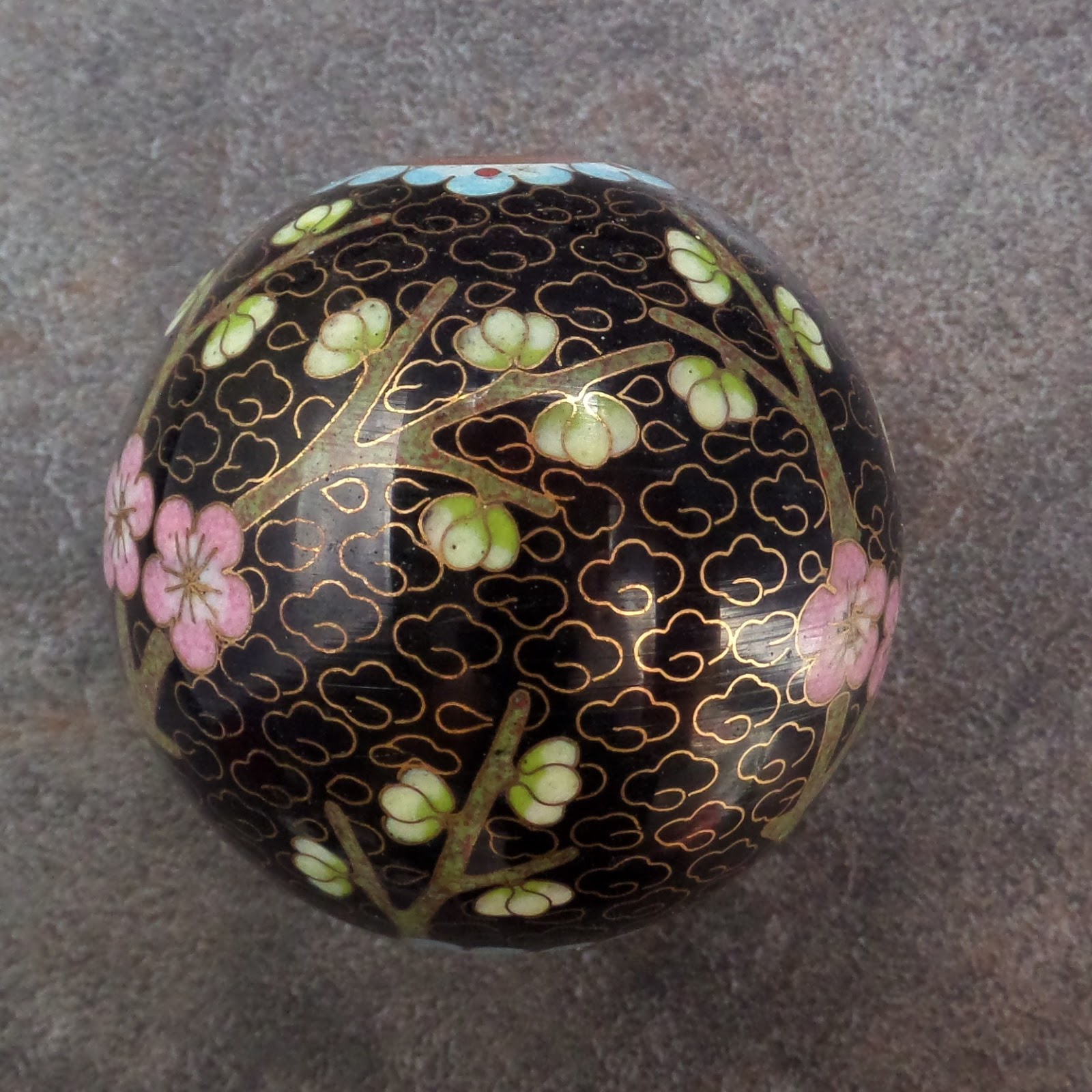
Another style of cloud that persists into the 1950s-60s is what I term a "peaked spiral," a sort of more rounded creampuff shape compared to the stretched crinkle clouds.  It appears on pieces from the 1920s through the 1960s.  The yellow vases are from a 1920s department store, the red vases were purchased in Moscow in the 1950s.


Then the crinkle and peaked spiral clouds disappear, overtaken and replaced by a little motif that instantly brands a piece as being produced after the 1950s, and most likely during or after the 1970s:
One of several condiment sets on offer from eBay seller liwz88, who relates that these were made during the 1980s, but then stored in the factory warehouse for thirty years.

Information available on the JingFa factory provides a clue why this might have happened:

“Built in 1956, the cloisonne factory is the biggest in China with 6 workshops and 1,800 workers. The “Beijing Enamel Brand” cloisonne wares are made in this factory. They take up over 70 percent of cloisonne wares produced in China. With a registered trade mark Jingfa, the products won an honourable title of renowned product in Beijing in 1975. They were conferred the title of “top quality product” by the Ministry of Light Industry in 1979, and again won the prize of the National Hundred-Flower Golden Cup in 1981.”  [TravelChinaNow: An Introduction to CloisonneFactory]

With production supervised for quality, especially during the 60s-70s decade of the Cultural Revolution, who would feel safe diverging from award-winning success and bucking the majority?  Plus, this small and simple cloud motif has the advantage of being more easily and uniformly replicated (possibly with a standard issue specialized set of pliers?) and applied to fill in irregular background areas.  If neatness and exact replication of a design are what the workshop overseers are looking for, this motif is almost ideal.  Do a Google Image search and you'll discover hundreds of photos showing cloisonne manufacture at Chinese workshops.  


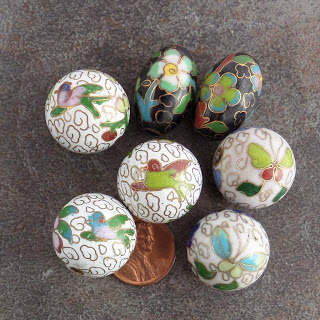
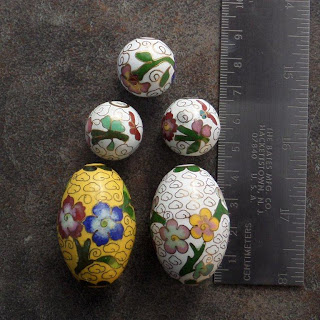
Beads that seem to date from the 1960s-80s often feature tiny JingFa clouds in various sizes, sometimes open, sometimes closed, as well as other spiral or peaked cloud motifs. But eventually, at least for cloisonné beads, just the cloud and abbreviated shortened cloud and droplet shapes seem to be the sole background motifs.
Exceptionally nice beads with high polish; clouds look a bit more quatrefoil.

Butterflies and the JingFa swallow.

Beads at top show spirals and "peaked" cloud motifs


The blue beads match a strand from eBay with credible dating to the 1960s.  Notice the small round beads feature spirals as well as the clouds.

eBay necklace similar to turquoise beads in preceding photo.

Information provided by eBay seller huskylover1955: "How do you know this is from the 1960s?" Answer: "My friend is Chinese and goes to China often to visit family.  She purchased them there during that period." 


Spirals and clouds on strand on left.

According to the eBay seller, they imported the white necklace in 1981.


The JingFa cloud still continues to show up everywhere in the background.
 [Resplendent vases in factory showroom, 2010 - link has been 404'd as of 2023]
 
 Although I await contrary evidence, so far I have not seen a single piece of cloisonné that can be reliably dated prior to the 1950s that contains this simple little cloud as a background cover pattern; in other words, if you see it, the piece you are examining is not an antique, and was produced within the last 50 years.

UPDATE: The biography of Jin Shiquan relates how he invented a contraption to produce multiples of wire motifs, especially the little background clouds otherwise so tedious to make.
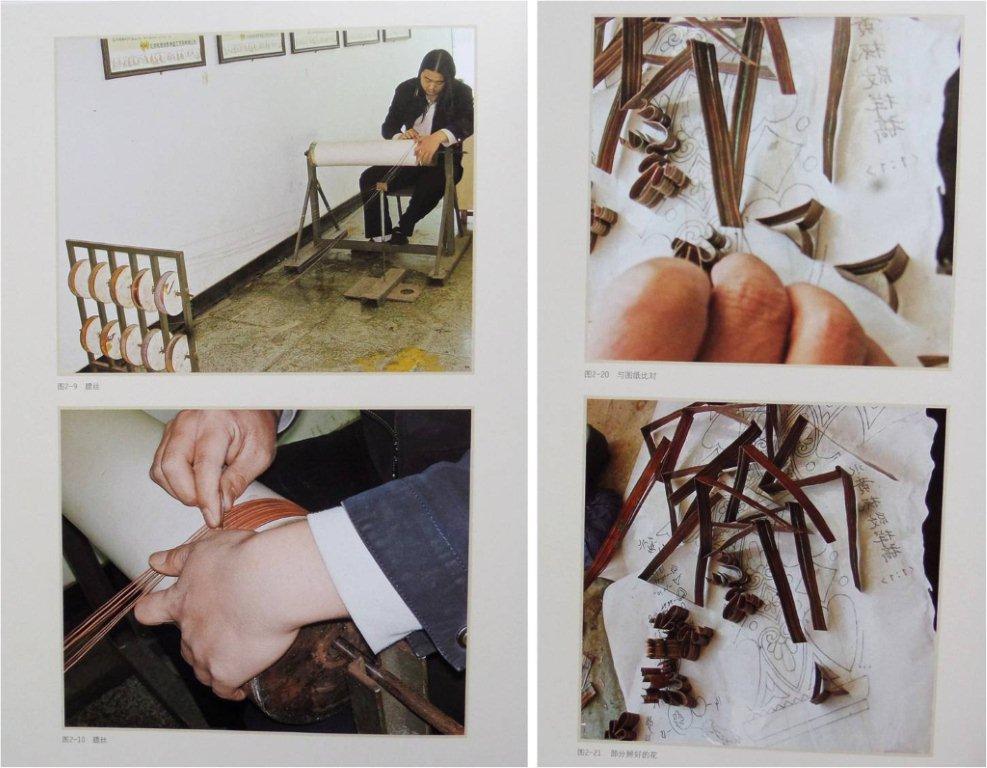
CloisonneWires_(2).jpg (109.4 KB)

CloisonneWires_004.jpg (65.5 KB)

Tuesday, October 29, 2013

Puzzling Evidence - the Lao Tian Li Dragon 老天利

I’ve come to think of this stereotypical cloisonné dragon design as “Lao Tian Li’s” because it is so distinctive and coincident with his lifetime [circa 1860-1930?]

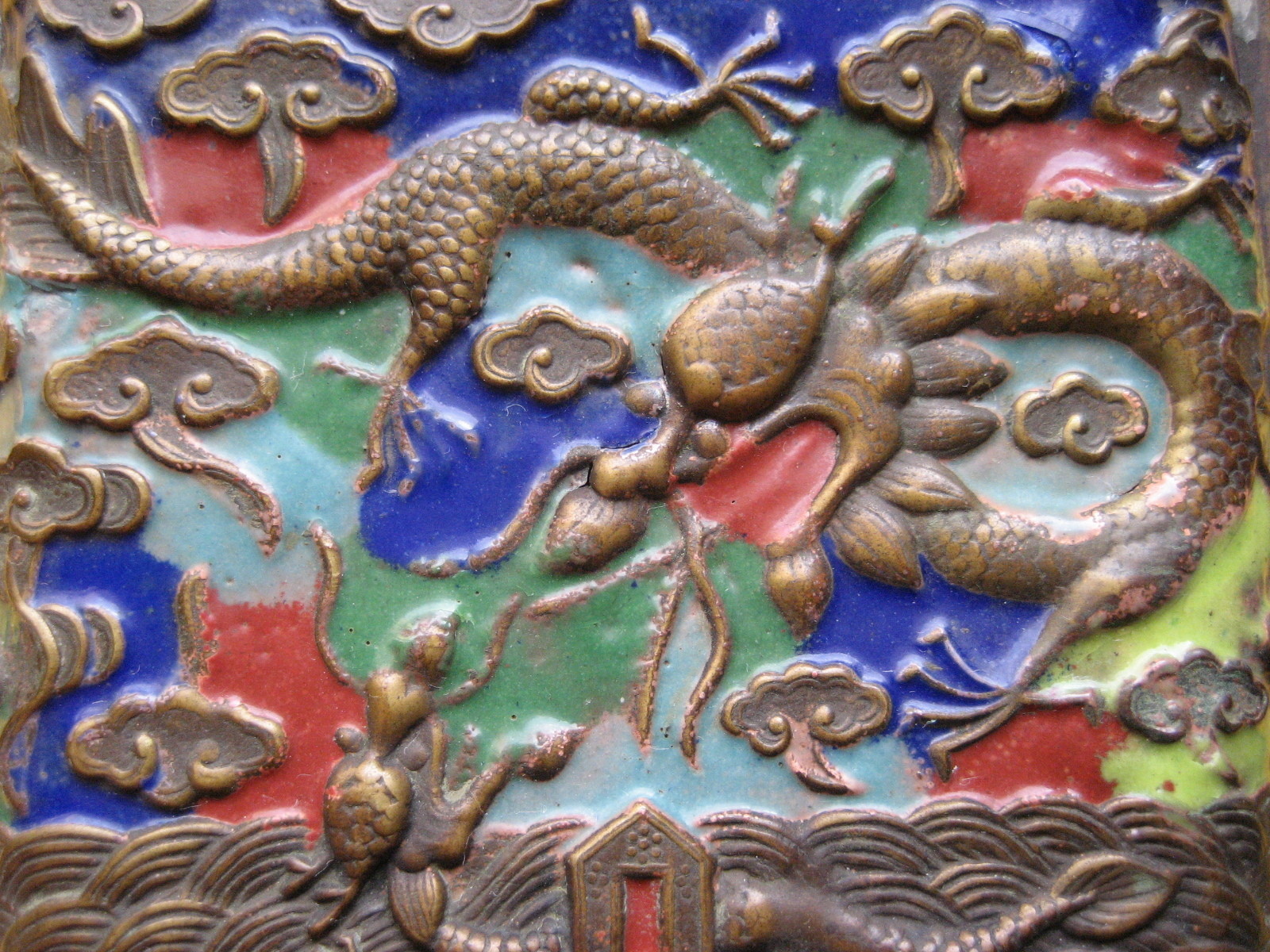
I wondered if it was the workshop where he was employed that set the standard for cloisonné dragon iconography for at least 50 years.  I’m not saying Lao Tian Li invented the dragon iconography – here’s a Chinese dragon design in brass:

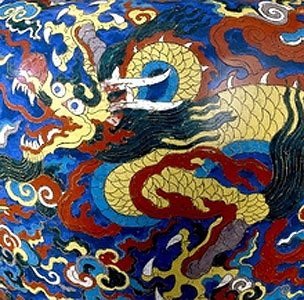
And a much older Ming dragon in the British Museum:

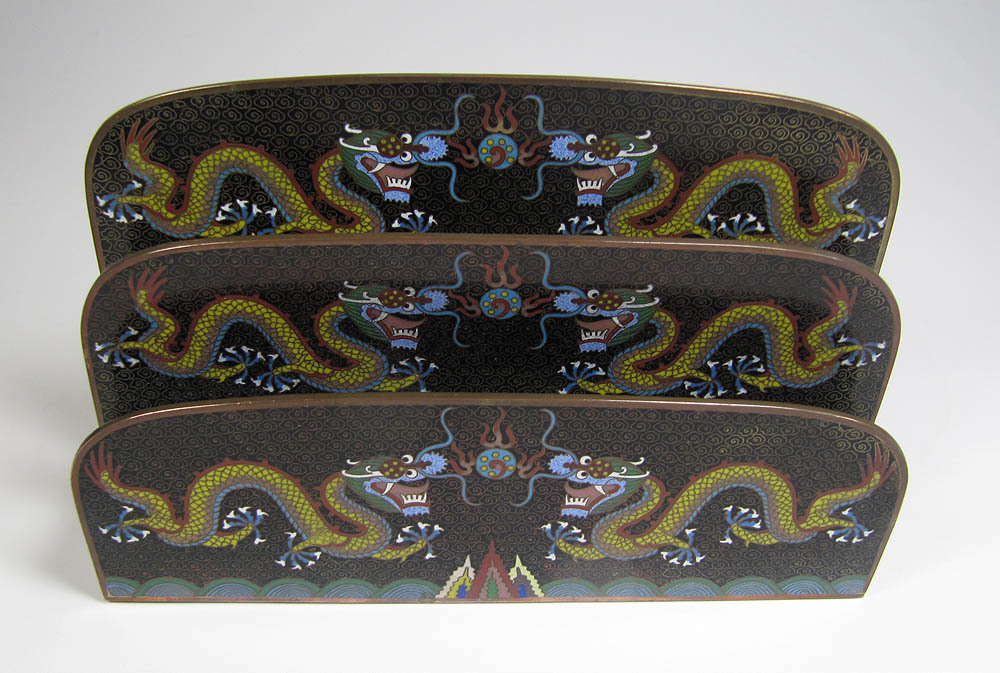
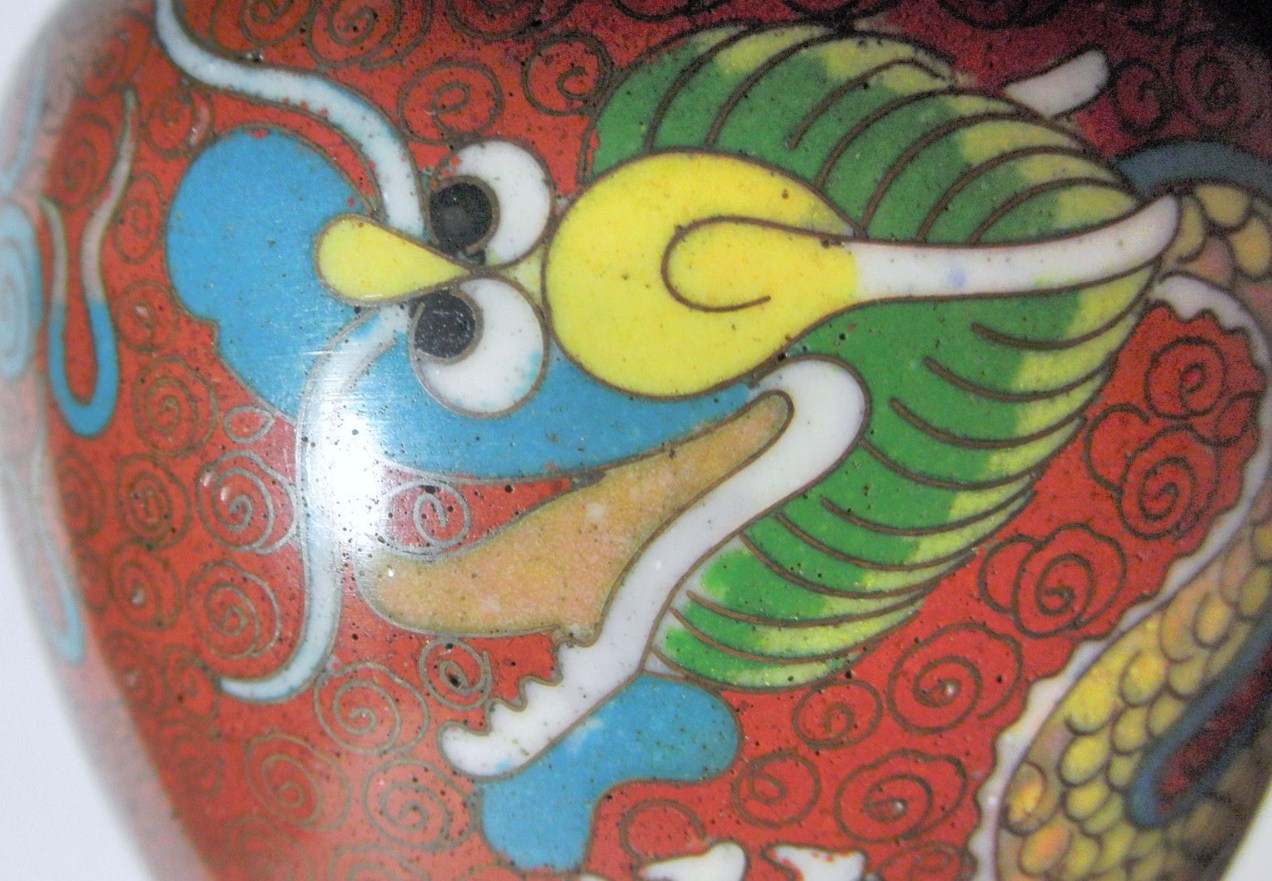
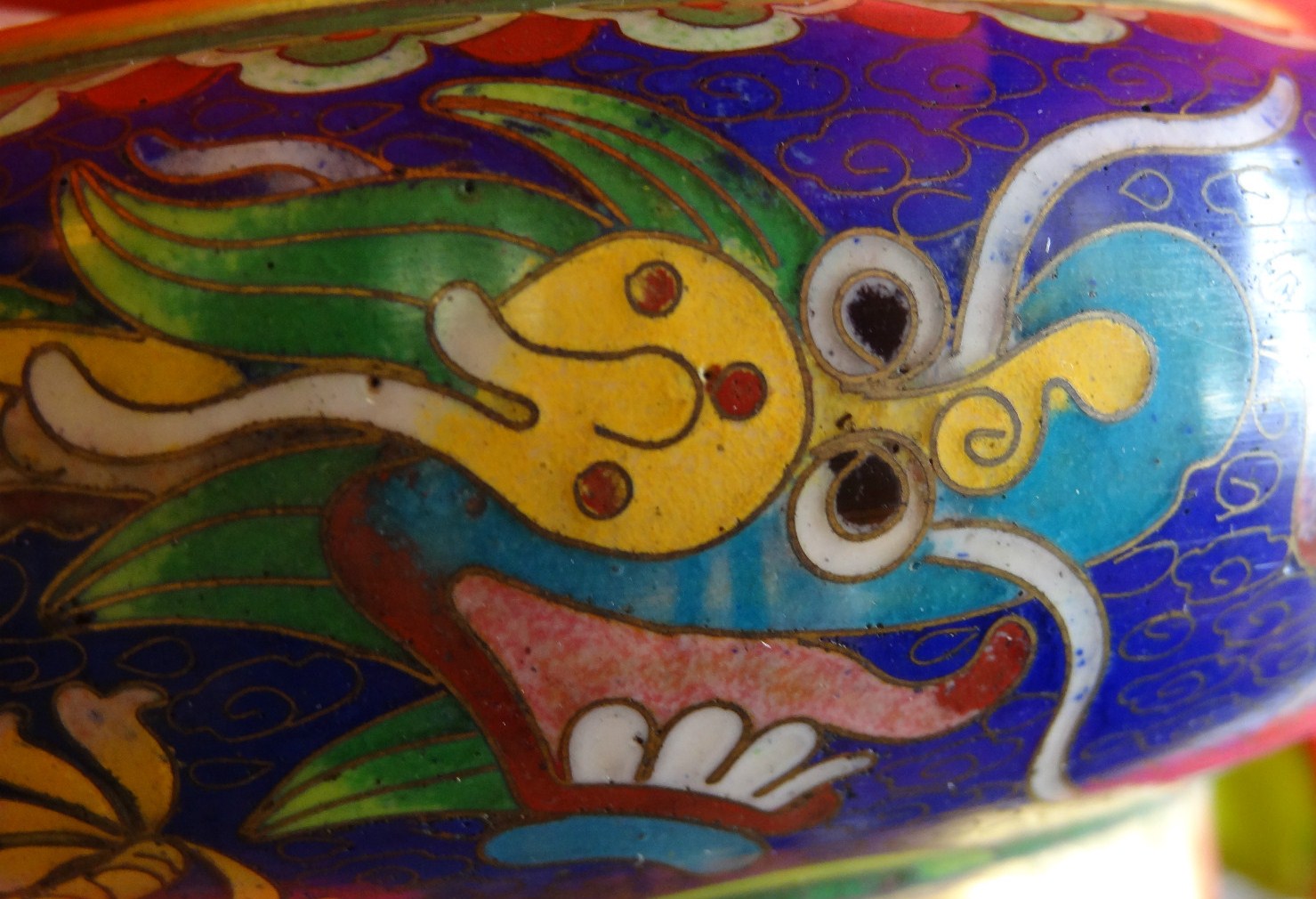
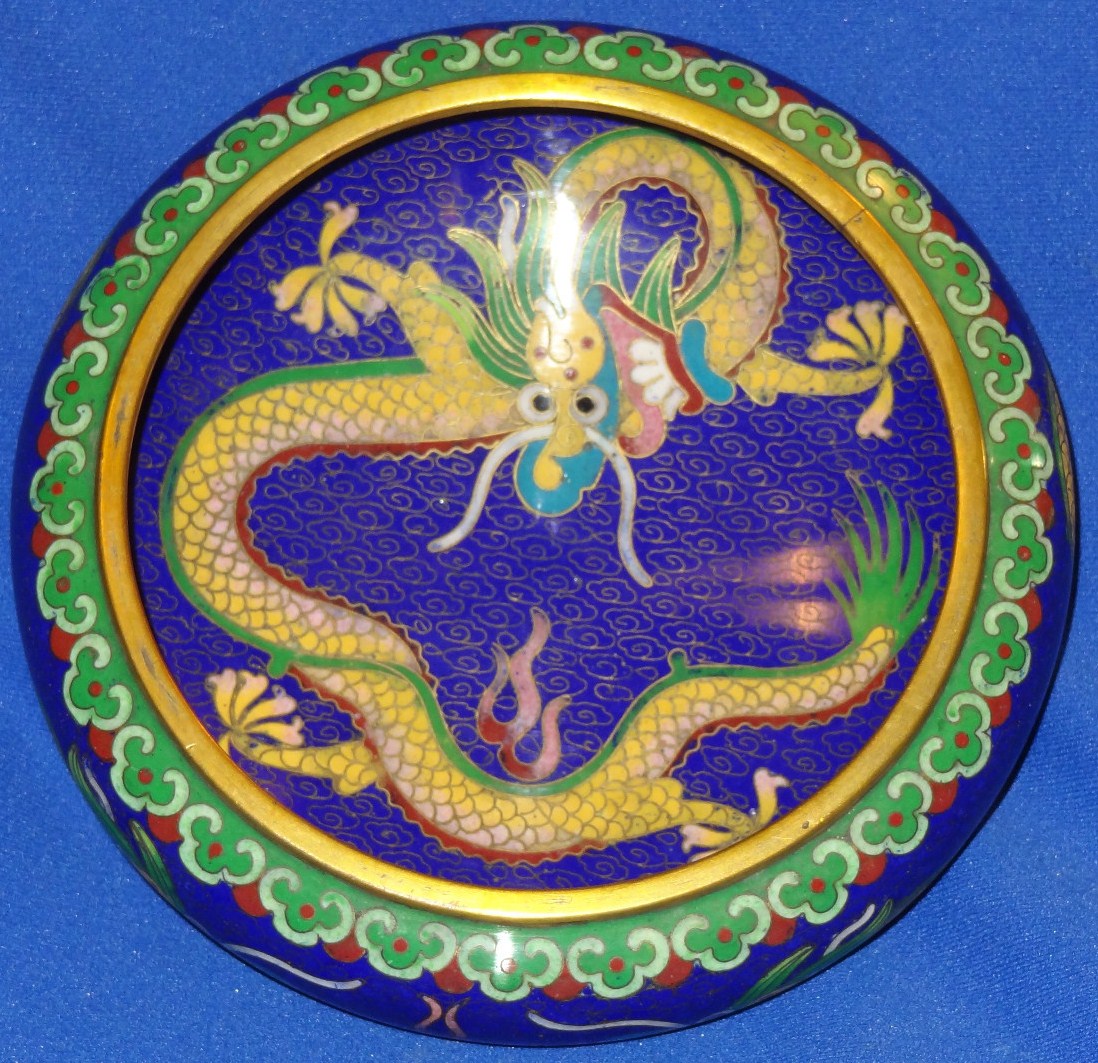
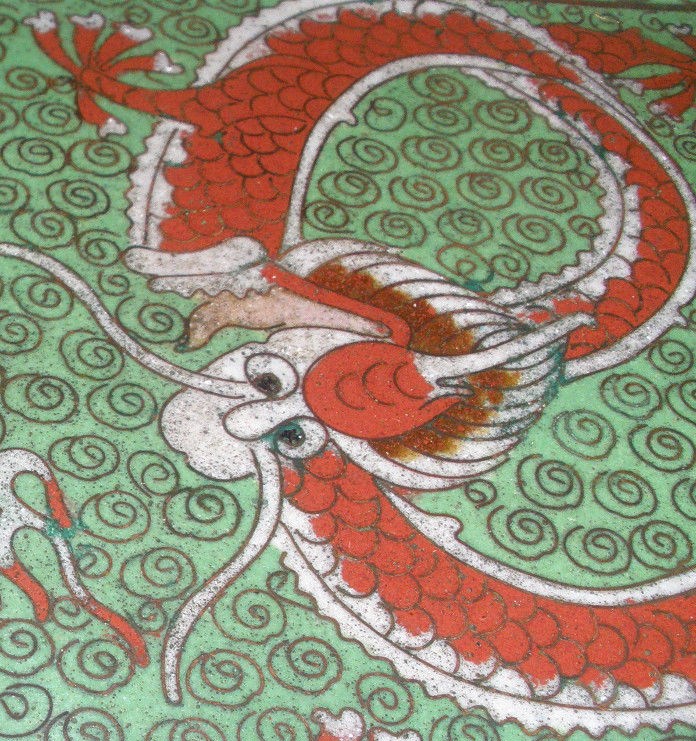
However, the cheerful 20th century Chinese cloisonné dragons are quite distinctive from the bristly Japanese or earlier Chinese representations.  Lao Tian Li’s signed pieces are among the best versions, carefully detailed, showing a lively 5-toed dragon with pointed claws and distinct toe pads and spurs on the legs, rounded chin and distinctive bulbous snout with bumpy or spiky edges, a pair of sinuous barbels alongside the nostrils, animated close-set black and white eyes, pronged horns emerging from a bulbous dotted base on the dragon’s forehead, open mouth with curved pointed tongue, angled jaw defined by a double line, fangs with outer pointed tushes, and flowing mane.  The body scales are neatly applied, with individual scales following the belly edge (instead of merely a wavy line) and a thin barbed crest along the back.  Head, claws, tail and body are proportionate to one another.  Uniform small rounded crinkly clouds with a tight round center fill the background and are very neatly and evenly applied.

Two variant poses are common :
 1) a long profile suitable for the edges of boxes and shallow bowls or for curling around a vase or candlestick;

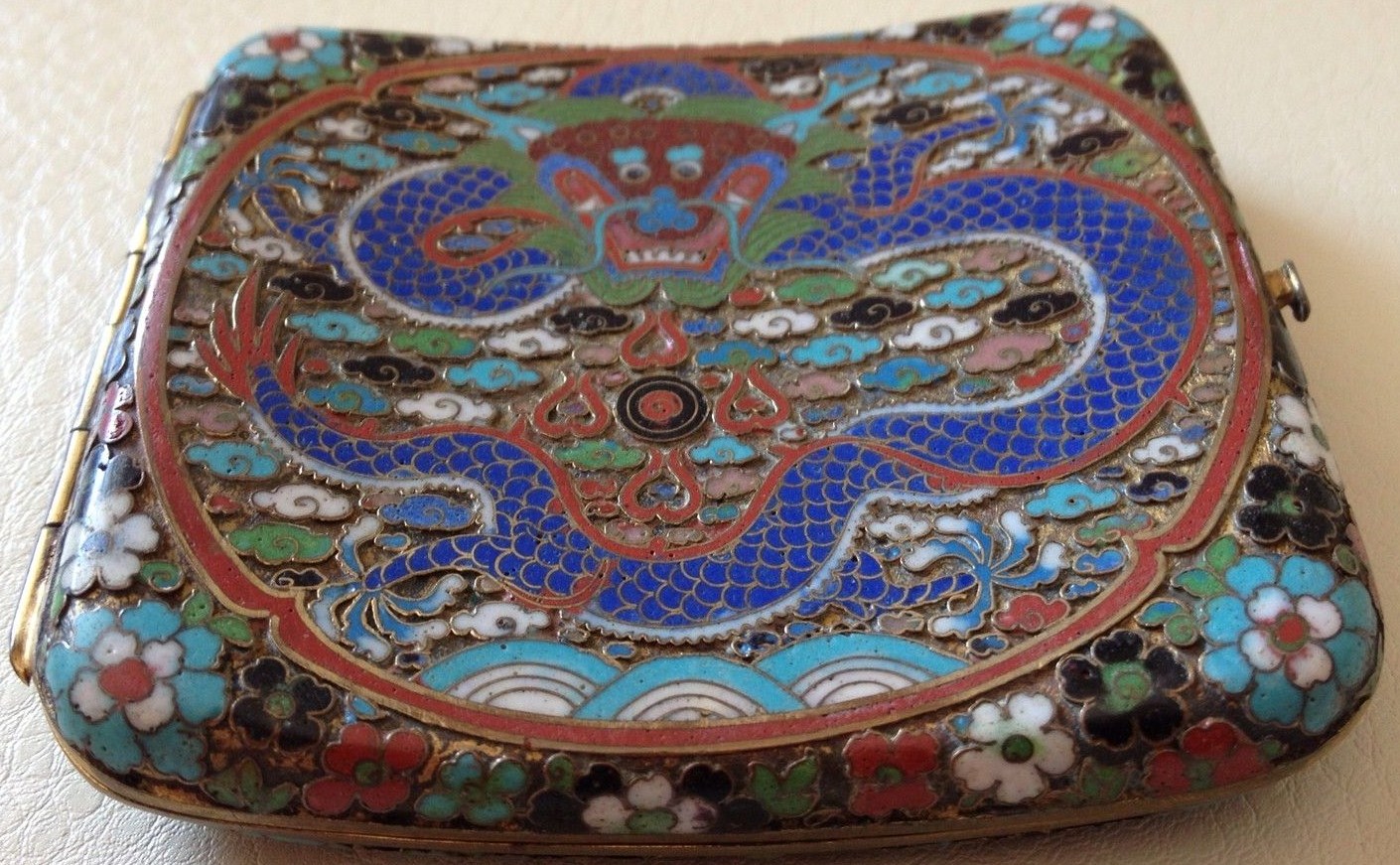
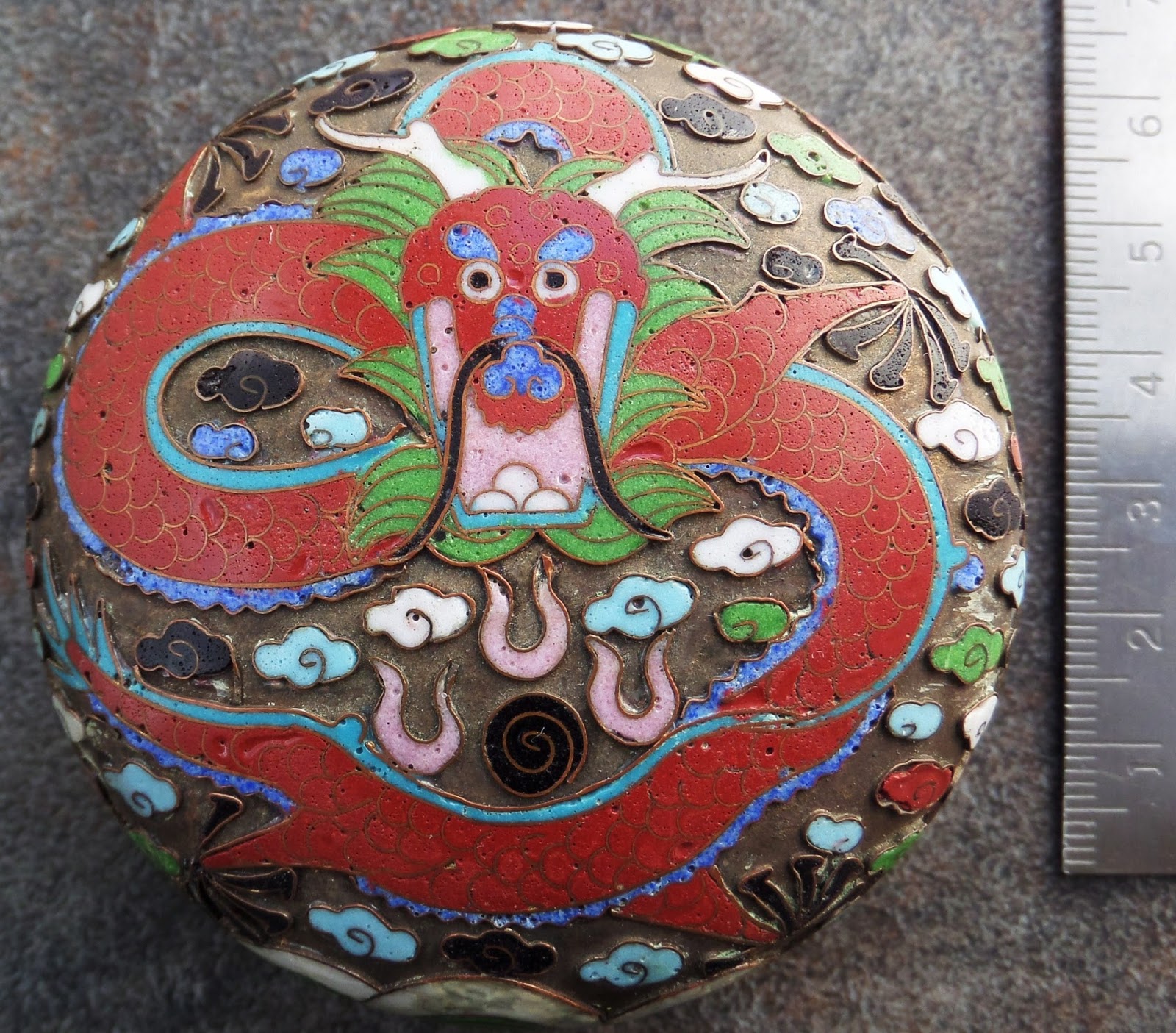
2) a frontal rather geometric head-on view with a spotted forehead, squared lower jaw, and “Comin’ atcha!” expression. This latter frontal view seems to have been a favorite for having fun with variations in colors and design details, although the overall layout remains stereotypical. 

The worst craftsmanship of all seems to appear on items featuring a third rather awkward hybrid pose: the sprawled body with outspread claws of the frontal pose combined with a sort of three-quarters profile head.  

In many versions of this hybrid Pose 3, basic artistic mistakes can be seen such as the awkward spots where the head overlaps the body, often seeming to sever it.


This pose seems to cluster in items made from the 1930s through the 1970s, and may have been the favorite of one particular artist or workshop.  I haven’t been able to find examples that are unequivocally from earlier decades, and none at all signed by Lao Tian Li.

Simplified versions of dragons in all three poses often look bulb-nosed and cross-eyed, with a jelly bean chin.


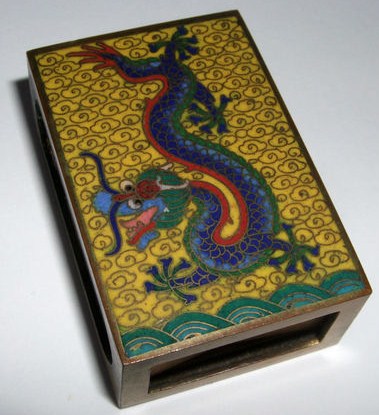
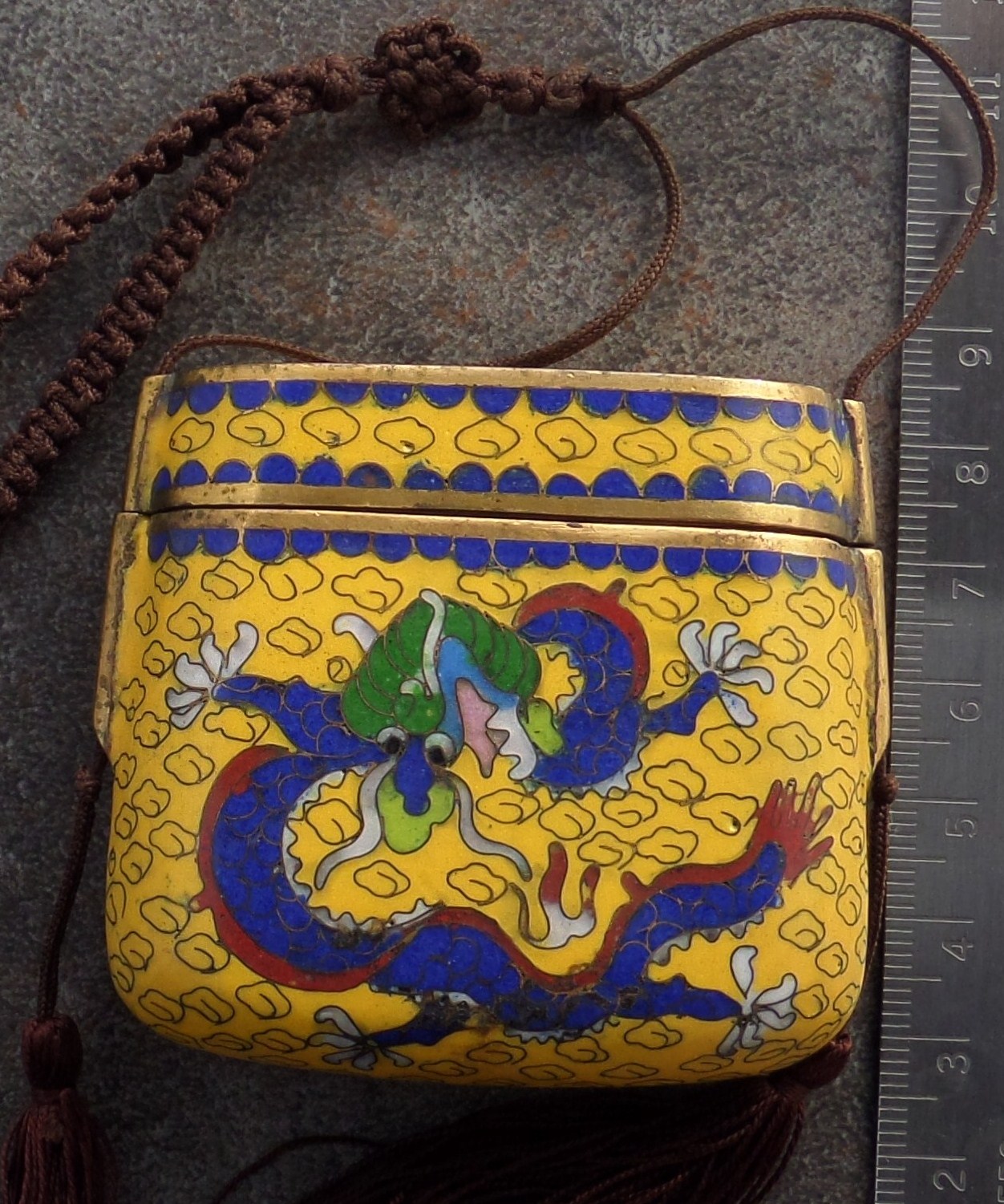
Pre-World War 2 Chinese cloisonné production seems to have been a combination of high quality pieces produced by urban workshops under a master or masters, and a cottage industry in villages that produced folk-art items to sell for cash to supplement their agricultural income.   Once the basic dragon stereotype was set, it was adhered to even in the more casually made household bric-a-brac.  If one’s task is to work with standardized pieces and a memorized pattern, turning out the same basic design over and over, neatness and efficiency are probably of greater concern than personal artistic expression. Nonetheless, even in small and presumably less expensive pieces such as matchboxes, a difference is obvious between pieces made by someone with artistic ability who cared, and by someone who was just doing work.
A carefully worked cigarette case

My cute litte dragon box - the cloison wires are hair-thin.

Great little matchbox with good design, color, and workmanship

tA small inro-style purse of careless work.
It can be hazardous to try to date a piece from the hodgepodge of painted, stamped, engraved, or papered labels that might have been applied. I (and apparently many online auction sellers) have difficulty sorting items into approximate age categories – Late Qing? Early Republic? Roaring 20s? Depression 30s? Warring 40s? Nonetheless, production does seem to get less detailed and meticulous around the 1930s, for entirely understandable reasons – worldwide economic depression, wars, occupation, and older Qing-era craftspeople fading from the scene.  A crude four-toed dragon, often with black eyes, seems to have appeared on beads and fashion accessories around the late 1930s.  These beads show up in Japan as well as in the United States - more on them in an upcoming post. 

The JingFa cloisonné factory was founded in 1956.  By this time the People’s Republic had been through a terror and political purges, but Mao’s Famine and Cultural Revolution were still to come.  Collectivization of the agricultural villages and famine likely reduced the population of part-time cottage artisans.  It’s difficult to see how high quality cloisonné production could have persisted under such circumstances, but apparently some artists and workshops struggled onward trying to produce well made versions of traditional Chinese motifs, revolutionary themes, and “modern” designs that might appeal to foreign buyers.

By the early 1970s arts and craft production was being encouraged by the government in order to earn foreign exchange (Pier One Imports and Lillian Vernon come to mind).  The Montreal Gazette of Oct 2, 1973 recounts how despite the ongoing Cultural Revolution the remaining older artisans had to totter out of the back rooms and show the newer workers how to make the old-style designs instead of revolutionary themes.  The last gasp of the older dragon stereotype seems to occur around the 1970s.  Then it appears that newer artistic directors took over in the factories and workshops and instituted their own standard dragon patterns and motifs.
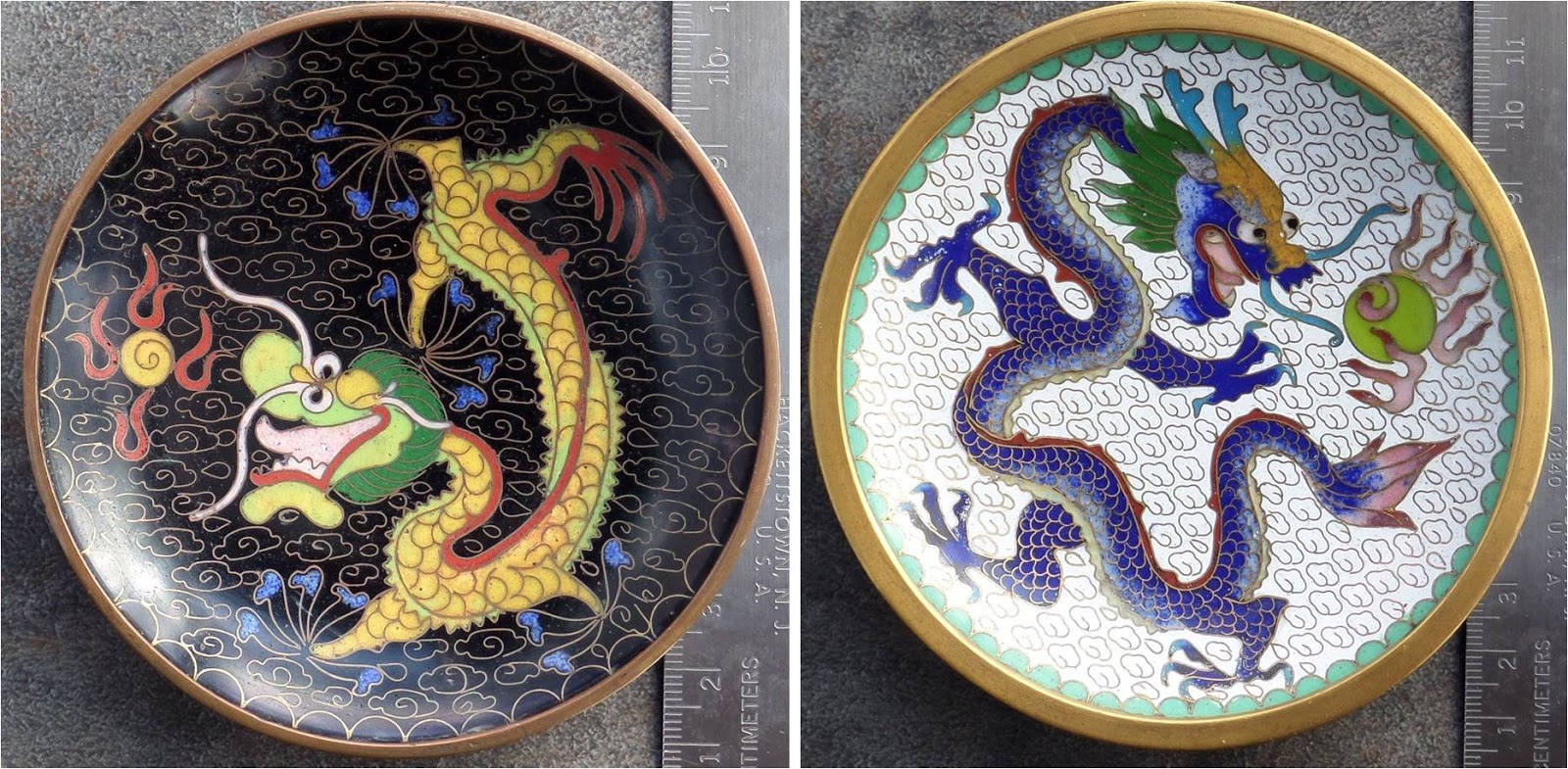
Small bowl from c1930s on left, similar bowl from 1980s-90s on right. Note the difference in the style of clouds in the background - JingFa (Beijing Enamel Factory) post-1960 clouds on the right.

Vibrant modern covered jar from eBay seller liwz88 in Beijing

Thursday, October 17, 2013

Puzzling Evidence - Twisted Wire Cloisonne Beads in Mandarin Court Necklaces [Chao Zhu 朝珠]

A Google search on this topic will reveal many examples of the necklace that Qing Dynasty officials were obliged to wear as part of their formal dress.  

I found these beads in an eBay auction, badly re-strung on tiger tail, but apparently preserving the original assemblage and composition, which presumably had been strung on knotted silk that rotted over the decades.  The oval pink glass beads, sometimes referred to as "starburst" or "galaxy" millefiori have been identified as products of a glass factory in Boshan, China, probably from the 1920-30s, possibly produced under Japanese management.  The crystal and black faceted pressed glass rondels are typical European beads often seen in necklaces from the 1920s-1930s.   Thus, this necklace might have been made in the years between World Wars 1 and 2.


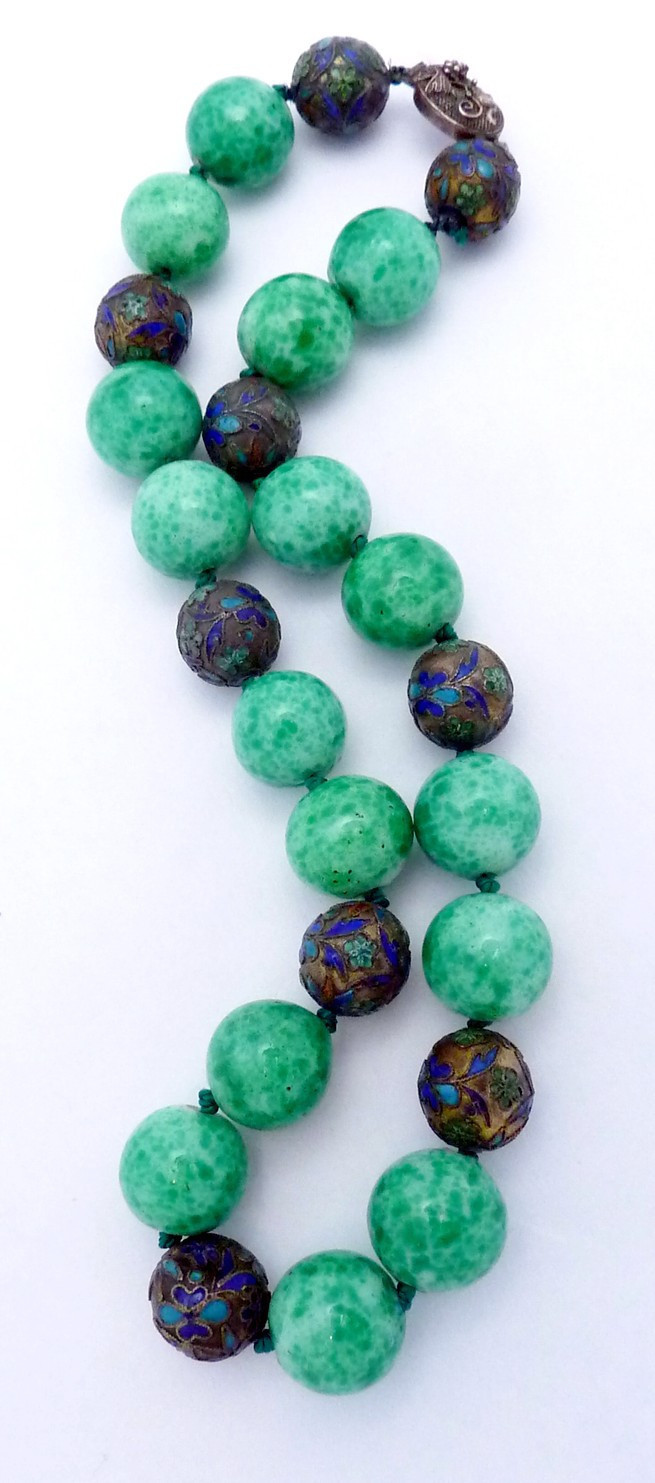
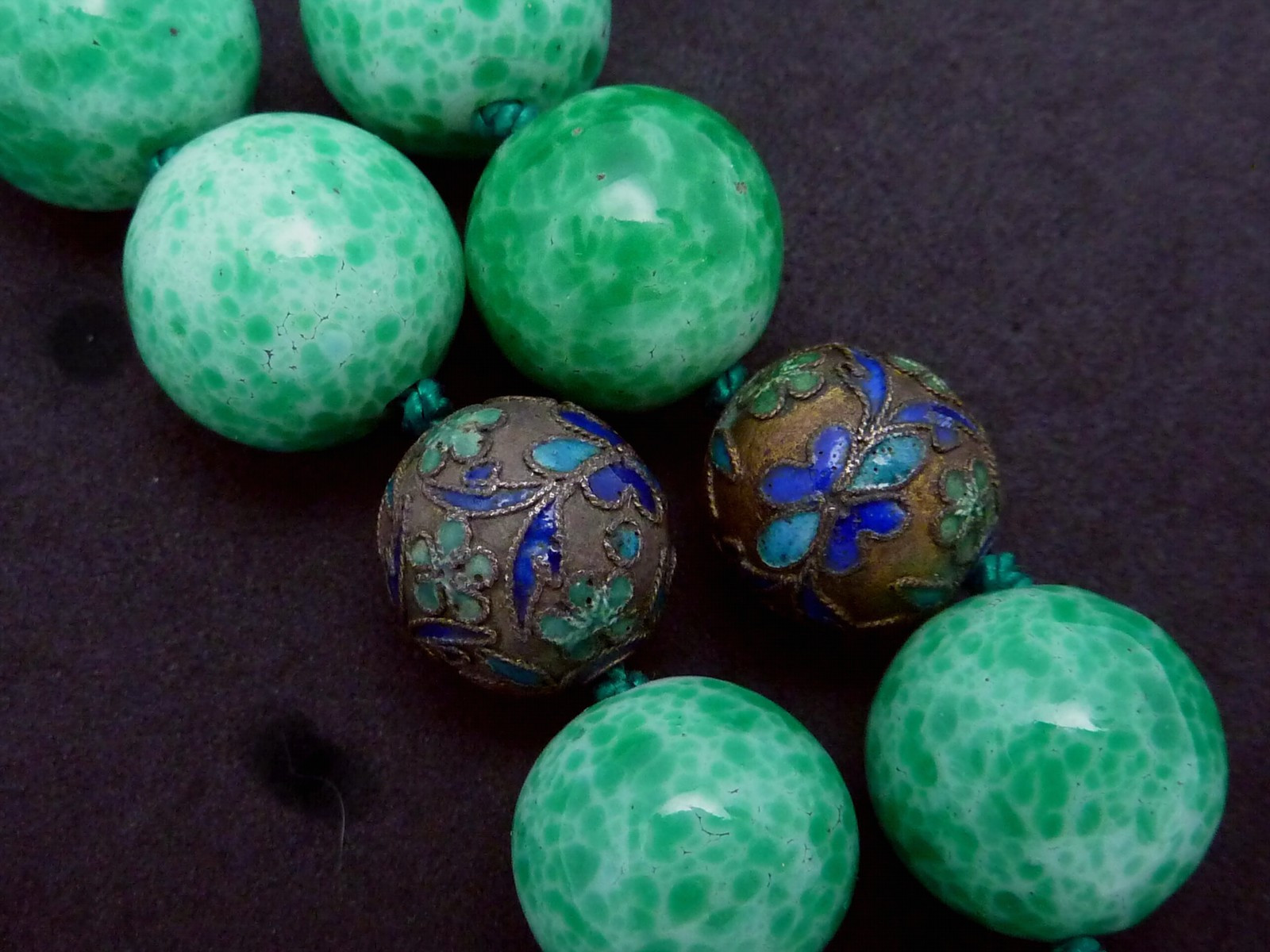
Here's an example of what appears to be an intact necklace from the Deco era featuring this style of twisted wire openwork cloisonne beads and green glass crumb beads often referred to as "Peking Glass."  The silver clasp is especially charming, with its classic Chinese combination of "squirrel and grapes."
With permission of Susan Morton, thevintagesilvershop on eBay


Subsequently I located another set of this type of cloisonne bead - the outer ring of beads in the photo below.

The two sets are superficially similar - here's the basic pattern, rolled from a bead in  the necklace set:


However, the beads from the necklace are perfectly matched and more precisely crafted, as the photos below demonstrate [necklace beads are on the left].


Also note the different different positioning of the end caps pattern against the circumference pattern.
In a discussion at beadcollector.net of the necklace beads, it was suggested that because of their comparatively small size (12-14mm) and fine detail that they might have been from a disassembled court necklace. [Pre-1940s Chinese Cloisonne]

Such as:
Larger court necklace beads in twisted wire cloisonne


What exactly do I mean by “twisted wire” cloisonné? 
The cloisons are formed by twisted wire, not thin metal strips
The piece is only fired to melt the enamel, which is not ground or polished.

Tsarist Russian enamellists favored this technique for their intricate and beautiful products.


Possibly because it can be a more abbreviated and less labor-intensive technique, it’s still in wide use in China today for fashion jewelry beads and trinkets.  Contemporary enamels – which may be epoxy resins as well as glass enamels – appear in transparent jewel-like tones as well as pastel colors resembling fondant frosting.
Recent Chinese beads purchased on eBay from trhenning.
Recent decorative trinkets from China

UPDATE MAY2022
Recently I acquired a strand of these beads, strung on braided cord with a new spring ring clasp.