Monday, January 13, 2014

Puzzling Evidence - The Dot Artist of Cloisonne Beads

Photographing small jewelry items tends to focus your attention upon little details.  Thus, I noticed a pattern appearing in certain cloisonne beads, characterized by:
  • Tiny dots evenly spaced around the circumference
  • Very detailed flowers
  • Repetitive motifs in the flower petals, especially a trefoil shape that doesn't show up on other cloisonne beads
  • Careful and exact composition of the floral sprays - branches look like branches, leaves like leaves, buds like buds, instead of the often blobby look of mass-produced beads
  • Spirals and older-style clouds used for background motifs
  • Older style rather than the JingFa-style of flower bud
  • Strung with nicer gemstone beads and clasps
Writers on the production method of cloisonne are adamant about the time it takes to make a cloisonne object - nearly a week for a vase, for instance.  Nowadays so many things are made via machine or production line, I think we tend to forget that craftsmanship and artistry are often very time-consuming tasks.  Whoever this unknown and unsung bead artist was, carefully using tiny metal strips to draw tiny flowers upon tiny round objects, I think her skilled craftsmanship deserves some recognition.


Strung with wire and crimp beads, most likely not Chinese stringing

Loose beads used to create a stickpin
Update:  eBay vendor itmustbeit recently featured a very nice necklace of these beads, and granted permission to post a pic here:
The silver clasp looks more old-fashioned to me than similar clasps more commonly encountered
Update: Another nice necklace, this time with a morning glory clasp:
Smaller beads (12mm) but with a variety of colors and flowers and cute little butterflies. The background motifs are spirals on the dot beads.  The beads with the butterfly/daisy/buds combination lack dots, have tiny cloud-like motifs in the background.
eBay vendor Antiques of Northbrook (cellarbuy1) found another nice example of The Dot Artist's work:

RubyLane vendor Vintage Jewels, Antique Haven L.L.C. also has a spectacular necklace on offer:

UPDATE: Two more Dot Artist necklaces.  Both have filigree clasps stamped "Silver, Made in China."
This necklace appears to have been re-strung with new wire links.
 

And another spectacular example from France.  Note especially the chrysanthemum flower design, and the blossom and branch beads.


The remains of a necklace with cinnabar beads:
And rarest of all, a necklace with scroll patterns:

According to the 28" length given, these appear to be 15mm in size.

UPDATE: More necklaces by The Dot Artist:
The smallest Dot Artist beads I've found so far - 10mm.  There are three patterns going on here - tiny daisies, petaled flowers and leaves, and (near the clasp) tiny gourds and gourd blossoms.  
Compared with 12mm and 15mm beads.

Necklace was broken, I re-attached the pieces.  What I noticed about these beads is the older enamel color, the composition of the design, the older style carnelian beads, and the absence of JingFa clouds as background motifs - just spirals and those signature dots.

A long 30-inch necklace of 15mm beads with a morning glory clasp.  Again, older enamel colors.  Notice also the centers of the flowers, the various different designs on the beads, the blue petal "cap" on the bead lower center with the pink flower, the absence of JingFa clouds.


UPDATE: At last, someone with information as to where and when she purchased a Dot Artist necklace - Shanghai in the mid-1970s.  eBay vendor andcam1018 states, 

"I worked in the mainland China when it first opened to tourism and purchased many beautiful pieces.This beautiful blue cloisonne hand knotted necklace was purchased by me in the Shanghai China Friendship store in the mid 1970's.  It is a real master piece and looks gorgeous when worn.  It is 23 inches long and contains 40 cloisonne beads and one round clasp.  Each bead is handmade so none are identical."
Notice the Morning Glory clasp and the tiny gourd pattern on some of the beads.


Wednesday, January 8, 2014

张同禄 Zhang Tonglu and Robert Kuo - Two Innovative Careers in Chinese Cloisonne

In October of 1949, the Chinese civil war ended with the founding of the People's Republic of China.  Many members of the Nationalist party fled to the island of Formosa, now called Taiwan. One such person was a painter, who founded a cloisonne workshop.  His son, Robert Kuo, worked in the factory from his teenage years, learning the art of cloisonne.  In the 1970s Robert moved to Beverly Hills to establish his own atelier.  A lengthier post on Kuo cloisonne is coming up shortly.

Status Kuo by Finn Olaf-Jones

Meanwhile, Zhang Tonglu, also a painter, joined the Beijing Arts and Crafts Factory and also spent many hard years mastering the art of cloisonne.  Recently he was celebrated for his achievements.

Google Images for Zhang Tonglu

Informative article about Zhang Tonglu's career:
http://www.jtlzj.net/jingtailanjieshao/161.html

What struck me was the different path each artist pursued to grandeur in cloisonne - Robert Kuo to modern architectural pieces, Zhang Tonglu to baroque gilded and bejeweled splendor.


Tuesday, January 7, 2014

Puzzling Evidence - Chinese Cloisonne in 1933 Advertisement of N. Shure Co., Chicago

This was an eBay item too neat to pass up, so now it's mine; however, I bought it to share with you because documentation for vintage cloisonne is not all that common.

Here are a couple of pictures, so the details can be viewed more closely than in the scan.
Over the past months, I've seen pieces similar to all of these on eBay.


The little online currency inflation calculator I used determined that $15 in 1933 is the equivalent of about $270 today.

UPDATE: A catalog page one year later, 1934, shows a price increase for the 15 in. lotus pond vase, for example, had increased to $13.50. A correspondent provided pages from a later 1937 catalog, where the price of the 15 in. lotus pond vase dropped to $5.50.  
But then in another earlier? later? catalog page, the price has increased again to $23.  Perhaps the Shure Company, centered in Chicago, purchased a supply of vases for the 1933 World's Fair, and then struggled to unload them in subsequent years?


Friday, December 20, 2013

Puzzling Evidence - The JingFa Plum or Cherry Blossom Bud

In my quest to discover what the tell-tale signs were to distinguish older Chinese cloisonné beads from newer products, one of the motifs I noticed that changed with the decades was the little wire cloud used to stabilize the background enamel (the JingFa Cloud).  Another is the construction method for blossom buds.

This little bowl is clearly prior to World War II because of its red “CHINA” marking on the bottom. 

According to Internet lore (I haven't fact-checked this) the 1890 McKinley Tariff Act was further amended in 1921 to require “Made In” to be added to the country-origin mark for items for export to the United States.  Many shops continued to mark their wares as they always had, exporters simply pasting “Made in China” paper labels onto items destined for the U.S. 


Note the three different types of marks on these items that were clearly produced by the same workshop.


To continue with the examination of our little bowl, note the way the blossom buds are wired: a central round wire, with arcs from the same circle on either side.  Three pieces of wire.
3-wire buds


In other cloisonné items that seem to date from the 1920s-1940s, a blossom bud appears that is made of a single wire curved into 3 loops:
3-loop buds


In this exceptionally nice pair of vases [pictures courtesy of eBay vendor splicer9], their “Made In China” base stamp dating them to between 1921 and 1949, both styles of blossom buds are apparent.  Whether this was one artist working two variations on a theme, or co-workers with two different ideas as to how to execute the blossom branch motif, we’ll likely never know.


Contrast the older vase pair with a nice mirror-image JingFa pair likely of post-70s manufacture:


A nice set of beads featuring buds made by the 3-loop method, various clouds and spirals, and a Morning Glory Clasp.


This charm bracelet, based upon the style of clasp, seems likely to date from the 1930s.  The style of the cloisonné bead is also consistent with other cloisonné beads used in costume jewelry at that time – a rather large bead, with a limited palette of opaque enamel colors.

The bud motifs are comparatively large, as if the same diameter circular jig used for household items had simply been appropriated to make the bead wires.  Three pieces of wire to make a bud.
The 1930s bead with similar companions of unknown age, all displaying the 3-wire bud.  Note the "crinkle" and "peaked" cloud patterns in the two beads on the right, and the fine detail of the center bead.
Here’s another piece that has a late 30s-early 40s look to it.  Again, note the limited enamel palette, but this time the blossom buds are comparatively small and calibrated to the overall design.
Each pendant measures 35x28mm
Necklaces with nicer silver or cloisonné clasps that display the 3-wire bud, with spirals and peaked clouds:

Beads are 15mm


This rare little set of beads, that came accompanied with credible provenance from the 1950s, shows the 3-wire blossom bud accompanied by tiny JingFa clouds: 
Beads are 12mm
  
Here is the seller’s touching account:
My parents are Russian, and my father’s first job after graduation (he is a geologist) was in China, it was 1955-1958, I believe (I was not born yet).  They traveled all over China, spending a few months here and there (my mom and my brother in some town and father “in the field” – surveying the surrounding areas).  Definitely Peking and Shanghai, but also Chuntsin in the South and more places whose names I don’t remember.  My mom lives with me here now, but she is 82 and her memory is not good.  I found those beads among her things when I moved her, but she can’t remember where they are from; she thinks she got them in China.”

The original silk knotting had deteriorated and the clasp had disappeared, so the seller re-strung the beads with wire loops.  Those curious about the history of the time can read Wikipedia on the Sino-Soviet Split, as well as Tombstone and Mao’sGreat Famine.  Once again, tiny trinkets like beads get caught up in the whirlpools of history.

As described in a prior post, the JingFa cloisonné factory cooperative was formed in 1956.  What appears on pieces clearly of JingFa manufacture (as evidenced by the stereotypical little cloud motifs also on these pieces) is a new method for making a blossom bud out of one continuous wire: the center is curved into a sort of pinched droplet, then two “wings” are formed on the same curve and bent somewhat to butt their ends against the center drop.  The buds often look a bit elongated, as the central droplet often isn’t perfectly circular.  The wire ends are at the tip of the bud, not against the base near the stem.
JingFa buds


As with the older “crinkle” and “peaked spiral” clouds, the 3-wire and 3-loop blossom buds could have been continued to be used by other workshops, or by different artisans working under the JingFa cooperative.  It’s not as if a gong was sounded and use of older motifs ceased – more examples can be found with both the JingFa Cloud and the older style 3-wire bud:  
One possible explanation for this is that the JingFa style of cloud appears on cloisonne items made before 1956 – but the evidence for that so far is entirely lacking.  The more likely explanation seems to be older craftspersons or senior artists continuing to make cloisonné motifs in their usual manner, using tiny JingFa clouds right along with peaked clouds and spirals.  This Montreal Gazette article from 1973 describes how older craftspeople were recruited to restore traditional designs after products of the Cultural Revolution proved unappealing.  However, like the older cloud styles, eventually the 3-wire and 3-loop buds disappear, and only the JingFa bud appears.
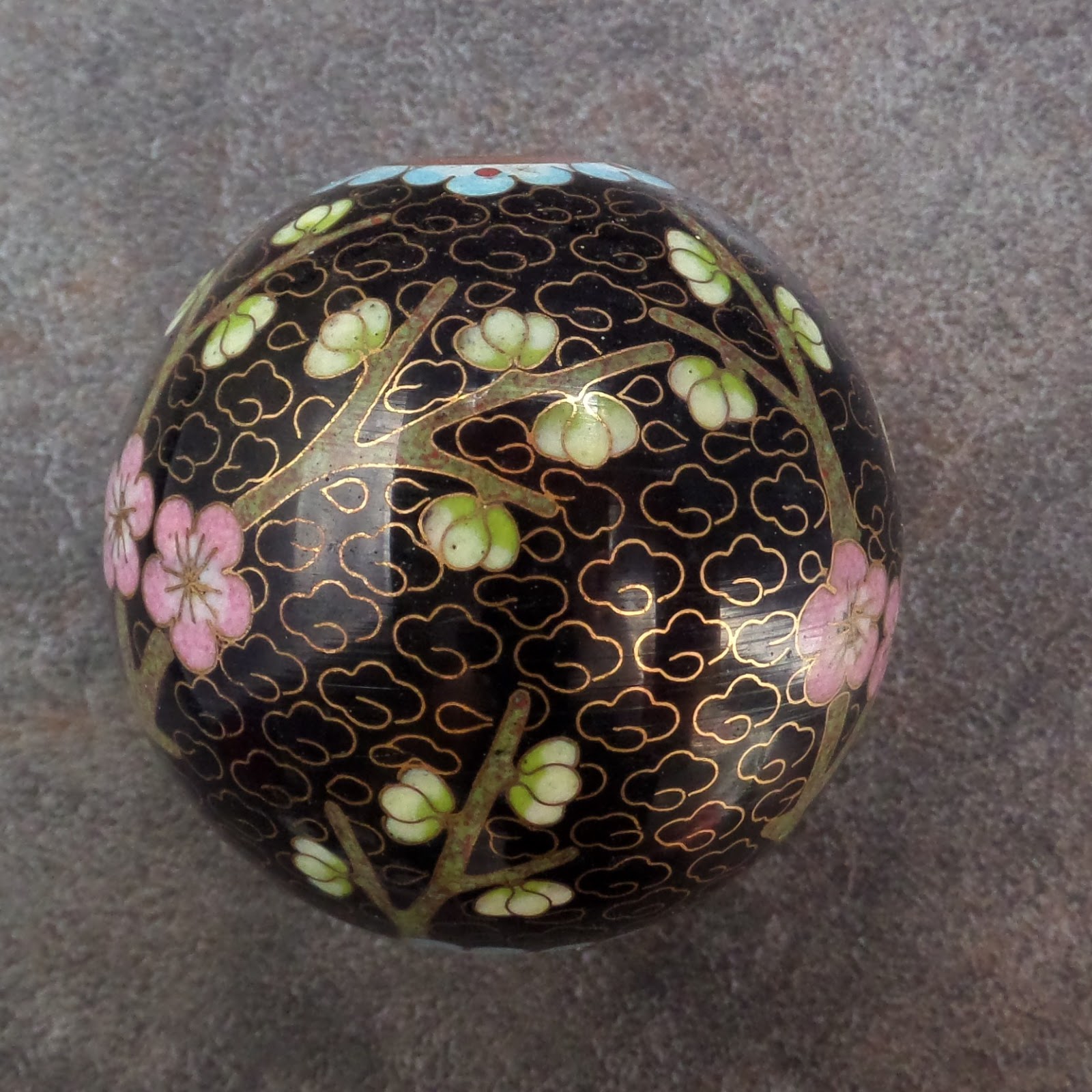
Neatly made JingFa clouds and blossom buds, on a giant bead probably made sometime circa 1970.

Sunday, December 8, 2013

Puzzling Evidence - 凤凰 The Fenghuang, or Chinese Phoenix in Cloisonne Beads

Earlier this year I purchased via online auction a Chinese cloisonne pendant or large disk bead with a phoenix on one side and a dragon on the other: 
The pendant turned out to be damaged, so I returned it for a refund. It was re-sold, and the buyer removed its original cord, re-strung it into an attractive bead necklace, and successfully sold it again.  What caught my curiosity was that, in her online auction, she described the pendant to be from around 1910.  Discussion at beadcollector.net had persuaded me that this sort of pendant was vintage 1970s.  Which date was correct?  What were the clues that might enable one to date such an object?

Subsequently I harvested a number of these large disk beads from the Internet, either as purchases or images:
Three pendants with JingFa clouds, a black pendant with older style "crinkle" clouds.  Note the variance in workmanship - red upper left is the poorest.
Dragons on reverse sides
A Laurel Burch necklace from the late 1970s, according to its previous owner. A lovely, graceful bird.

Older style "crinkle" clouds, artist definitely had trouble putting the bird together.


Similar, but smaller and thinner, beads show up on belts that seem to date from the 1930s:
Now in a private collection, from Magic Dragon's Store.  Note that some beads are actual hand-wired cloisonne, others are exact champleve duplicates of a different phoenix design.  The cloisonne beads feature a rather simple version of the bird, and spiral "peaked" clouds.
Champleve beads from another belt

Apparently removed from belt (rectangular hole) and converted into a necklace.  Again, note the simplified design and cloud shapes that match cloisonne beads (not the champleve) beads on the first belt pictured above.
Note 10mm cloisonne clasp and older style of "peaked" spiral clouds
Phoenixes also turned up on cloisonne beads:
Artistic skill and workmanship vary quite a bit.  Heads...
Bodies and wings...


Tail feathers


Comparing the little phoenixes on the beads to this vintage vase, the more skilled of the two bead artists has done a rather amazing job of cramming so much lively detail onto a small curved surface.
Vase is stamped "CHINA" on base, seems to be pre-WWII.  Background enamel is actually a rich royal blue - digital cameras for some reason shift it toward a more turquoise sky blue.  I like the way the artist has managed to work with a limited palette of enamel colors to achieve a soft, rainbow-y effect.
Stunning pair of phoenix and peony vases, courtesy of W J M Antiques, Suffolk, United Kingdom
(click on the picture, these deserve a larger view)
Also for comparison, a small round pre-WWII dragon box not much bigger than the beads:

An oddity that turned up in my search is the way vendors described the creatures.  Dragons they understood immediately, but the phoenix apparently is not as easily recognizable as a bird and so wound up being called "serpents," "sea anemones," or "a fish."
The "fish."  Actually, I can understand this.
The pose seems to be similar to that of a courting male pheasant.
Lady Amherst's Pheasant
In fact, the whole bird, from the almond-shaped eyes, small tail feathers sticking out from the streaming peacock-style feathers, rainbow-colored wings, topknot, and wattle can be seen as an artistic composite of various real birds - golden pheasants, Lady Amherst's pheasants (note the smaller feathers sticking out from the sides of the tail), peacocks of course, and one of our favorite dinners, the Red Jungle Fowl.   Standing depictions feature long, crane-like legs.

Wikipedia has more, of course, for those interested in the actual history of the iconography, including an explanation as to why male plumage wound up in a bird that is now connected with femininity.

Here's a more recent enameled phoenix, designed for some mysterious purpose - display object? container cover?

As to dating the beads, what do you think?  1910, or 1970s?