Tuesday, July 14, 2015

Puzzlng Evidence - Characteristics of Cloisonne Works by Lao Tian Li 老天利 - Floral Designs

A comment in a recent post about a lotus pond vase with a Lao Tian Li signature raised the question, "How can you tell if a piece is by Lao Tian Li without relying on the signature?"

This is, of course, the crucial question in attributing any kind of artwork to a specific artist or atelier.  So by way of example, I've pulled some signed Lao Tian Li pieces from my picture files that feature similar compositions and floral designs:
Note the peculiar bracket-shaped veins in the leaves, and the spiky symmetrical chrysanthemum petals.


The next picture shows the full view of this vase.


This vase was the topic of a discussion at the Asian Arts Forum.
An unsigned vase displaying the distinctive style of flowers and leaves seen in the examples above, but with a heavier rim and more abbreviated collar and foot motifs that seem more characteristic of the 1920s-30s.
  A piece from the Lao Tian Li studio, or not?  What's your opinion?  
UPDATE: Scrollwork at the top, but not filled in with different colors from the background - another abbreviated feature.

UPDATE: A somewhat similar pattern in a vase pair displayed on a Chinese website.  The signature stamp seems to be similar to that used on the lotus pond vase featured in a previous post, perhaps used in the 1920s or later.


Sunday, July 12, 2015

Puzzling Evidence - Rare Antique Chinese Cloisonne Red-Crowned Crane 丹顶鹤 Beads

A previous post discussed the changes in how the red-crowned crane has been depicted in Chinese cloisonne.

Recently these two pairs of little beads turned up:


Oddly, the bead in the upper left features what looks like a tiny handmade screw or headpin patching a hole just above and to the left of the existing hole.
Glass enamels have to be formulated to adhere to specific metal substrates - glass that will stick to silver can't be used with copper, for example.  The enamels in these beads seem to be the type that requires a silver base - whether silver plate works as well as solid silver, I don't know.  These mostly transparent enamels show up on the twisted wire cloisonne used in Chinese court necklace beads, as well as on small boxes, dishes, and servant bells that seem to date from the decades around 1900.  The metallic white of a pure silver background allows the colors to shine clear and bright.
The pine tree, swirling clouds with red sun, green hill with grassy shoots and a pond, all match the iconography of the beads.


Design is created by repuosse engraving on the reverse side.  Dish is small, about 3" in diameter.


What I think makes these small dime-sized beads particularly rare is that design is rendered not with the more usual repousse technique or with twisted wires, but with tiny wires thinner than horsehair.  My guess is that the wires were bent in pairs, hence the symmetry in the designs for each pair. The positioning and size of the holes seems careless and awkward, which is too bad considering the level of skill it took to create the tiny cloisonne designs.

The beads were on what appeared to be hand-made eye pins, which I removed.  I wondered if the beads had originally been made for a Chinese person, and then got recycled into a necklace tailored to foreign taste, such as this piece that seems likely to be from the 1930s:


Wednesday, July 8, 2015

Puzzling Evidence - Deco Chinese Charm Jewelry 1930s: Miriam Haskell? Helen Burton's "The Camel Bell" Shops?

Last year I acquired this necklace:
The clasp is stamped "CHINA."  The links feature small cabochons of coral, lapis, and turquoise.
The large cinnabar bead near the center had not aged well, and looked disgusting, I thought. 
Another blog post is in the works about these old cinnabar beads.  Stay tuned.
So I located some cinnabar beads of about the same size and replaced the damaged bead.
The "guri" carved lacquer bead on the right looked the best, but it's an expensive bead and I didn't want to cut it away from the nice knotting.  The bead second right matched in size, so I used it.  The cinnabar seems a bit bright, but the original bead was probably a bright vermilion as well.  I figure the next owner of this necklace can darken the lacquer if she wants to.  
Then the owner of eBay shop Beads With A Past emailed me with pictures of a fabulous necklace she'd recently acquired:


My photo files produced more examples of jewelry using similar beads:


I replaced the corroded cloisonne bead on this bracelet.
Similar filigree links
More examples of that deteriorated cinnabar
What to make of all these?  They seem to be strictly Chinese designs from the Deco era.  Were they products of a workshop that perhaps supplied Helen Burton's "Camel Bell" shops in the Peking Hotel and the ship Empress of Britain during the 1920s-30s?  Were they the inspiration for pieces attributed to Miriam Haskell?  Or were they commissioned by Haskell from a Chinese workshop? Puzzling evidence.

UPDATE: A few more examples in a later post.

Saturday, July 4, 2015

Beads Traded into Africa vs Pacific Northwest "Russian" Blue Glass Fur Trade Beads

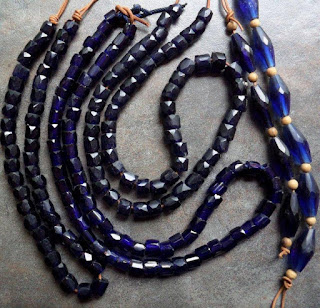
Sorting through my collection of trade beads recently, I observed that the very largest of my so-called "Russian" trade beads all have 7 sides.  Beads of this type were purportedly used in the 19th century slave trade (based upon an inscription of the Levin sample card in the British Museum, likely written decades after the slave trade was abolished in England in 1807) as well as in the North American fur trade, particularly in the Pacific Northwest.
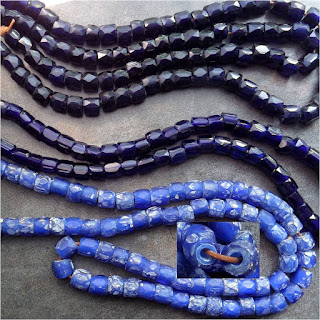
Beads of unknown source (likely Columbia River?), from the Pacific Northwest, and from the African trade.  About 13x13mm in size.  The upper strands are transparent uniform dark cobalt blue, the lower lighter blue strand has 3 layers of glass.  The light blue strand displays glass decomposition, most likely from burial in earth, and was collected in Africa by Michael Heide.
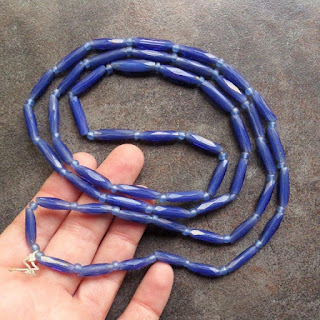
Beads closely resembling the long beads on the right appear on a 19th century sample card in the British Museum with a hand-written label, "Beads used in the African Trade for Slaves."  Dark blue beads similar to the strands on the left also appear in the right column of the sample card, but are smaller and have 6 sides. 
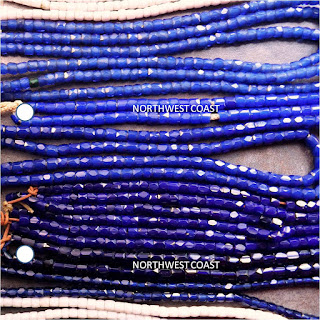
Dainty beads that appear to closely match those on the "Traded for Slaves" sample card (see below)


Various colors of blue, comparing Pacific Northwest beads with strands from Africa.  With the exception of the lowermost steely blue strand of beads, the African beads display a layered structure, with translucent glass overlaying a bright opal or opaque blue commonly called "Dutch" blue.  The Northwest Coast beads are often 7-sided, the African beads are smaller in diameter and usually have 6 sides (but not always - the two dark sapphire strands upper middle are strung on African raffia and have 7 sides).  The darker blue Pacific Northwest beads are a uniform color, but the lighter blue beads display a core of "Dutch" blue.  6-sided beads with multiple layers, as well as monochrome beads, have also been recovered at the Fort Vancouver fur trade post archaeological site in Portland, Oregon and elsewhere along the Pacific Northwest coast. (see PDF)
There's a fair amount of bead collector lore about these beads, including the usual heavy crust of confusion and misinformation that accumulates around antique objects.  So I did an internet trawl, and collected my notes and pictures into a Powerpoint document, available as a PDF for those interested.  This isn't a spiffily formatted presentation, but perhaps you will find it informative, as it contains pointers to books and online documents with in-depth research.

BeadsTraded for Slaves vs Traded for Furs

Those interested in extensive pictures of the varieties of these "Russian" beads can find an awesome online exhibit at the Picard Museum.

UPDATE: Found an online version of the British Museum Levin cards at ezakwantu.com.  I've circled the beads resembling those discussed above. As the Picards note in their online exhibit of beads on pre-1900 cards, with respect to the Levin cards in the British Museum, "there is no real evidence that these sample cards of beads traded for gold, ivory, palm oil and slaves are really accurate as to what they were traded for, and therefore are not to be taken literally."

UPDATE: Scan of the color Plate I from the 1985 pamphlet by Elizabeth Harris, "The Russian Bead," Northwest Colored Bead Chart No. 3.
The author states, "The beads pictured on plates I and II are predominantly from the collection of G. B. Fenstermaker.  June Payne and Albert J. Summerfield very generously loaned beads from their collections so that as wide a variety as possible could be shown."
[Open image in another tab if you wish to magnify it]


UPDATE: The Smithsonian's National Museum of the American Indian has an example of the type of bead collected by the Tlingit in Sitka, Alaska (site of the Russian-American Company).
 
"Collection history unknown; formerly in the collection of Frederick W. Skiff (1868-1947, a Portland, Oregon, accountant and antiquarian); purchased by MAI from Frederick Skiff in 1925."
https://americanindian.si.edu/collections-search/objects/NMAI_148302

More Pacific Northwest beads:


Neah Bay, Makah Reservation; Clallam County; Washington; USA
Collection History
Collected in 1916 by Leo J. Frachtenberg (1883-1930, an anthropologist who specialized in Native American languages) during fieldwork sponsored by MAI.


UPDATE MARCH 2024
Posted with the permission of the photographer, an extraordinary Tlingit vest composed of Russian trade beads, in the collection of the Smithsonian's National Museum of the American Indian.


Puzzling Evidence - Rare Lotus Pond Vase by Lao Tian Li 老天利 and "Made In China" Stamp

We know the Lao Tian Li studio continued into the early 1920s, because Jin Shiquan 金世权  at age 12 was apprenticed there in 1922 under senior craftsman Liu Guangde.  Was Lao Tian Li himself still alive then and overseeing the studio?  This interesting vase has a rare combination of stamps on its base - the signature stamp of Lao Tian Li, plus a "MADE IN CHINA" stamp.  A country of origin stamp including the words "Made In"  was required to be on products exported to the United States after a 1920 tariff act - previous to that, only the name of the manufacturing country was required.  The stamp is a stylized version of Lao Tian Li's engraved signature that appears on earlier pieces.


UPDATE: A following blog post comparing this vase with another piece in the lotus pond theme that seems to have been made for U.S. export:

http://www.beadiste.com/2015/07/puzzling-evidence-chinese-cloisonne.html