Monday, February 23, 2015

Puzzling Evidence – The Beijing Enamel Company’s 北京珐琅厂 JingFa 京 珐 Label Bird and Flower Design

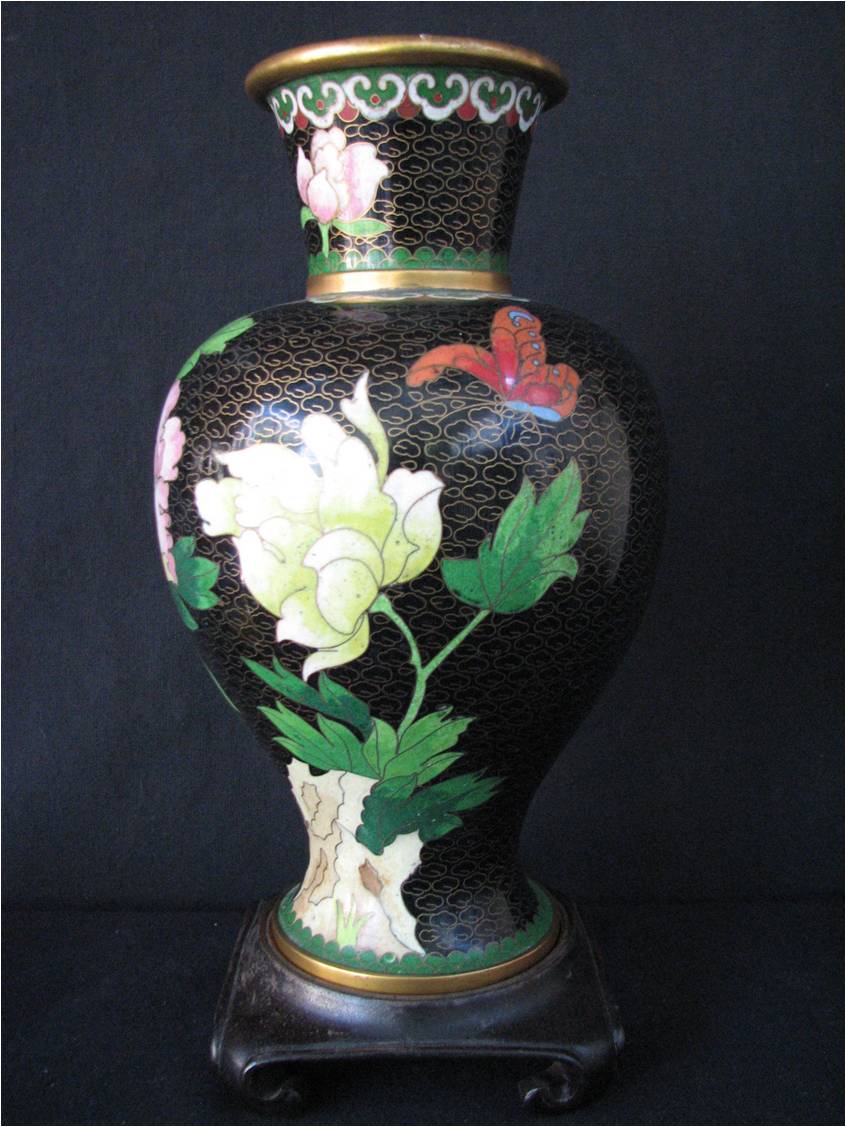
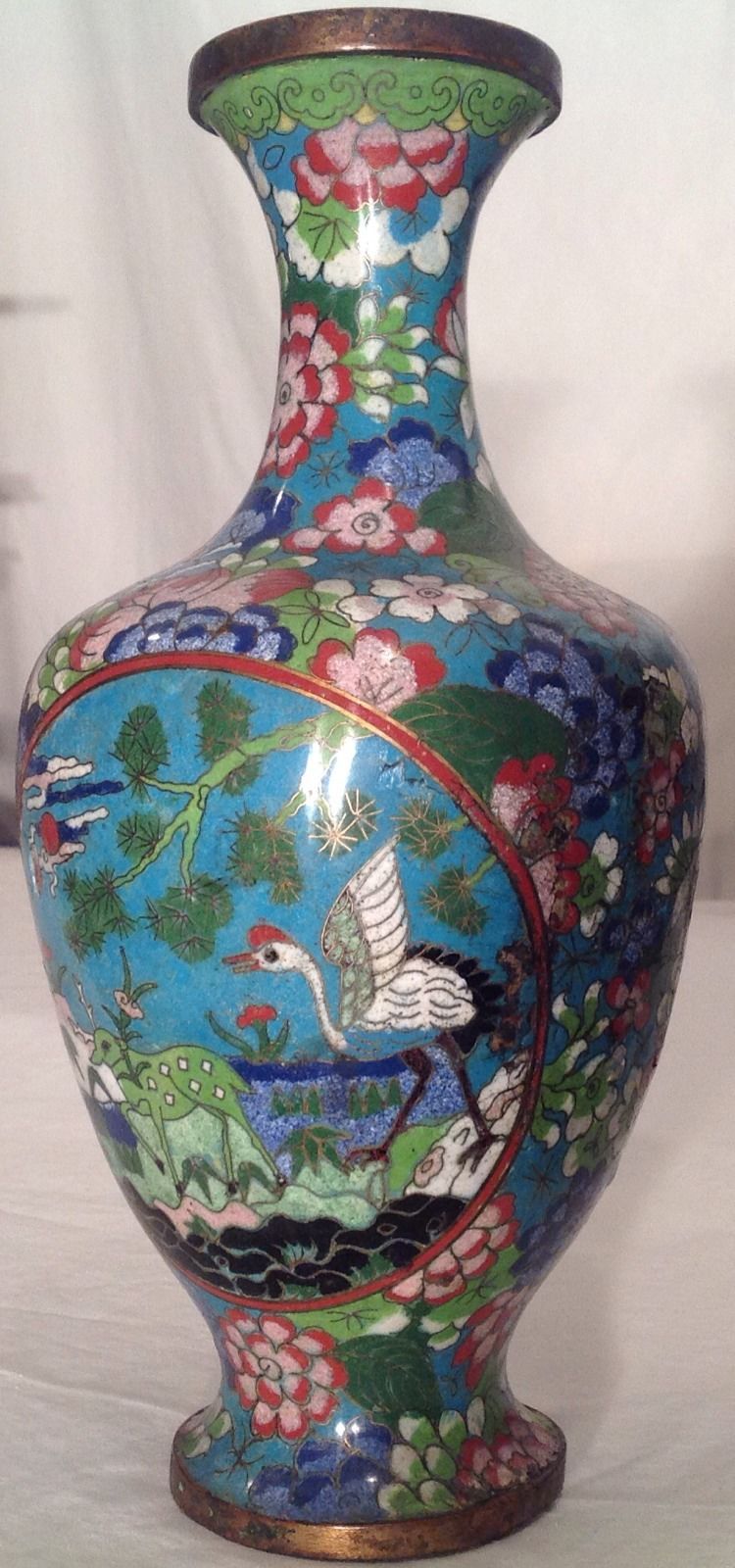
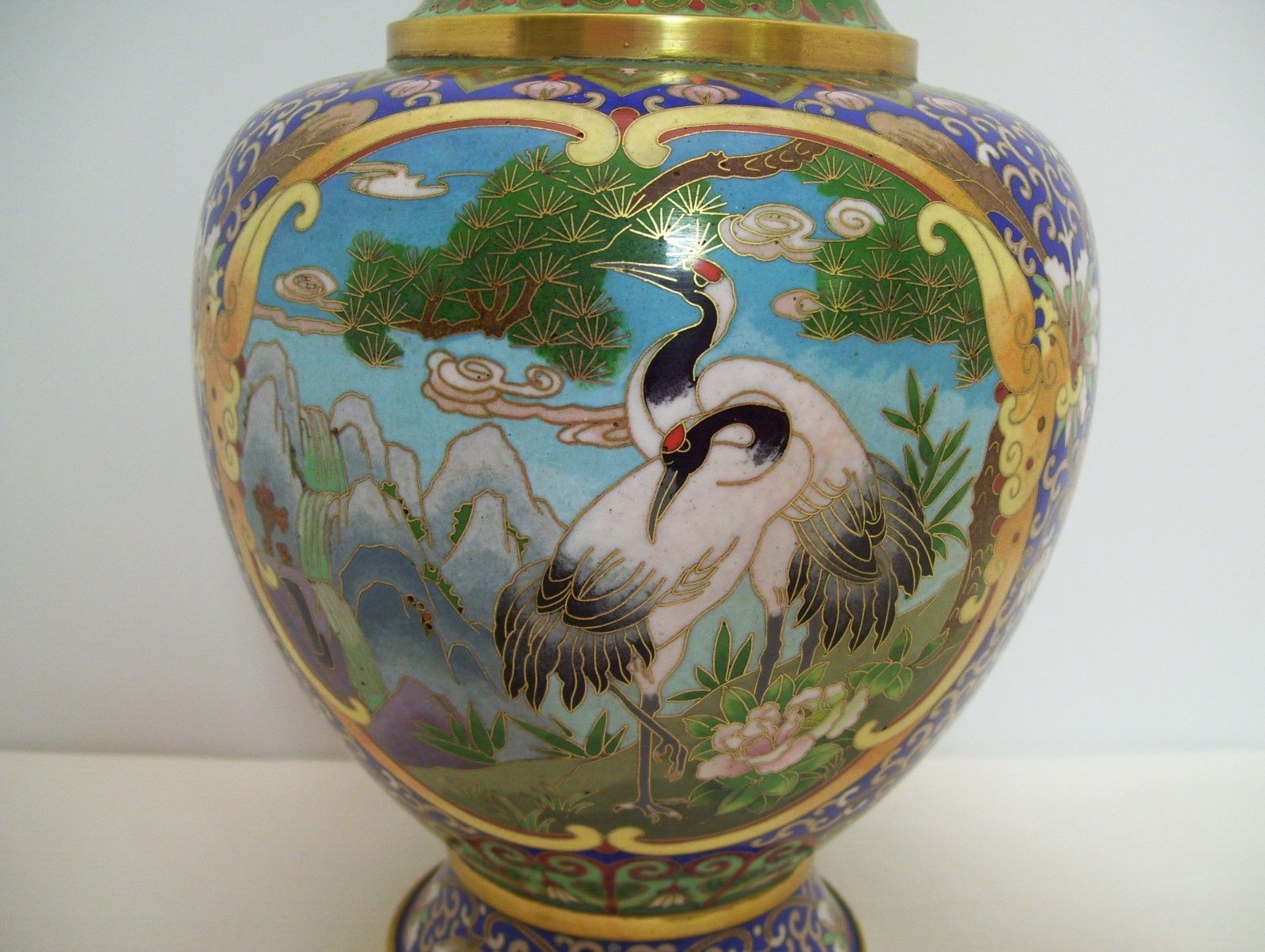
eBay vendor mudainew has on offer a vase that seems to be a nice early rendition of a favorite JingFa composition:


This design appears over and over and over again on a variety of items:
  •  On one side, a large floral design
  •  On the opposite site, a small floral design
  •  A jaunty flying bird, or sometimes a butterfly
  •  Jagged rocks in a distinctive motif of concentric wires and shaded, blended enamel colors
  • Neat and tidy rows of a distinctive cloud motif as the background pattern (diaper)
  •  Blossom buds rendered in a distinctive bending technique using a single wire 
  •  Pairs of vases or covered jars are rendered in exact mirror symmetry
  •  Use of bright orange and red and pastel enamels not seen in the earlier half of the 20th century
  •  Smoothly blended enamels shading from light to dark within a design motif, such as leaves or petals
  • Naturalistic depiction of the flowers 
Compare this composition with floral cloisonne vases from earlier decades:
The symmetry is approximately mirror image.

The enameled "CHINA" base mark indicates a date later than the McKinley Tariff Act of 1890, which required a country of origin mark on items imported into the U.S.


Close examination reveals that these vases, although similar in color, display two different methods of rendering the blossom and branch design - for example, in the flower buds and the woody stems.  The background of spirals seems to be a 1920s-40s style.  The words "Made In" were required by a 1920 Tariff Act amendment for the country of origin stamp.
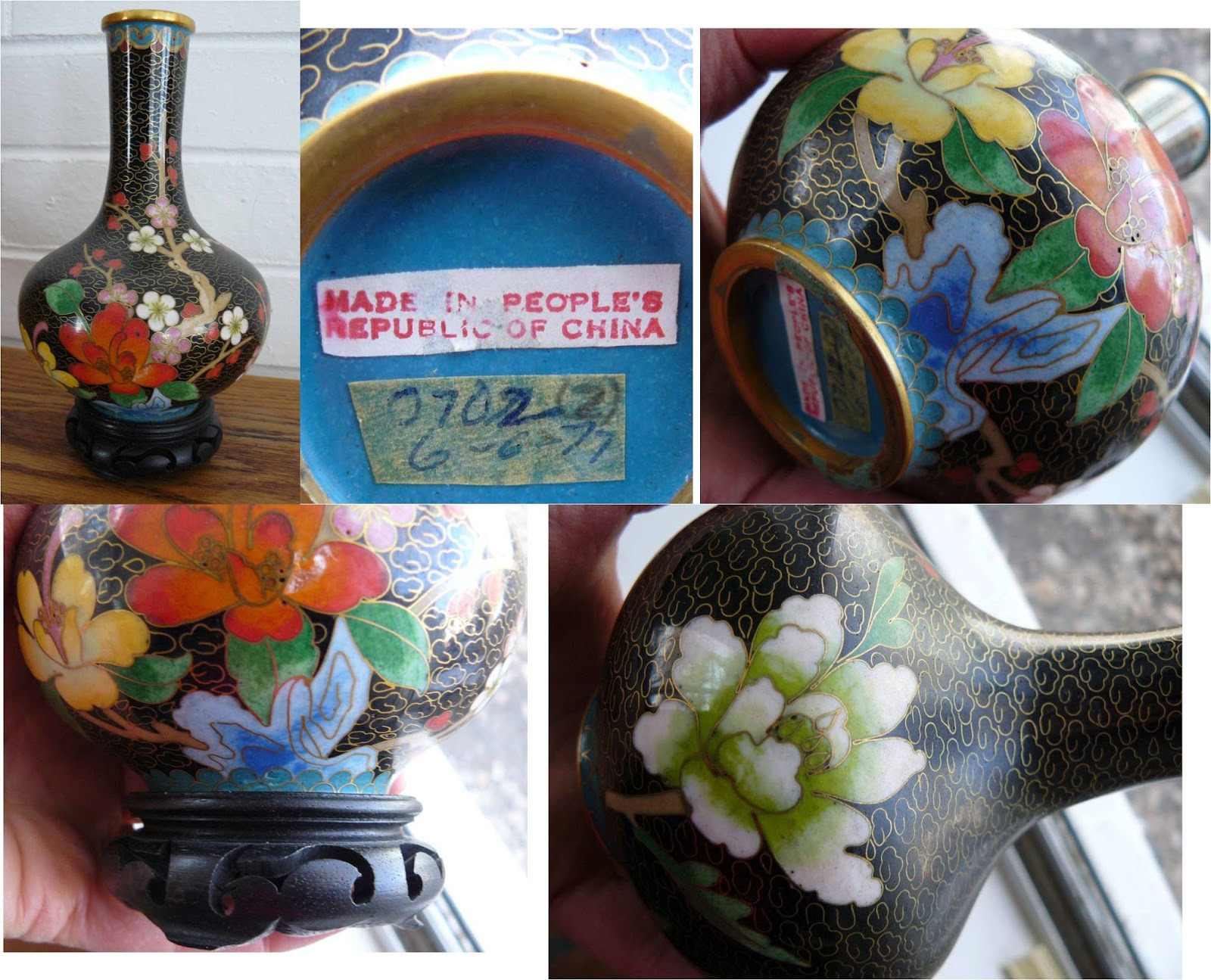
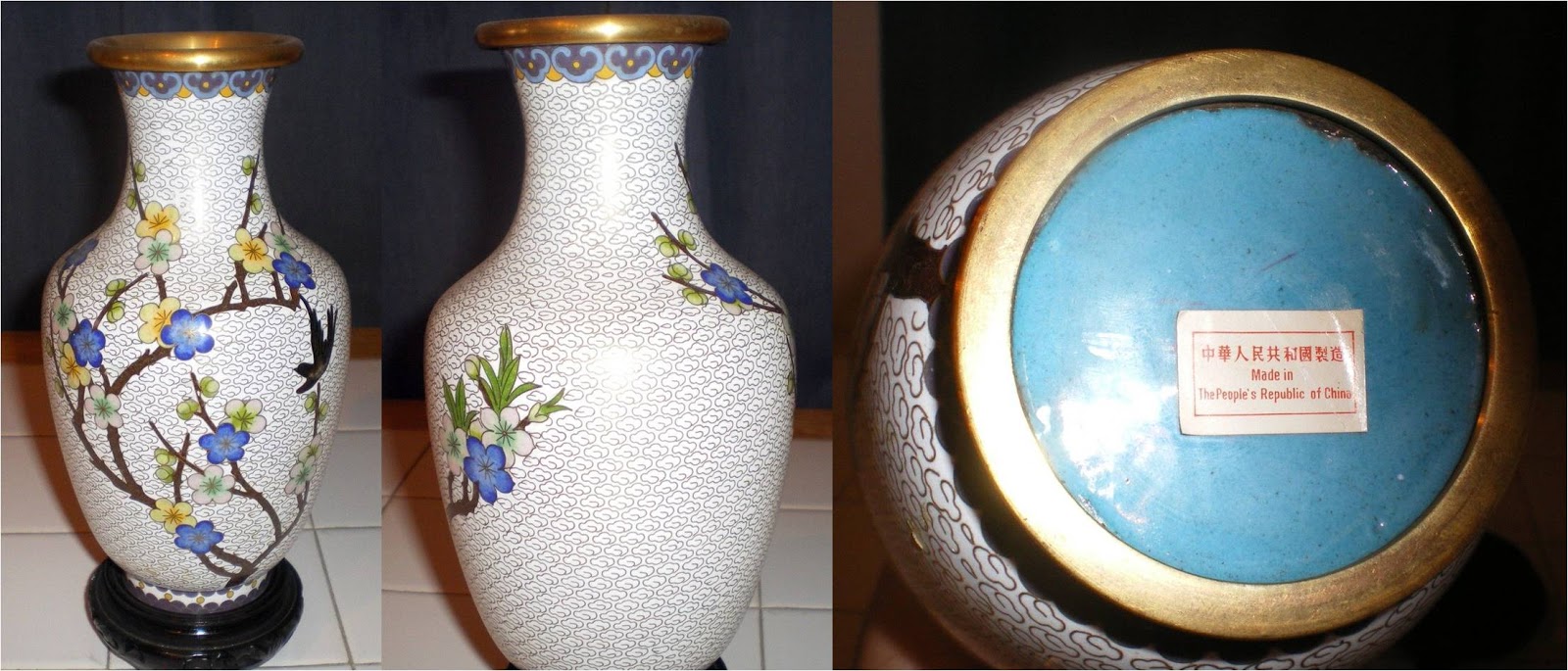
JingFa products:

“I bought this and many other items from one individuals estate. He being the first and only owner of this vase since the 70's when he visited a factory in China and watched them craft this exact vase, stage by stage over a week or so period long process before he was able to take it home. He says it was a fun experience to which this was his souvenir.” eBay seller buy1fromFred July 2013
The seller states that the labels were applied by the original owner when she purchased the vase.
The seller states that he brought this vase back from a visit to China in 1983.


The beige vase is interesting for it's theme - the classic "Three Friends of Winter," plum, bamboo, and pine.  Another Hu-shaped vase appears in a following post on 1960s Chinese cloisonne.


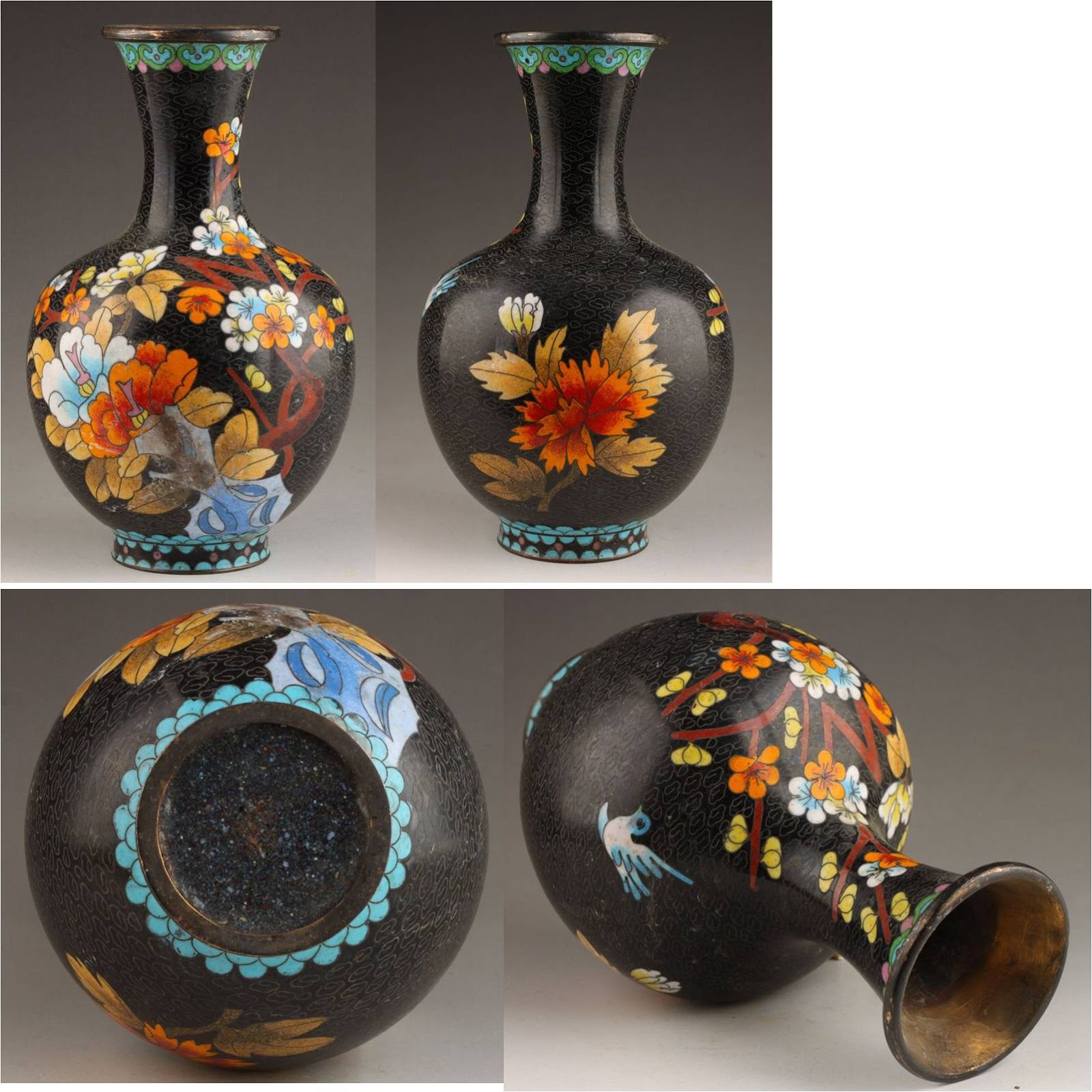
Granite black enamel on base instead of the more usual blue.


Note the ornate necks and feet, impeccable craftsmanship. 1980-90s products?
When were these items made?  The Beijing Enamel Company was formed in 1958 according to this article on their Web page. It was a state-supported industry responsible for production of fine cloisonné for sale abroad  for the purpose of earning valuable foreign exchange [see extended quote at end of this post].  

Foreign exchange, of course, is when you want to buy something from another country and have to use their currency for payment.  You have to swap your money for theirs – buy their money.  But what if they don’t want your money, because there’s nothing they can use it to buy?  It’s not as if you can just waltz out and buy a burger in Alaska with the Hungarian forints left over from your visit to your relatives in the old country, right? The solution, of course, is to start making things that foreigners will want to purchase with the currency you sold to them (“Look at this great embroidered tablecloth I bought in Budapest!”).  This of course quickly gets more complicated when an international floating foreign exchange market such as we have now develops.   But China’s big problem after 1949 was how to purchase the modern technology they needed, and how to earn the foreign exchange required for these purchases – “We need rubber and steel for tractors, what can we swap for them?”  In the 1962 book Escape from Red China the author, Robert Loh, quotes Mao, "One cent of foreign exchange is equal to one drop of human blood."
Alas, in 1958 one of China’s best prospects for a supplier and trading partner, the United States, was cut off by a trade embargo put in place as a result of the Korean War in 1950.  For various unfortunate reasons this embargo did not end until twenty years later, in 1972.  The Beijing Enamel Factory’s website describes how their production earned foreign exchange during the 1970s and early 1980s.  After Deng Xiaoping’s economic reforms and support for development of Special Economic Zones along the coast, production then shifted from traditional crafts to … everything else that any international customer might desire.  Boom!  We all know what happened next.  China now has a foreign exchange reserve of nearly $4 trillion.

Another account from the Beijing Enamel Factory [click on the Google translate button] relates how Qian Meihua worked to renovate the cloisonné production process and to establish an assembly line system to increase the levels of skill and efficiency.  Rather than one master overseeing a shop of journeymen and apprentices, cagily keeping trade secrets close lest his workmen become competitors, she was determined to modernize cloisonné manufacture and publish manuals to make the process open to anyone who wanted to pursue this type of artistry.
You can watch this CCTV video [skip to 3:00 to avoid the intro] and see that she and her co-workers succeeded – each separate task in the production sequence is now done by skilled technicians.

This standardization of tasks likely accounts for such design features as
  •  exact symmetry, because the wire technicians are copying a drawing, not applying wires freehand;
  •  multiple copies of a design, because wires are glued together and bent 8 to 10 at a time, so all pieces match exactly;
  • a uniform field of identical background clouds, as neatness and exactness were performance criteria for the technicians responsible for this part;
  • the comparatively simple flower and bird/butterfly designs of the 1970s becoming more elaborate, colorful, and ornate as the company artists and technicians expanded their skills and new enamel colors were developed [JingFa color brochure from the 1980s]

Many of the above examples are likely from the 1970s and 1980s, when it became possible for more people to visit China.  But what happened during the earlier 15 years of the Beijing Enamel Factory, from the mid-1950s through the 1960s?  What sort of things did they produce then?
------------------------------------------------------------------------------------------------------
Gluttons for punishment might find interesting some of the Web resources I read while working on this post:

AMERICAN BUSINESS AND THE CHINA TRADE EMBARGO IN THE 1950S by Kailai Huang, Massachusetts College of Liberal Arts

PBS: The American Experience: Nixon’s China Game, Timeline for  1971-74

景泰蓝产地:北京珐琅厂的历史与沉浮
  1949年刚解放时,我国百废俱兴,一些设备、钢材主要依靠进口,那时国家物资匮乏,没有什么能够换取大量外汇。唯有工艺美术品换汇率较高,北京就利用自 己的民族特色,用景泰蓝、牙雕、玉雕、金漆这样的特色产品打开市场。当时北京市珐琅厂成了北京市的出口创汇大户,有一半的外贸产品都是景泰蓝,行销世界五 大洲100多个国家和地区。进入八十年代后,景泰蓝出口达到顶峰,1980年和1981创出历史最好水平,年均出口创汇1000多万美元。

Google translate:
National Museum of China:  Cloisonne Origin: Beijing Enamel Factory's history and the ups and downs

in 1949 when the newly liberated our country Baifeijuxing, some equipment, steel mainly rely on imports, then the national shortage of materials, nothing can exchange a lot of foreign exchange. Only the higher arts exchange rates, Beijing will use its own national characteristics, open market with cloisonne, ivory, jade, gold lacquer such specialty products. Then export large Beijing Enamel Factory became Beijing, half of the foreign trade products are cloisonne, marketing the world's five continents in more than 100 countries and regions. After entering the eighties, cloisonne exports peaked in 1980 and 1981, reaching a record level, with an annual export volume of more than $ 10 million.

In December 1978, during the Third Plenum of the 11th Central Committee Congress of the Communist Party of China, Deng took over the reins of power.
Beginning in 1979, the economic reforms accelerated the market model, while the leaders maintained old Communist-style rhetoric. The commune system was gradually dismantled and the peasants began to have more freedom to manage the land they cultivated and sell their products on the market. At the same time, China's economy opened to foreign trade. On 1 January of that year, the United States recognized the People's Republic of China, leaving the Republic of China's Nationalist government to one side, and business contacts between China and the West began to grow. In late 1978, the aerospace company Boeing announced the sale of 747 aircraft to various airlines in the PRC, and the beverage company Coca-Cola made public their intention to open a production plant in Shanghai. …
To reassert his economic agenda, in the spring of 1992, Deng made his famous southern tour of China, visiting Guangzhou, Shenzhen, Zhuhai and spending the New Year in Shanghai, using his travels as a method of reasserting his economic policy after his retirement from office.

On his tour, Deng made various speeches and generated large local support for his reformist platform. He stressed the importance of economic reform in China, and criticized those who were against further reform and opening up. Although there was a debate on whether or not Deng actually said it, his perceived catchphrase, "To get rich is glorious" (致富光荣), unleashed a wave of personal entrepreneurship that continues to drive China's economy today. 

Monday, February 16, 2015

Puzzling Evidence - The Red-Crowned Crane 丹顶鹤 in 20th Century Chinese Cloisonne

In a caption for a picture of a necklace in my previous post about a millefleur pattern I mentioned that one of the cloisonne beads featured an old-fashioned version of a red-crowned crane.  
Crane bead is just to the right of center.

How could I tell it was older?  The depiction of the red crown seems to be the clue. Note how in Chinese cloisonne pieces from the earlier half of the 20th century the red crown sits atop the head like a tiny hat:
On offer from eBay vendor doctorette.


Note the resemblance of the flower centers to those in the necklace beads.

A Deco-era vase

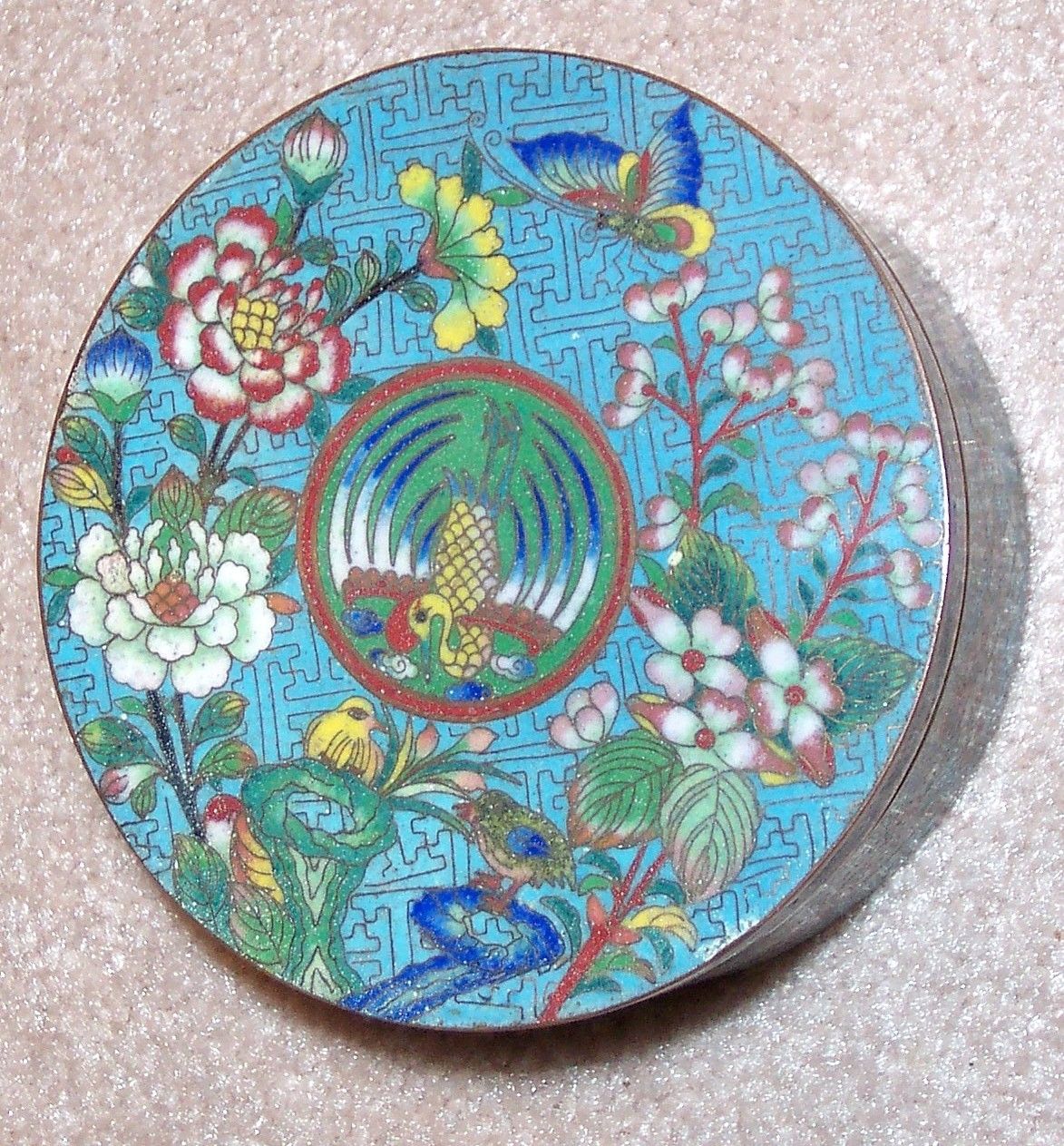
Another beautiful old Chinese box from doctorette.

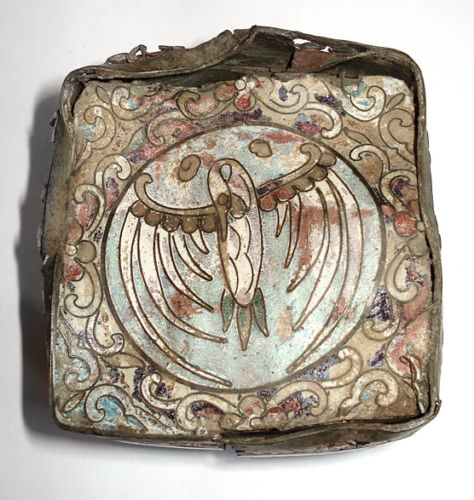
A box described as excavated from along the Siberia/China border.
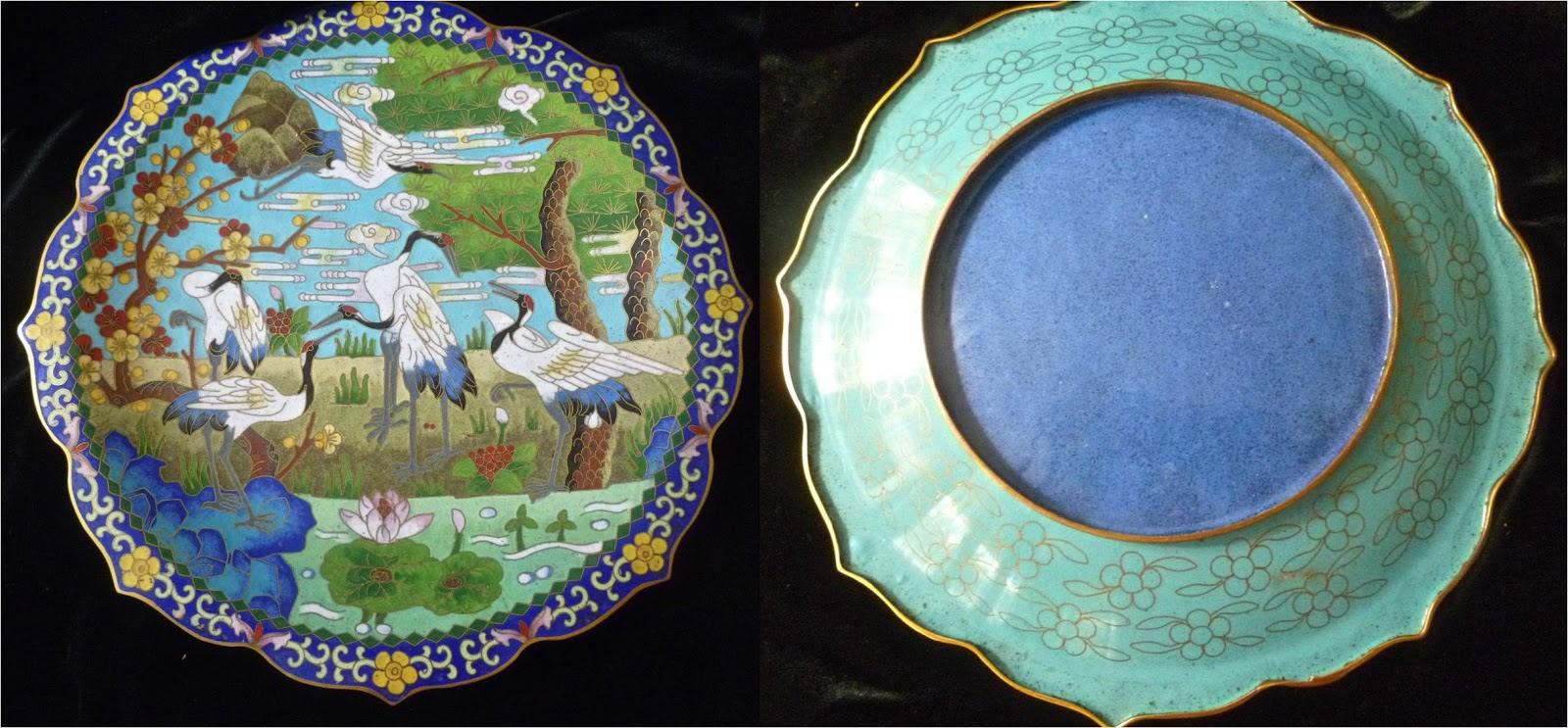
Pieces manufactured after the People's Republic of China reorganized the cloisonne workshops in 1956 show a different type of wirework iconography for the red-crowned crane:
Note how the red crest lies below the curve of the head, not above it.


Rubylane shop Historique described this plate and a similar one on offer as, "Purchased in Hong Kong in the late 1960’s at a night market."


Sunday, February 15, 2015

Puzzling Evidence - A Distinctive Millefleur Cloisonne Pattern

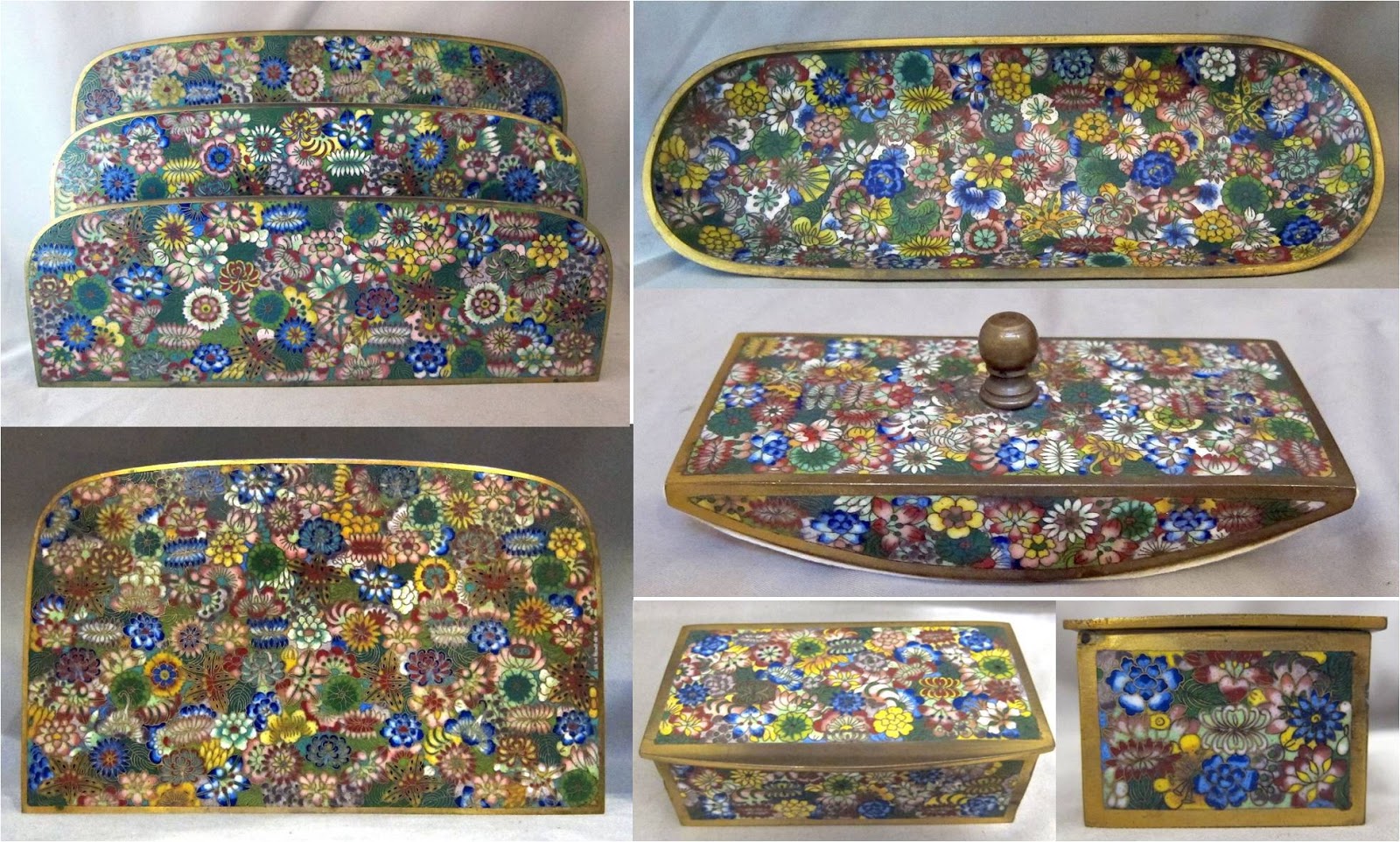
eBay vendor antiques143 has a couple of pieces on offer that display a distinctive mille fleur pattern likely to have been the work of one particular artist or small workshop.  


I have 3 matchbook covers in this pattern: a pair apparently made at the same time, and one other which is similar but a bit smaller and with a slightly different arrangement of the flowers. 
Identical wirework in the flowers & similarity of placement in the composition, different enamel colors and background motifs according to whim.  The artist was working freehand, not tracing a drawing.
The wirework is very tiny and fine.  This unique design style appears on other pieces that seem likely to be from the 1890s-1920s decades - unless desk sets continued to be used through later decades as well?
Matchbox, desk set, and jar featuring what look like identical floral motifs.
Pieces from a different desk set featuring this pattern.


By way of comparison, a desk set with the signature of Lao Tian Li.
Letter holder from Lao Tian Li desk set.

The fine, paper-thin wire and tiny detail of these millefleur pieces made me wonder why such tiny patterns were not also applied to beads?  Or perhaps they were?
Large beads strung as ornaments, beads featuring a style of background cloud motif common in the 1930s-40s.  The floral motifs on the beads are different from those on the matchbox, but the wirework - especially on the large ornament beads - is just as fine and precise.

The 1935 flyer from the Decheng workshop mentions beads as one of their varieties of cloisonne products.  
Cloisonné beads that appear in costume jewelry designs from the1930s seem to vary between graceful artistic compositions as in the white beads below, versus a more splashy folk-art look as seen in the oval beads suspended from the silver filigree roof brooch.


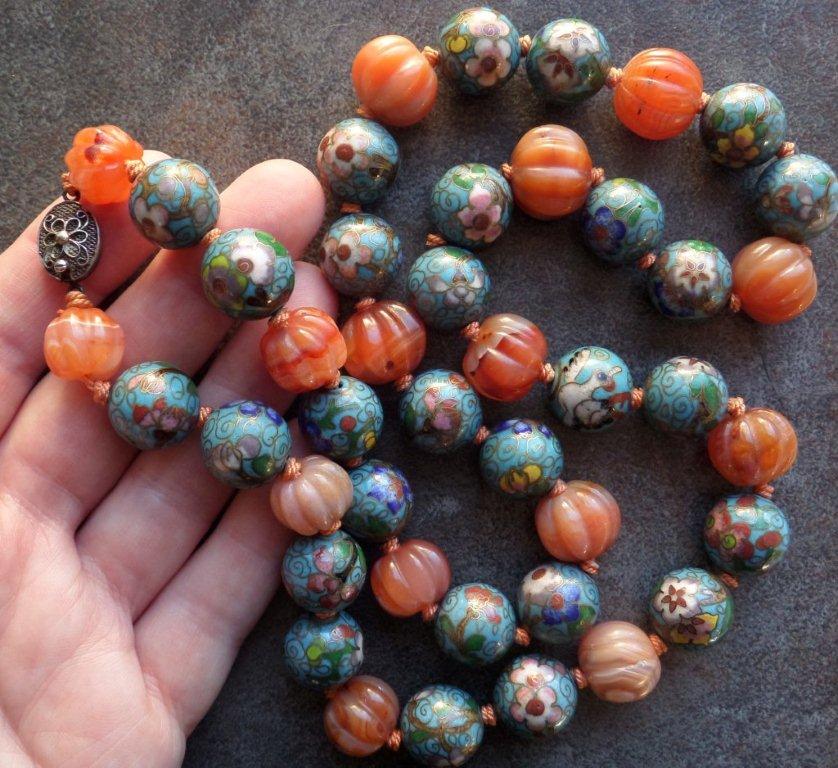
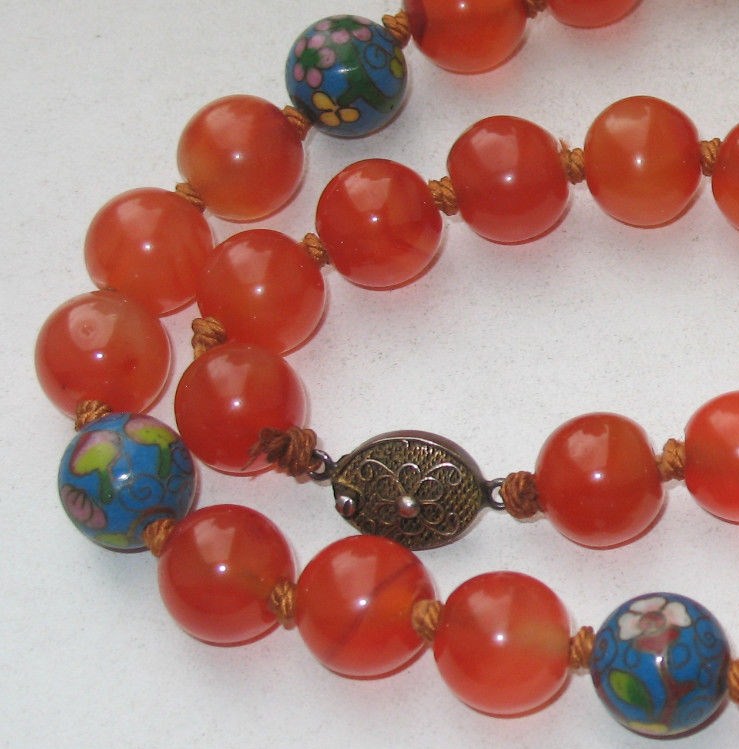
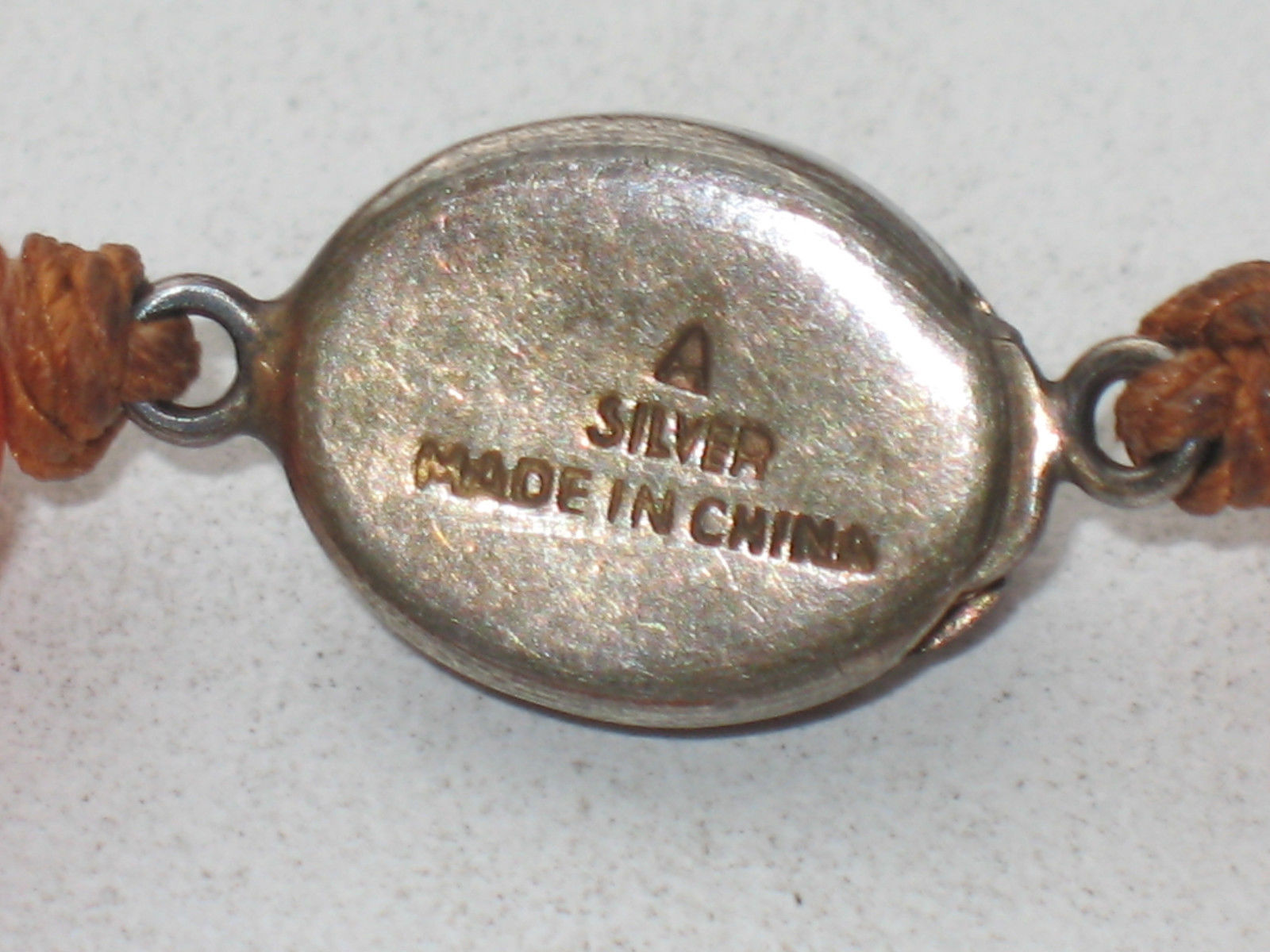
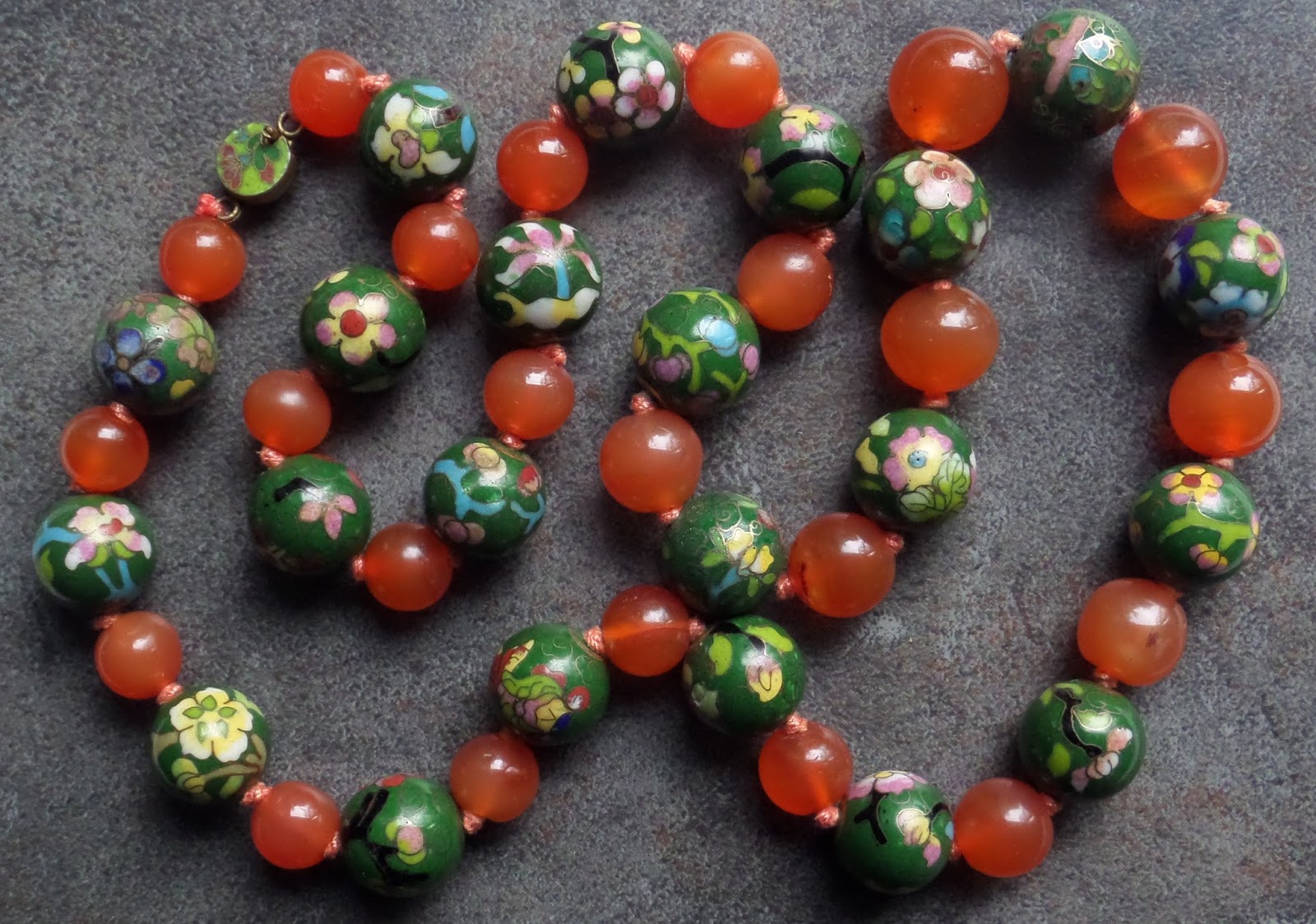
However, there is another cluster of cloisonné bead jewelry designs that are obviously of Chinese manufacture: classic necklaces combining fine cloisonné beads with gemstone beads made from carnelian, rose quartz, tigereye, and jade, often featuring filigree box clasps with a "Silver Made In China" stamp.

One bead features an old-fashioned version of the red-crowned crane motif.

Another old-fashioned crane bead.

A carnelian and cloisonne necklace from Germany whose former owner informed the auction agent that it was purchased in China during the 1930s as a gift to her mother.

Clasp from the necklace pictured above.
Another carnelian and cloisonne necklace.  According to her daughter, the deceased owner of this necklace considered it an heirloom.
Unlike necklaces featuring mass-produced beads of identical design throughout, perhaps these necklaces might be better interpreted as suites of similar beads – as if an artisan turned out a small collection of beads on any given day or week that, according to personal whim or inspiration, explored a variety of motifs tied together via a matching background color and size.  These small matching series were then strung with complementary gemstone beads, either using knotted silk or a wire loop chain technique.    No two necklaces are ever exactly the same, because each uses a separate small suite of beads, not identical beads from a box of 200.  

Were these nicer beads and necklaces in fact made during the 1920s-40s decades?   What do you think?

UPDATE: This 2012 Daily Mail article features a 1936 desk set given as a gift from the Duke of Windsor to his brother the King. The set, similar in style to millefleur sets, is worked in the "curling grass" pattern.

Tuesday, February 3, 2015

Puzzling Evidence - A Clue About the De Xing Cheng (Teh Hsing Ch'eng, Teh Hsin Cheng 德興成) Cloisonne景泰蓝 Workshop


Recently I acquired a small box containing a rumpled paper flyer from the “Teh Hsing Ch’eng” shop in what is now Beijing.  The Chinese characters translate as “De Xing Cheng Fa Lang Zhu” - Dexing Cheng Enamel Workshop? [Later: Transliteration expert "rat" at the Asian Art forum corrected the last character to read as "zhuang" = shop. Makes better sense.]  At the time the flyer was printed – 1935 – the city was known as Peiping, as the Nationalist government had moved the capital of China south to Nanjing in 1927, thus making the old name Peking (Northern Capital) inappropriate. 
I’m not sure what to call the motif – Artemisia leaf, or vine scroll? – but it seems to be a perennial favorite Chinese design.  Another example can be seen in the 1923 bowl gifted by the warlord Feng Yuxiang.


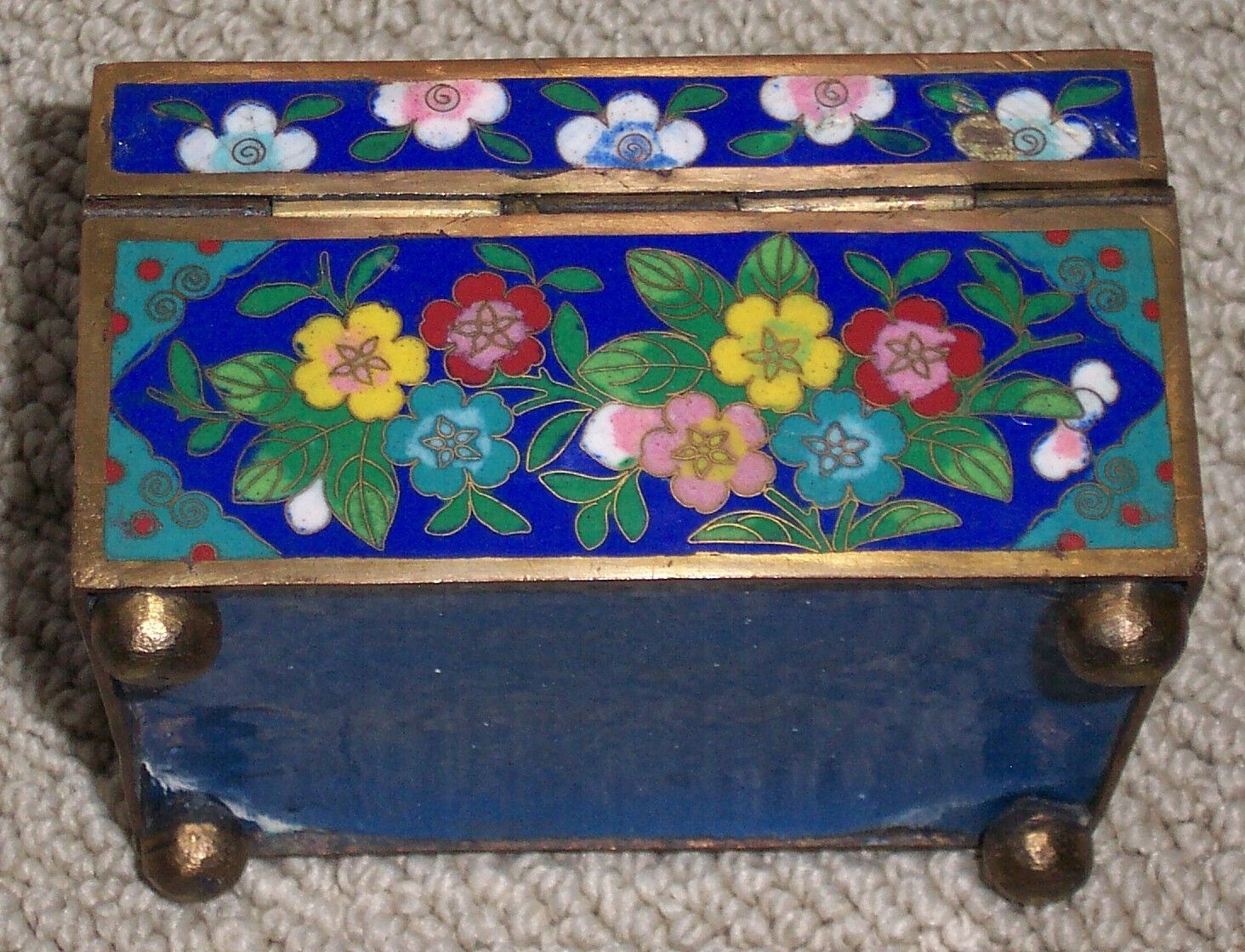
Box with paper on left, comparing workmanship with another smaller box from the same collection, as well as a similar cigarette case from a different collector.  The wirework on the small box and case is very fine and precise and the polish is impeccable, whereas the larger box displays pits in the enamel.
The top side of the cigarette case features a fine dragon.

The My Dad the US China Marine blog shows a picture of a business card dated to 1945-47:
Hatamen Street ran alongside the eastern edge of the Legation Quarter, where foreign diplomats resided.  
Postcard of the Tung Tan Pailou (arch) on Hatamen Street (now Chongwenmen Street).
After steaming the paper to flatten it, the following text could be read (missing text is indicated in red):
THE HISTORY OF CHINESE CLOISSONNE AND OUR STORE
THE TEH HSING CH’ENG
The cloisonné ware is known as one of the famous Chinese art products.  It involves a variety of processes all of hand as follows:  (1) to have a brass plate made into the shape of desired ware, such as vase, box, jar, etc.  (2) To set on the brass ware a lattice-work of silver or copper wire in certain design.  (3) To fill coloured enamel into the lattice-work.  (4) To bake the ware for several times in kiln.  (5) To polish it, when the ware is taken out of the kiln.  When these processes are gone through, the result is an article of exceeding beauty.
The cloisonné ware was first produced about in 1449 during the reign of Emperor Ch’ing Tai of Ming Dynasty; hence the name “Ch’ing Tai Lan.”
After 1810, with the death of the great Chien Lung of Tsing Dynasty, the art was completely lost to China.
About 1860, the lost art was found again by the founder of our store, Mr. Chia, in the following manner:
Mr. Y___wa Chia, a native of Shantung and a maker of [hat?] buttons for [high] officials in Peking, saw, by accident, some [colored?] pieces of stone, which was left by a bankrupt artist to an old woman [to dispose] of.  Indeed, these stone pieces were the material for making the [cloisonné?] ware, but nobody knew about that. Mr. Chia was struck by their beauty and bought a few pieces of them more out of curiosity than anything else.  Thereafter, on the poor woman’s request, he bought all of the rest for a small price.  On returning home, he secluded himself in his workshop and began his effort to delve into the secret of the making of the cloisonné ware.  After a considerable time, he succeeded.  As at that time, the cloisonné ware was very rare on the market, Mr. Chia sold his product for a good price, especially to the high officials who used to take them as the old curios of Ming Dynasty.
Upon his success, Mr. Chia founded our cloisonné store, known as Teh Hsing Ch’eng, at Yang Mei Chu Hsieh Chieh, Peking, about seventy-five years ago; and since then many of the European and American customers have ordered the products with great satisfaction.
We manufacture the large and small pieces of cloisonné ware, such as: vases, beads, flower-jars, smoking sets, incense burners, etc.  Besides obtaining different prizes from the national and provincial exhibitions, we have also been awarded with gold and silver medals, together with diplomas, from Kaloniale Tentoonstelling, Samarang in 1914; Panama-Pacific International Exposition in 1915; Liege International Exposition in 1930; etc.
Last year, our store, Teh Hsing Ch’eng, was removed at 20 Hatamen Street, Peiping (Peking).  Your inspection at anytime is warmly welcome.
THE TEH HSING CH’ENG
       July 1st, 1935.         [number 20 struck out, “52” written in ink alongside]  20 Hatamen Street, Peiping

Printed the The Yu Lien Press


A couple of things struck me in this account.  First, the legend about the founder re-inventing cloisonné in his workshop.  1860 saw the end of the Second Opium War, with the looting and burning of the Summer Palace by the French and British.  The display of this war loot in Europe caused an intensification of interest in Chinese cloisonné, as Susan Weber relates in her chapter in Beatrice Quette’s book, Cloisonne: Chinese Enamels from the Yuan,Ming, and Qing Dynasties:

The sacking of the Summer Palace in Beijing in 1860 marked a major turning point in the collecting of cloisonné in Europe.  Prize pieces were among the war booty that the French and British army forces divided between them.  The English portion of the Summer Palace loot went to Queen Victoria and her generals, but by 1862 goods plundered by individual officers were being sold throughout Europe.  … Prices at any sale that included Summer Palace objects were high, as collectors vied for pieces made for the imperial court rather than for the Western export market.  Many of these objects eventually became part of British and French public collections, particularly the Victoria and Albert Museum, the Lady Lever Art Gallery in Liverpool, and the Musee des Arts decoratifs in Paris.

The Opium Wars and the Taiping Rebellion left the Qing government in financial disarray, and the imperial cloisonné workshops were closed.  The flyer’s account might indeed have been based upon workshop materials and unemployed artists turned out onto the streets of Peking.  Cloisonné enamels do start out as lumps of colored glass, which need to be finely ground and mixed with water to produce the enamel pastes.  Perhaps some unemployed craftsmen might have been hired to assist the company founder in his efforts to re-discover the secrets of cloisonné manufacture and invent new enamels?

Beatrice Quette recounts on page 28 of her book:

During the Guangxu reign [1875-1909], there was a return to high-quality production, notably for the foreign market.  Enamel colors became fresh, delicate, and varied, and thick layering made a comeback.  The enamel powders used in this production came from minerals collected in Boshan County in Shandong Province  [Note: Boshan became, and still is, an important glass production center].  Mixed colors were widely used, notably in skillfully rendered passages of shading.  … The layer of enamel is thinner and the objects are lighter…

[and from page 16 in Quette’s book:]

During the last quarter of the nineteenth century, marks began to identify names of manufactories.  The name Decheng is stamped into the metal base of a vase from the George Walter Vincent Smith Art Museum and the same name appears on a paper label glued onto the back of either a disk or a circular plaque in the collection of the Phoenix Art Museum.  This label, written in Chinese and French and possibly made for an international exposition in Paris in either 1889 or 1900s, gives the address of the Decheng Manufactory [Chinese characters] and warns against imitations: “The only true manufactory, Teuo-Tcheng, is located in Beijing outside the Tsien-men gate near the middle of the Yan-mei-tchou-sie-kiai [note similarity to the flyer’s “Yang Mei Chu Hsieh Chieh, Peking” address] road (north side).”  This suggests considerable concern about quality and forgeries and was meant to authenticate the object’s origin.

What appears to be another example of this label showed up on this piece from an online auction:
http://www.liveauctioneers.com/item/9262254
The second thing that struck me is the boast about foisting off the workshop's products onto “high officials” as Ming dynasty artifacts.  Ironic, considering that “only true manufactory” warning statement about imitations on the 1889 labels.

Also striking is the gap between exhibition dates – many in the 1900-10s, only one in the 1930s, and that one the Belgian Liege exhibition which apparently wasn't much of a success.  The 1930s were an awful decade of economic depression and war destruction.  Presumably the older cloisonné craftsmen from the late 19th century were by this time retiring or dying off, and workshops likely were in trouble both in supply of raw materials and craftsmen.  In 1937 Japan invaded and took over the city of Peiping.  The biography of cloisonné artist Jin Shiquan recounts how he fled back to his village and had to abandon cloisonné work for 15 years until the re-organization of the tattered Beijing workshops in the mid-1950s.

The flyer in the box is dated 1935, but when was the box actually made? Was it old stock from the 1920s, or was the workshop still struggling to produce pieces for sale despite the havoc of the 1930s?  There were other cloisonné objects gathered by this collector that seem to date to the 1920-30s era – did the flyer accompany this particular box at the time of purchase, or another piece or pieces?  Also, might other pieces in the collection come from different workshops, such as Lao Tian Li's?  We know the Lao Tian Li workshop was still operating in 1922, as Jin Shiquan started there as an apprentice at age 11.

One final question - because this blog is mostly an attempt to resolve when the various types of Chinese cloisonné beads were made - consider the mention of “beads” in the flyer, and “jade beads” in the ad.  Were cloisonné beads sold?  Or just jade beads?

Puzzling evidence.

UPDATE SEPTEMBER 2025: Informative research by Manuel Parada Lopez de Corselas:
"Decheng, Beitang and Tushanwan Cloisonné Workshops: A New Contribution on Chinese Christian Art"

Excerpt:
"The first cloisonné workshops opened in Beijing during the 19th century were Tianli, Tianruitang, Decheng, and Dexingcheng (Zhou 2022, pp. 188–89). Tianli (天利) was established towards the end of the Daoguang reign (1782–1850) or at the beginning of the Xianfeng reign (1850–1861), around 1845–1850, and it closed in 1900 (Zhou 2022, p. 47). It was owned by the Imperial Household Department of the Qing Dynasty, and it was located in the Ruyi Pavilion (如意館) of the Summer Palace. As such, it continued the imperial tradition but at a lower cost. Its purpose was to supply the court with the necessary objects and generate some income, although sales were discreetly conducted to avoid damaging the prestige of the royal household. The Tianruitang workshop (天瑞堂) was also established during the Xianfeng reign, but no marked objects from it have been found (Zhou 2022, p. 38). Decheng (德成) or Decheng Manufactory (德成琺瑯局), with its Quanxingcheng factory (全兴成), was founded by Jia Derun (1840–1900) 贾德润, courtesy name Yuhua 玉华, in 1860 and closed around 1935 (Zhou 2022, pp. 57–60). Dexingcheng (德兴成) was founded by Jia Yutang 贾玉堂, courtesy name Deze 德泽, the younger brother of the founder of the Decheng workshop. Initially, both workshops were connected until Dexingcheng became independent around 1890; this workshop closed around 1937 (Zhou 2022, pp. 77–78)."

Cite: 
Zhou, Chunbing. 2022. Bureau of Enamel: Research and Collection of Famous Cloisonné Workshops in Modern China (珐琅局: 中国近代景泰蓝名作坊研究与收藏). Shanghai Shi: Shanghai Wen Hua Chu Ban She. [Google Scholar]

 Note that there is disagreement with some of Zhou's analysis of workshop dates:
"
This is an important reference book for studying late Qing Dynasty enamel, but it also contains many erroneous views, such as the view on "天利.
[1920s] was precisely the most glorious period of the Lao Tianli factory. The Lao Tianli workshop was founded in 1901. It reached its peak between 1923 and 1925, when they employed more than 300 workers and engaged in multiple lines of business, with cloisonné accounting for more than half of their production. At its height, the annual output value exceeded about 200,000. Thereafter, they began to decline. By around 1928, they employed only about 60 workers. In order to adapt to the market, they had to produce coarse and inexpensive cloisonné items, but this could not stop the factory’s deteriorating performance. By 1935, only a little more than ten people remained engaged in production. As late as 1947, Lao Tianli still existed. Although no records show that they were still engaged in production, it is possible that they continued to sell their stock in the hope of reviving once circumstances improved." 
--Private Expert Collector of Ming Cloisonne