Sunday, December 1, 2013

Puzzling Evidence - The Morning Glory Clasp

In a discussion at beadcollector.net, we wondered if it was possible to date a Chinese cloisonné necklace by the style of clasp.  Those who frequent online auction sites may have noticed a type of floral cloisonné clasp that some vendors imagine dates from the Deco era (roughly between World Wars I and II, or the 1920s-early 1940s).  The flower is a morning glory.

In this photo of beads in my collection, the green strand on the bottom is the earliest, with a claimed date of 1950s (“According to the daughter, this was purchased in Asia in the 50s”).  The seller of the white ovals necklace at the top stated that they had imported this and similar necklaces in 1981. The craftsmanship of this white necklace seems a bit more hurried and typical of mass production; hence I placed it at the top end of the sequence, although I do not know the dating of the other necklaces, or whether the Morning Glory Clasp continued to be used past the 1980s.
Green beads from 1950s at bottom, white ovals from 1981 at top.
"Purchased in Asia in the 50s." With original box.

I also have a strand of small turquoise rounds and slender ovals, which appears similar to another necklace that was sold on eBay – my strand has what seems to be a vermeil filigree clasp, the eBay strand has a Morning Glory Clasp.  These beads are comparatively dainty – the rounds are only 8mm.  The eBay seller stated that a Chinese friend who travels to China to visit relatives purchased this necklace there in the 1960s.
purchased in China in the 1960s
My similar beads with vermeil filigree clasp
Thus we have three accounts that seem to place this clasp within a late 50s – early 80s timeframe of about 25 years.

As to the quality of the workmanship on these beads, they’re quite nice, displaying good detail, often a variety of floral designs and colors throughout the strand, plus an occasional butterfly.
 

The Morning Glory Clasp is a machine-stamped design – the cloison wires are not hand-applied.  Examining the clasp with a 10X loupe, one can see that the enamel has been carefully applied in just the right amount (usually) to result in a shiny fire-polished glaze that requires no subsequent grinding and polishing.  There are no polishing artifacts such as parallel lines and matte areas that can be seen on wired cloisonné.
Necklace with Morning Glory Clasp, 3 necklaces and a bracelet with actual cloisonne clasps (i.e., hand-wired cloisons)
10mm cloisonne clasp
Large 18mm beads, 15mm cloisonne clasp
14mm light celadon green beads with 15mm wisteria? grapes? motif cloisonne clasp

Comparing the three necklaces with a cloisonné clasp to those with the Morning Glory Clasp, some noticeable differences appear:

1)      The cloisonné clasp beads are large, and feel lighter in weight compared to the Morning Glory Clasp necklaces.
Some stats:
Green beads 88 grams, 24 inches with clasp, 20 18mm beads, 15mm clasp
Light celadon beads, 75.6 grams, almost 25 inches with clasp, 25 14mm beads, 15mm clasp
Light blue beads 93 grams, almost 28 inches with clasp, 28 15mm beads, 10mm clasp
15mm Morning Glory Clasp cobalt beads (4th clasp from the top in picture of all 8 necklaces) over 100 grams [scale maxed out], 20.5 inches, 26 15mm beads
15mm Morning Glory Clasp green beads 97.4 grams, almost 26 inches with clasp, 44 12mm bead

2)      All three cloisonné clasp necklaces are chained, not strung on cord or twisted silk. 
3)      Generally superior detail and greater variety of designs in the cloisonné clasp necklaces.  While the Morning Glory Clasp necklaces can contain a variety of floral patterns and colors (instead of one repetitive stereotyped design) and the occasional butterfly (note the black, red and blue oval strands in the picture), in the cloisonné clasp necklaces one can also find birds, koi goldfish, peaches, gourds, grapes, Buddhist motifs such as castanets, flower basket, paired fish… 
4)      All the Morning Glory Clasp beads mainly feature JingFa clouds, with an occasional peaked spiral cloud to be found.  The reverse appears in the cloisonné clasp necklaces – these use mainly older peaked spiral or crinkle clouds, with JingFa clouds only on a certain few beads.

It seems unlikely that the Morning Glory Clasp pre-dates World War II; rather, it appears to be an artifact mainly of the 1960s and 70s. 
A nice strand of neatly made and attractive beads
  
It also appears with other cloisonné-type beads, such as those with cinnabar or stamped or twisted wire patterns.


As to dating those necklaces with actual wired cloisonné clasps, the evidence is puzzling.  For example, the blue and light blue background enamels look identical to necklaces with the Morning Glory Clasp. Older artists? Artistry vs. mass production? Different workshops?

UPDATE: A bracelet with what looks like a cloisonne (i.e., hand-wired cloisons) version of the Morning Glory Clasp was sold recently on eBay.  Some pics, courtesy of the vendor, Vickysdesign917


A similar bracelet design from my collection:


UPDATE: An auction featuring 21 necklaces with this clasp, some apparently still in their factory wrappers:

Wednesday, November 20, 2013

Puzzling Evidence - A Helen Burton Champleve Connection?

Helen Burton was proprietor of The Camel Bell gift shop in the Peking Hotel during the 1920s-30s, and a notable prisoner of the Weihsien internment camp during the early years of World War II.  Donald Menzies (now sadly passed) wrote an informative biography of Helen, which includes a Life magazine photo of her wearing a 30s-style necklace and dramatic bracelets.  The photo was taken during a sad occasion; nonetheless, Helen is neat and stylish despite having just been released from two years of prison camp and recovering from pneumonia.  A remarkable woman.

A possible example of the type of jewelry Helen sold at The Camel Bell and its auxiliary shop on the passenger ship Empress of Britain was featured on eBay, and is of interest because it still had the original box with a Camel Bell label.
Note the use of carved blue glass beads and drops typical of those used for Qing court necklaces.


In my quest to find pre-World War II Chinese cloisonné dragon beads, I encountered two specimens of an interesting brass belt:
Sold by MagicDragonsStore on Etsy

Note the two different styles of dragon/phoenix beads


The floral and dragon bead patterns can be found in other late 1930s-early 1940s costume jewelry, as explored in previous posts on MiriamHaskell and Louis C. Mark.  However, upon examination with a loupe, there are two striking anomalies about the large disk-shaped dragon/phoenix beads:
Beads in the belt in my possession


1) They are not wired cloisonné.  That is, unlike the other beads, the cloisons are not formed by thin strips of copper wire; instead, the cloisons are all perfectly identical, and are specimens of the champlevé technique.  I have no idea how the designs were reproduced – stamping from a die seems most likely, as this technique shows up in other Chinese cloisonné right up the present.  In other words, the design was not outlined by thin copper strips, but instead stamped or etched; the only difference from one bead to another is the colors of enamels that were subsequently painted into the design holes and background.
 
Here is a little bracelet featuring champlevé bells – note how the interior view shows what seems to be a stamped pattern [possibly Thai?].
eBay vendor didirdh


And here is a more recently manufactured small round box offered by eBay vendor liwz88 that shows the technique very clearly. Because of the transparent enamels, I suppose this particular piece could also be called basse-taille - but the point remains that the cloisons were formed mechanically, not by hand, and can be exactly reproduced from one piece to the next.


2)    The dragons are not drawn in the stereotypical style that shows up in the other beads, as described in a prior post.

Here’s a similar dragon design offered by eBay vendor, featuring transparent enamels reminiscent of the Canton enamel technique.  Interestingly, this piece is listed as a Japanese obidome.
courtesy of eBay vendor the-original-crazy-lady-antiques


A large Haskell-style brooch featuring these champleve beads:

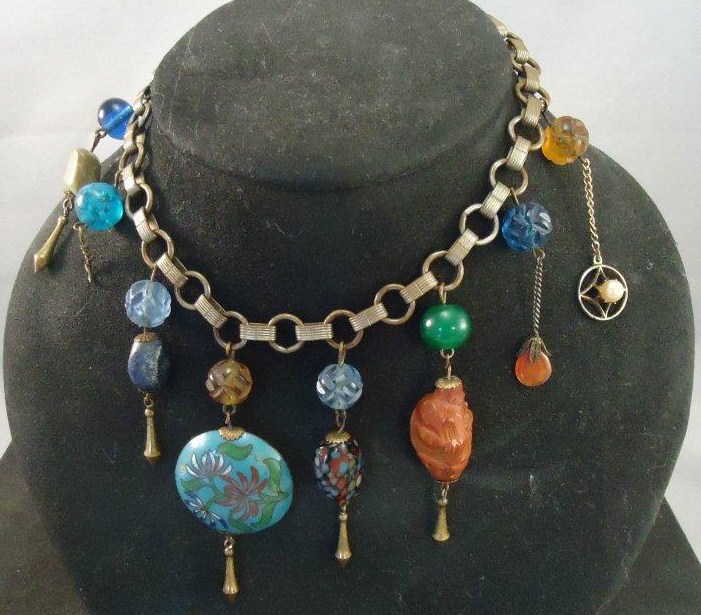
This necklace also features old court necklace-style cut glass beads, a large disc-shaped cloisonne pendant, brass chain and other assorted Chinese stone charms:


And recently on eBay, a silver brooch featuring this champlevé dragon design in a round brocade-covered cotton-filled box that appears to be similar in style to the Camel Bell box that accompanied the blue glass beads necklace and earrings.  
courtesy of mymomsantiqueshop

In the biography by Don Menzies cited above, in a letter Helen says that she sent a shipment from her shop to Rhode Island in 1937, just prior to the Japanese invasion of China.  A possible origin for these cloisonne beads, belts, and other jewelry?

Sunday, November 17, 2013

Puzzling Evidence - Louis C. Mark, Rice-Weiner, and the Mysterious Qun Li Mark 群力

群力


Most costume jewelry collectors have encountered the famous water carrier brooch patented in 1941 by Louis C. Mark, head designer for the Rice-Weiner jewelry company during the early 1940s. 


Mark also patented a Chinese-themed bracelet.
Has anyone ever seen an actual produced example of this?  

Another famous patented Mark design is the eagle brooch from 1940.
courtesy of eBay vendor amxbmw
An extensive account of the Rice-Weiner company can be found in the second volume of Carla and Roberto Brunialti’s American Costume Jewelry: Art and Industry1935-1950:

…in the period under review, Rice-Weiner was an important firm, which, particularly in the years between 1938 and 1950 manufactured premium jewelry, which was famous for the quality of its design, materials, and manufacture.

The first design patented on behalf of Rice-Weiner by Louis C. Mark of Providence, the firm’s head designer, was an American eagle in fighting stance, dated 13th August 1940. … In September of the following year Mark designed and partly patented brooches, necklaces, bracelets and earrings  inspired, according to “Women’s Wear Daily” of 7th July 1941, by Byzantine, Moorish, and Persian motifs (the latter bear the trademark PERSIAN CRAFT accompanied by signs that could be Persian alphabet letters), as well as Etruscan … Maya … and Chinese motifs.

The signs that appear before and after the trademark “Thief of Bagdad Korda©” are not, as is commonly believed, the figures 113 and 61, but letters from the Arabic alphabet… Whether they are correct or a fantasy creation is not known.  The designs were probably by Louis C. Mark.”
A brooch from the Thief of Baghdad series, featuring Arabic? letters

What seems relevant here is the penchant for use of non-English letters in the trademark stamps.

The water carrier brooch appears in two main variations.

The first version closely matches the patent drawing, with enamel dots on the man’s shorts and Chinese cloisonné beads.  The pin is positioned vertically.
Gold-colored plating with patent mark, courtesy of eBay vendor kraftyrose

Silver-colored plating with Qun Li mark, courtesy of eBay vendor popgems

Brooch in upper left is in the private collection of Morning Glory Antiques & Jewelry

Brooch on bottom courtesy of eBay vendor jeweler2

A second version features rhinestones instead of enamel dots on the shorts, and Venetian lampwork beads, pressed glass, or wood beads. The pin is positioned diagonally.
Brooch on right with blue beads courtesy of eBay vendor victorian_lady

An unusual version as a sweater chain

As shown above, the cloisonné bead versions display either of two marks - one with the patent number, and the other with a mysterious pair of Chinese characters.  One of the posters at beadcollector.net kindly identified these characters as Qun Li, translating roughly as “group-herd-flock strength,” pronounced approximately as “joon lee.” (An older transcription might appear as Ch'un Lee - I'm not up to speed in this area, however, so don't accept that without question.) The fact that it is accompanied by a © copyright symbol makes it seem unlikely to be a non-US. mark – who except a U.S. manufacturer would care about a U.S. copyright?  I wondered if there was someone named June or Julie or Lee among Louis Mark’s relatives and acquaintances. Perhaps those literate in Arabic can examine those other Rice-Weiner marks and determine if they have any assonance or other similarity to the Qun Li characters.

The rhinestone pieces lack any identifying mark.  While the Brunialti book features a photograph of a rhinestone water carrier brooch, I think the evidence indicates that this was a later version produced 1) when the original supply of Chinese cloisonné beads ran out and could not be restocked (trade interruption due to World War II, Chinese civil war?), or 2) as a design variant or copy, or 3) both.  

Louis Mark left Rice-Weiner in 1946, formed the Barclay Company, and died in 1954.  The travails of the Barclay Company and the 1950s costume jewelry trade can be sampled in this legal document.

Mark’s patented designs for Rice-Weiner featuring Oriental motifs seem relevant, as the Qun Li mark appears on other brooches.  Notice how these are all very large pieces.

Morning Glory Antiques & Jewelry's website

courtesy of eBay vendor coutequecoute - note similarity of pot metal and enamel between eagle and dragon brooches
  
courtesy of eBay vendor willexpectit


These strike me as a Westerner’s impression of Oriental motifs, not something produced by an actual Asian designer.  The cloisonné beads used, however, are distinctly Chinese.  Those who have waded through my previous post onMiriam Haskell will have noticed the similar variety of Chinese cloisonné dragon and floral motif beads appearing in those pieces, which seem to date from the late 1930s-early 1940s.

I’ve been unable to find any rhinestone versions of the water carrier brooch that feature the Qun Li mark. While Louis Mark may have used Qun Li for his own mysterious reasons when he worked for Rice-Weiner, it seems unlikely he used the mark when he worked for the Barclay Company. The company was formed in 1946, and the supply of Chinese cloisonné beads had likely run out by then.  World War II was over, the Dior New Look was in the wings for 1947, and big early-40s brooches were falling out of fashion.

It appears that someone imported a stock of Chinese cloisonné beads around the late 1930s, at least two distinct costume jewelry designers used them in the early 1940s … and then they were gone 

UPATE April 2014:
eBay seller wondollar found another vintage brooch that is likely a Rice-Weiner piece.  The size of the bead is about 1".


UPDATE: eBay vendor sarahjean.860 found another Rice Weiner dragon brooch with the Louis C. Mark "Qun Li" mark:
UPDATE: More examples:

Fabulous gilded dragon brooch from the private collection of Morning Glory Antiques & Jewelry (brooch is not for sale)