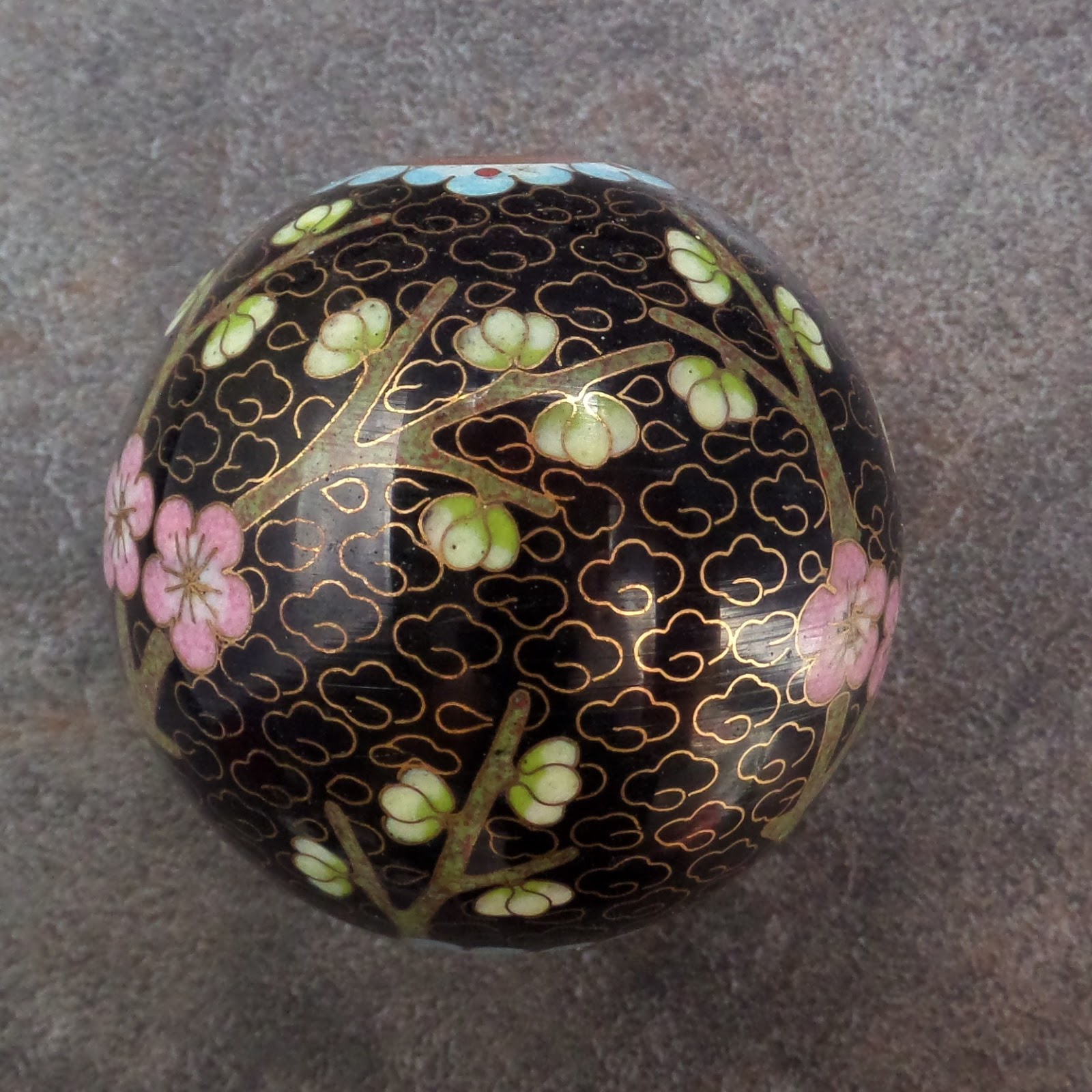
When I first became interested in cloisonné dragon beads, a
beadcollector.net member observed that these beads showed up in costume jewelryattributed to Miriam Haskell
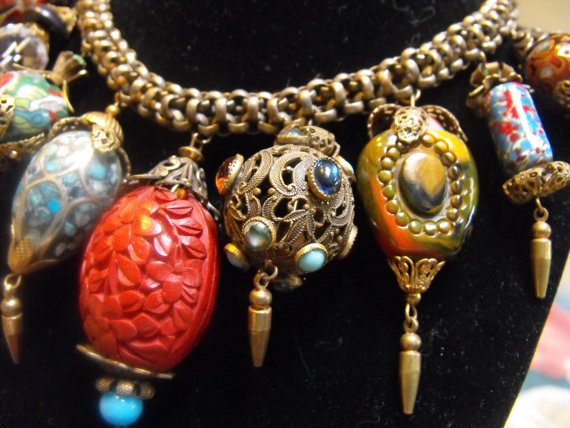
Investigating further, I learned that Frank Hess was the
head designer for the Miriam Haskell workshop after Miriam hired him in the
late 1920s, and that Haskell jewelry prior to World War II was unsigned. However, in none of the books I had on hand
could I find the slightest mention that this jewelry featuring “oriental”
charms was the product of the Haskell workshop, although such an attribution
seems to be a consistent piece of internet auction legend and lore. The closest thing I could discover was a
cryptic quote from Deanna Farneti
Cera's "The Jewels of Miriam Haskell” at the website of Morning Glory Antiques & Jewelry:
Political events also influenced designers. Out of sympathy for the Chinese and Greek people who were fighting Japan and Italy…they turned to those antique cultures for inspiration." Cera, The Jewels of Miriam Haskell, p 29.
The Second Sino-Japanese War began in July of 1937, and the
Italian invasion of Greece was in 1940.
The pieces in question are lavish with metal findings, which became less
obtainable as World War II progressed and metal supplies were diverted to
military manufacture, hence another indication for a 1930s or early-1940s date.
However, at first I was unable to find any evidence that
these pieces were part of a manufacturer’s “line” – i.e., coordinated pieces
that could be duplicated over and over again for multiple sales. And then eBay vendor coutequecoute provided a
clue, pointing out a pinback finding that matched one attributed as characteristic
of the Haskell workshop on page 74 of Gordon and Pamiloff’s book MiriamHaskell Jewelry.
 |
| coutequecoute |
Note that the book brooch
with this matching pin back is made from orange Czech glass leaves, not coral;
however, an adjacent picture featuring a
wired pin back with folded ends is made of tiny coral branches similar to coutequecoute’s set. Morning Glory
Antiques & Jewelry website shows a promotional
watercolor from the 1940s of Haskell jewelry made from these little coral
branches, and other Haskell coral branch jewelry pieces are discussed on page 152
of Gordon & Pamiloff’s book.
 |
| Haskell watercolor from Morning Glory Antiques & Jewelry |
Checking my archive of photos trawled from the Internet, I
found another coral and dragon bead brooch.

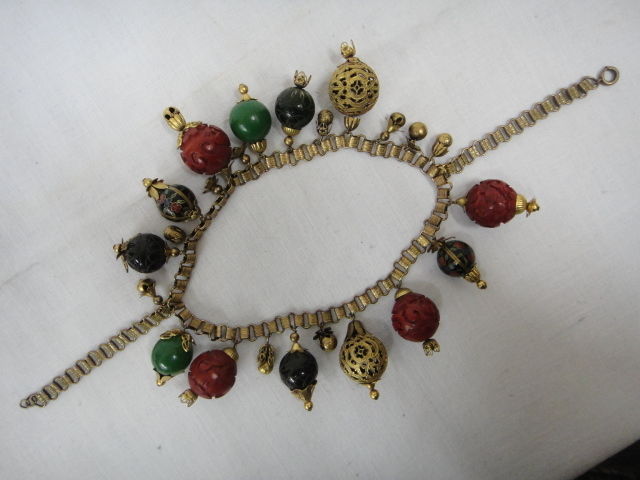
More evidence for a designer’s line using dragon beads turned
up in my pictures archive – four necklaces with matching clasps, chain, and
overall design, including the sequence of the suspended charms (from left to
right: Japanese lacquer, cut crystal,
cloisonné dragon, brass/turquoise chip inlay, carved cinnabar and jeweled
brass, “Bakelite,” lampwork glass or pressed glass, Japanese lacquer).
 |
| Lower left bracelet and necklace set Laurie Steig Vintage Jewelry |
Curiously, at first I thought the necklaces labeled 1 and 1A
were the exact same piece and that a Neiger Czech pressed glass “Egyptian” bead
had been substituted for the cylindrical lampwork bead; however, there seem to
be some differences in the fine details.

Many of the beads used in the charms can be found again and
again in similar compositions. The brass
findings vary from one piece to another, although appear to be coordinated
within a piece. A Czech origin seems
likely for the findings. The molded
“composition” beads with Japanese motifs and the faux-ojime Japanese lacquer beads
also appear in other pre-World War II necklaces, which beadcollector.net
discussions have theorized might be cruise ship or tourist trinket jewelry.
Japanese lacquer beads at beadcollector.net
Molded composition beads with Japanese motifs
Japanese lacquer beads at beadcollector.net
Molded composition beads with Japanese motifs


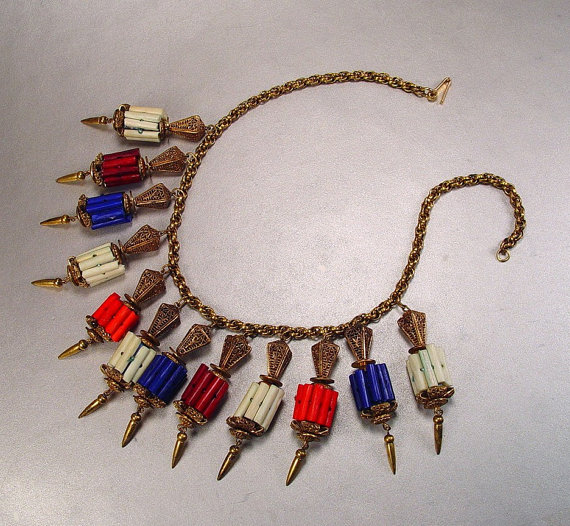 |
| Note the red-white-blue theme. |


 |
| with permission of Florence Foster, Beads With A Past |
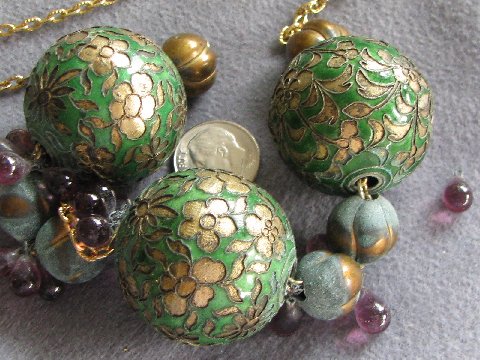 |
| with permission of Florence Foster |


 |
| Similar brass beads appear in the more opulent pieces above with tiny jeweled cabs attached to them |


 |
| boylerpf shop at Etsy |
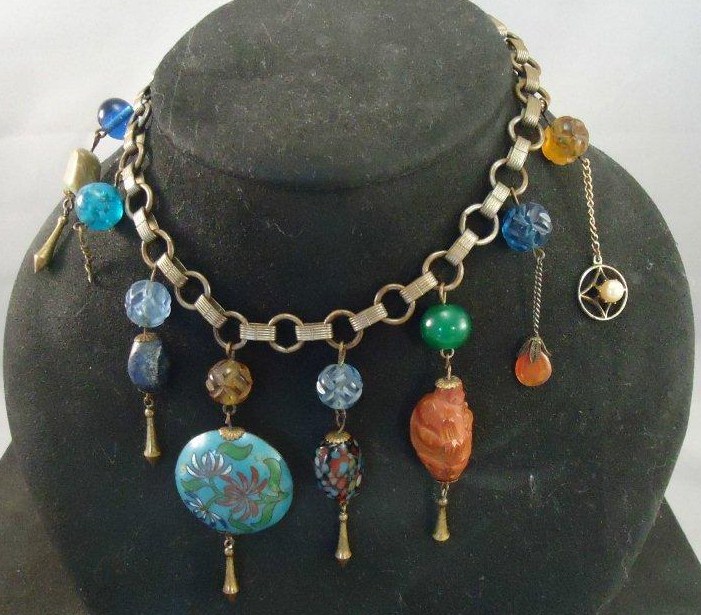 |
| Chinese beads, including carved glass beads similar to those used in Qing court necklaces. Likely an outlier from another designer? |


 |
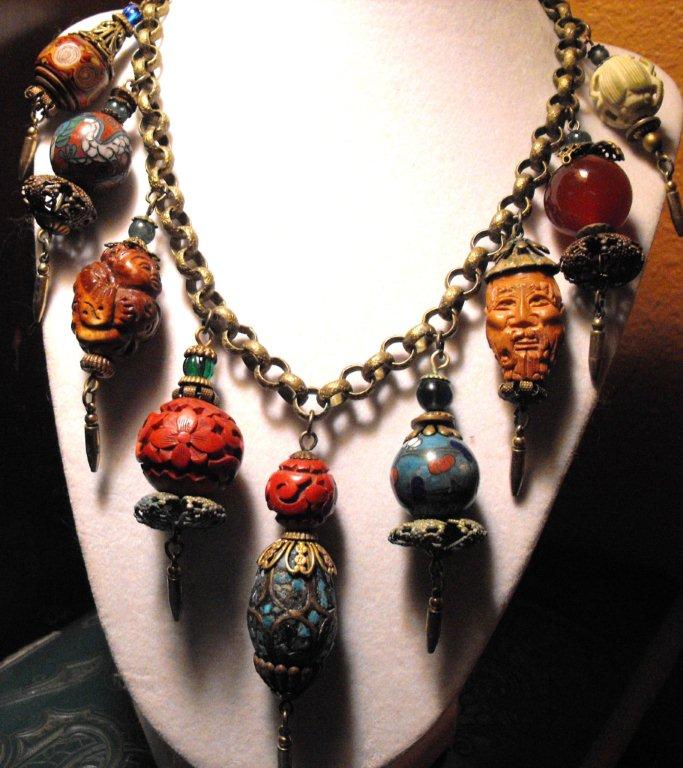
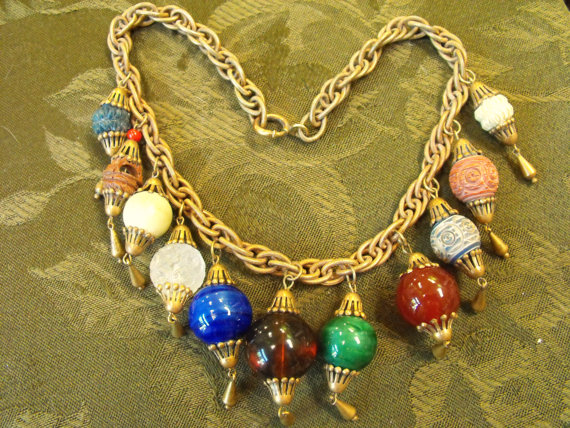
| Glass, Japanese lacquer, glass with molded glass cap, glass, "Bakelite," cinnabar, molded glass, molded composition with Japanese motifs, silver plated hollow blown molded glass, brass and turquoise inlay, glass. Big beads, about an inch in diameter each. |


 |
| sold by Magic Dragon |

 |
| TerraSoulJewelry |


 |
| TerraSoulJewelry |
 |
| TerraSoulJewelry - sold |
 |
| TerraSoulJewelry - sold |
 |
| TerraSoulJewelry - sold |
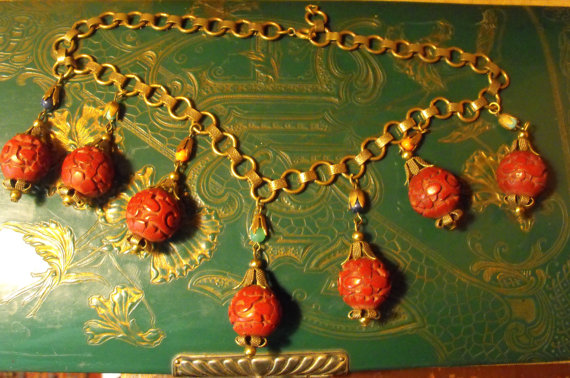
Not all the pieces pictured above may be from the same designer, of course. Many pieces are from TerraSoulJewelry, so you may want to bookmark her Etsy shop if you collect this rare jewelry.
The coral pieces and opulent charm necklaces aside, this type of costume jewelry seems to me to have more of a Ziegfeld Follies rather than a
Park Avenue look to it, and might have been created as a fun, novelty line for
one season, perhaps as part of a resort-wear line, with occasional one-offs for
the 5th Avenue shop or given to buyers as prototypes. If the line was indeed produced during
the 1930s, the decade of the Great Depression, purchasers were presumably more
well-to-do and capable of buying something frivolous that within a few months
would be unwearable, “so last year” because of its distinctive and easily
recognized look.
1920s? 1930s? 1940s? Haskell? Other designers? All of them, Katie? Puzzling evidence.
Chinese cloisonné dragon beads also appear in brass belts,
and in brooches featuring the mysterious Qun Li mark – more on these pieces in the next post. https://www.beadiste.com/2013/11/puzzling-evidence-louis-c-mark-rice.html

UPDATE: A possible connection to Helen Burton? https://www.beadiste.com/2015/07/puzzling-evidence-deco-chinese-charm.html
UPDATE: A commenter sent links to a dramatic necklace of jade rings and cloisonne dragon beads. Some readers were unable to open the links, so here are the photos:


UPDATE: A dozen years later, in late 2024 and early 2025 I did a series of blog posts collating the information acquired about various possible lines of late 1930s-early 1940s designs attributed to Miriam Haskell. Here is a link to one post.
https://www.beadiste.com/2024/12/?m=0
You can check the blog index for the other Haskell-ralated posts in October and December 2024 and January 2025