Saturday, July 4, 2015

Beads Traded into Africa vs Pacific Northwest "Russian" Blue Glass Fur Trade Beads

Sorting through my collection of trade beads recently, I observed that the very largest of my so-called "Russian" trade beads all have 7 sides.  Beads of this type were purportedly used in the 19th century slave trade (based upon an inscription of the Levin sample card in the British Museum, likely written decades after the slave trade was abolished in England in 1807) as well as in the North American fur trade, particularly in the Pacific Northwest.
Beads of unknown source (likely Columbia River?), from the Pacific Northwest, and from the African trade.  About 13x13mm in size.  The upper strands are transparent uniform dark cobalt blue, the lower lighter blue strand has 3 layers of glass.  The light blue strand displays glass decomposition, most likely from burial in earth, and was collected in Africa by Michael Heide.
Beads closely resembling the long beads on the right appear on a 19th century sample card in the British Museum with a hand-written label, "Beads used in the African Trade for Slaves."  Dark blue beads similar to the strands on the left also appear in the right column of the sample card, but are smaller and have 6 sides. 
Dainty beads that appear to closely match those on the "Traded for Slaves" sample card (see below)


Various colors of blue, comparing Pacific Northwest beads with strands from Africa.  With the exception of the lowermost steely blue strand of beads, the African beads display a layered structure, with translucent glass overlaying a bright opal or opaque blue commonly called "Dutch" blue.  The Northwest Coast beads are often 7-sided, the African beads are smaller in diameter and usually have 6 sides (but not always - the two dark sapphire strands upper middle are strung on African raffia and have 7 sides).  The darker blue Pacific Northwest beads are a uniform color, but the lighter blue beads display a core of "Dutch" blue.  6-sided beads with multiple layers, as well as monochrome beads, have also been recovered at the Fort Vancouver fur trade post archaeological site in Portland, Oregon and elsewhere along the Pacific Northwest coast. (see PDF)
There's a fair amount of bead collector lore about these beads, including the usual heavy crust of confusion and misinformation that accumulates around antique objects.  So I did an internet trawl, and collected my notes and pictures into a Powerpoint document, available as a PDF for those interested.  This isn't a spiffily formatted presentation, but perhaps you will find it informative, as it contains pointers to books and online documents with in-depth research.

BeadsTraded for Slaves vs Traded for Furs

Those interested in extensive pictures of the varieties of these "Russian" beads can find an awesome online exhibit at the Picard Museum.

UPDATE: Found an online version of the British Museum Levin cards at ezakwantu.com.  I've circled the beads resembling those discussed above. As the Picards note in their online exhibit of beads on pre-1900 cards, with respect to the Levin cards in the British Museum, "there is no real evidence that these sample cards of beads traded for gold, ivory, palm oil and slaves are really accurate as to what they were traded for, and therefore are not to be taken literally."

UPDATE: Scan of the color Plate I from the 1985 pamphlet by Elizabeth Harris, "The Russian Bead," Northwest Colored Bead Chart No. 3.
The author states, "The beads pictured on plates I and II are predominantly from the collection of G. B. Fenstermaker.  June Payne and Albert J. Summerfield very generously loaned beads from their collections so that as wide a variety as possible could be shown."
[Open image in another tab if you wish to magnify it]


UPDATE: The Smithsonian's National Museum of the American Indian has an example of the type of bead collected by the Tlingit in Sitka, Alaska (site of the Russian-American Company).
 
"Collection history unknown; formerly in the collection of Frederick W. Skiff (1868-1947, a Portland, Oregon, accountant and antiquarian); purchased by MAI from Frederick Skiff in 1925."
https://americanindian.si.edu/collections-search/objects/NMAI_148302

More Pacific Northwest beads:


Neah Bay, Makah Reservation; Clallam County; Washington; USA
Collection History
Collected in 1916 by Leo J. Frachtenberg (1883-1930, an anthropologist who specialized in Native American languages) during fieldwork sponsored by MAI.


UPDATE MARCH 2024
Posted with the permission of the photographer, an extraordinary Tlingit vest composed of Russian trade beads, in the collection of the Smithsonian's National Museum of the American Indian.


Puzzling Evidence - Rare Lotus Pond Vase by Lao Tian Li 老天利 and "Made In China" Stamp

We know the Lao Tian Li studio continued into the early 1920s, because Jin Shiquan 金世权  at age 12 was apprenticed there in 1922 under senior craftsman Liu Guangde.  Was Lao Tian Li himself still alive then and overseeing the studio?  This interesting vase has a rare combination of stamps on its base - the signature stamp of Lao Tian Li, plus a "MADE IN CHINA" stamp.  A country of origin stamp including the words "Made In"  was required to be on products exported to the United States after a 1920 tariff act - previous to that, only the name of the manufacturing country was required.  The stamp is a stylized version of Lao Tian Li's engraved signature that appears on earlier pieces.


UPDATE: A following blog post comparing this vase with another piece in the lotus pond theme that seems to have been made for U.S. export:

http://www.beadiste.com/2015/07/puzzling-evidence-chinese-cloisonne.html

Thursday, March 12, 2015

Puzzling Evidence - Mysterious Belts and B. Blumenthal & Co. Inc. 1930s Jewelry

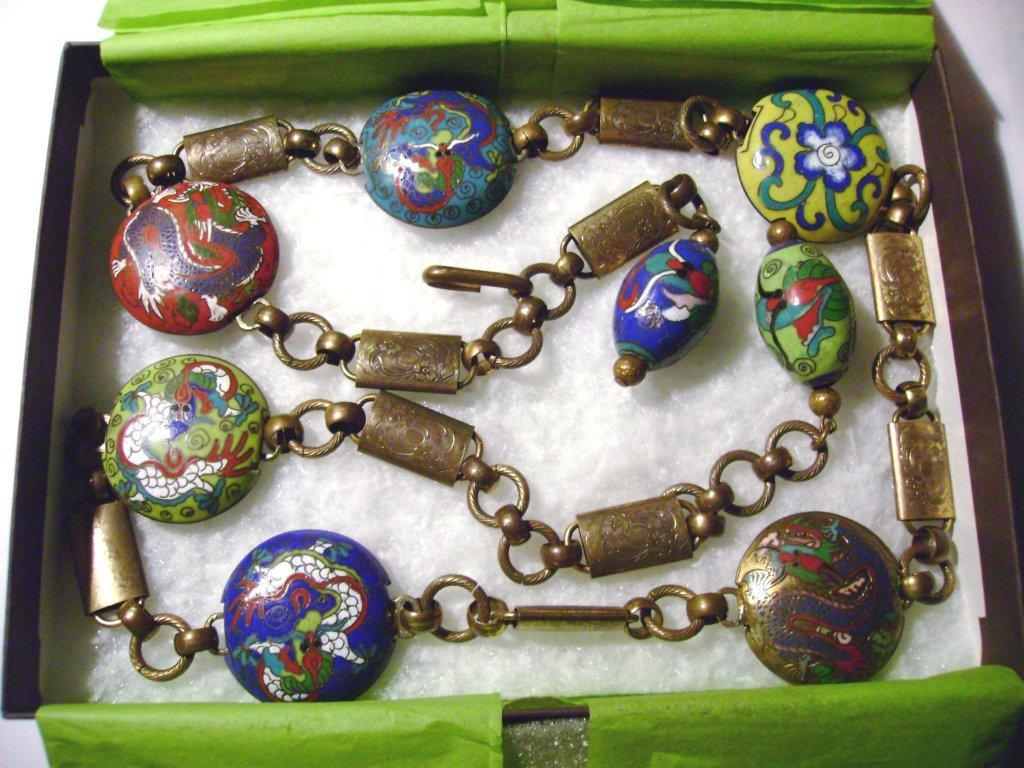
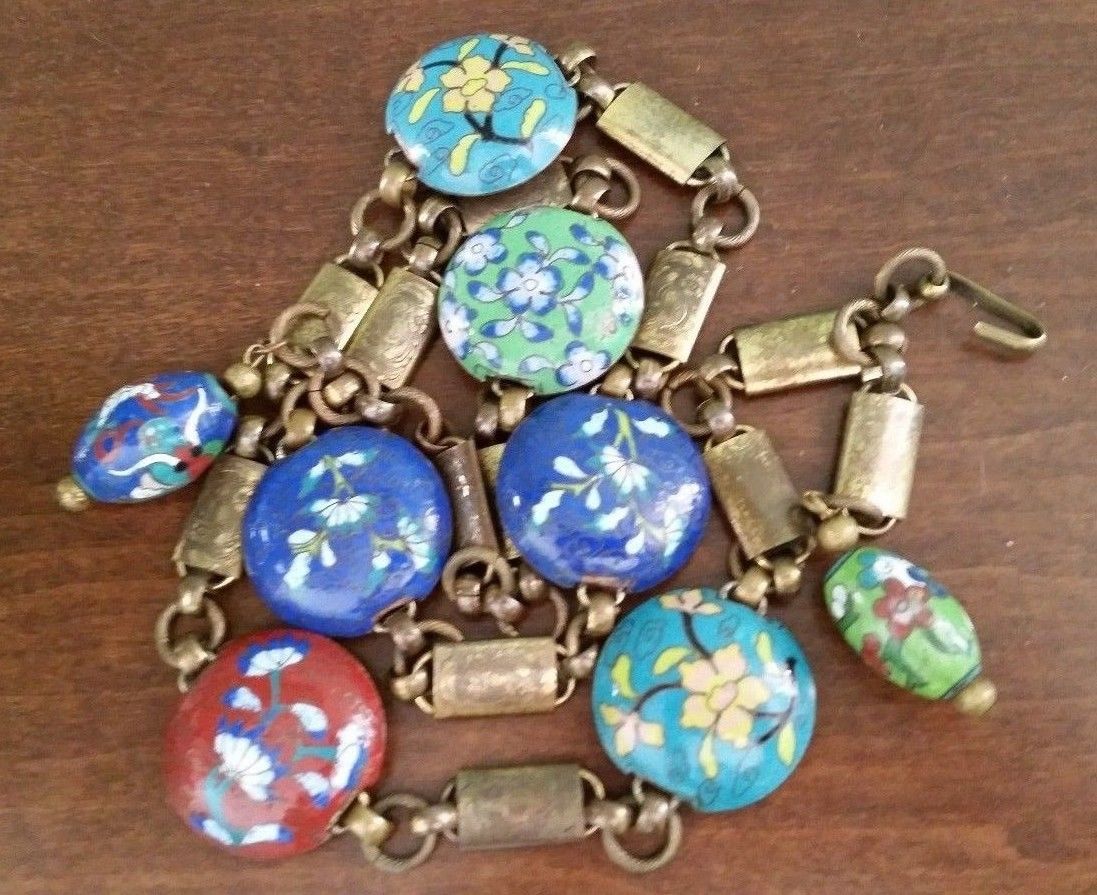
In previous posts about Deco-era cloisonne beads, large disk-shaped beads with slotted openings appear, often in a distinctive brass belt:


These belts often feature cloisonne dragon and floral beads that appear in designs by Louis C. Mark for the Rice-Weiner company and pieces attributed to Miriam Haskell.
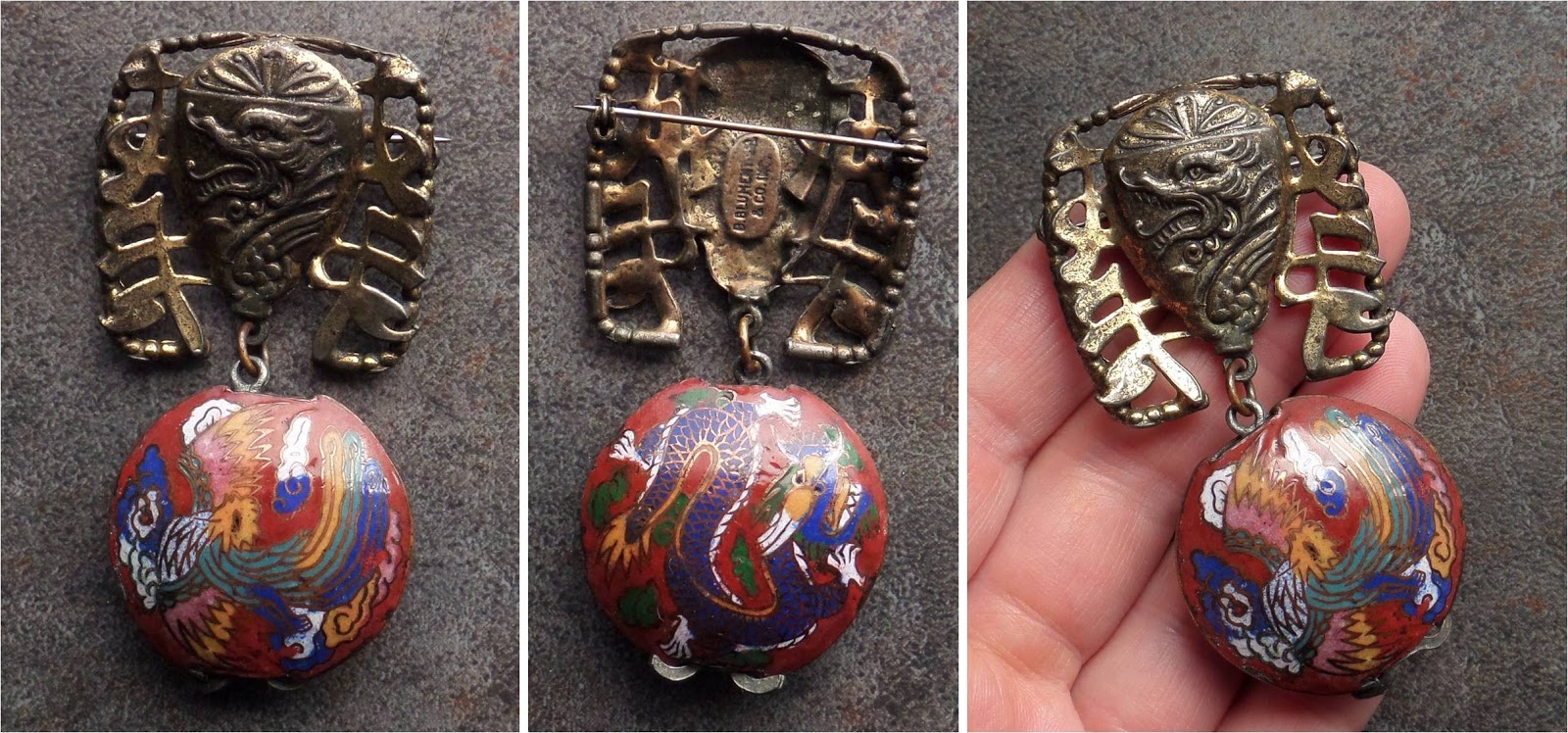
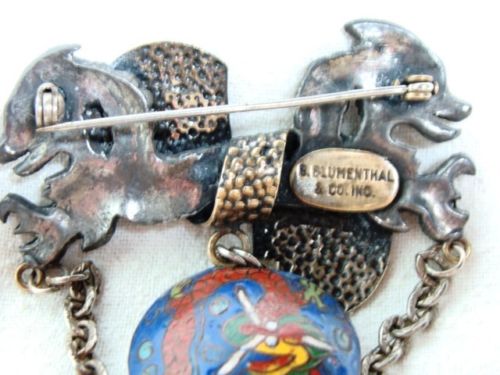
However, the large disk-shaped beads also appear on brooches or pins with the B. Blumenthal & Co. Inc. trademark stamp:
On offer from eBay vendor moonspinner09


Rubylane shop owner Karen A. at Rare Treasures connects the dots and suggests that these brass belts might actually have been produced by B. Blumenthal & Co. Inc.
This seems like a good possibility, as the brooches and belts are consistent with 1930s fashions and costume jewelry.

UPDATE: A blog reader has contributed these photos of matched octagonal champleve phoenix and dragon disk beads that  the seller stated were belt pieces. "I found them at a very tiny and primitive antique shop on Hwy 90 Bat St. Louis ,Mississippi pre 1990's." 
They seem carefully enameled, with the unusual feature of turquoise enamel surrounding the slotted hole and what seems to be a silver plating.  I like how the artisans colored each piece a bit differently, especially the phoenixes.


Saturday, February 28, 2015

Puzzling Evidence - Chinese Cloisonne in the 1960s

What happened in the Chinese cloisonne workshops during the ten years between the organization of the workshops in the mid-1950s and the Cultural Revolution in 1966?

Accounts from various sources (books, online) agree that the condition of the workshops was deteriorated and impoverished after the wars and economic turmoil of the previous 40 years, with many older artists unable to support themselves by their craft - Jin Shiquan, for example, was selling almond milk on the streets of Beijing.  Thus a modest guaranteed income in a state-supported enterprise and the ability to once again create cloisonne was welcome.  Did this result in a burst of enthusiasm and a revival of inventive artistry?

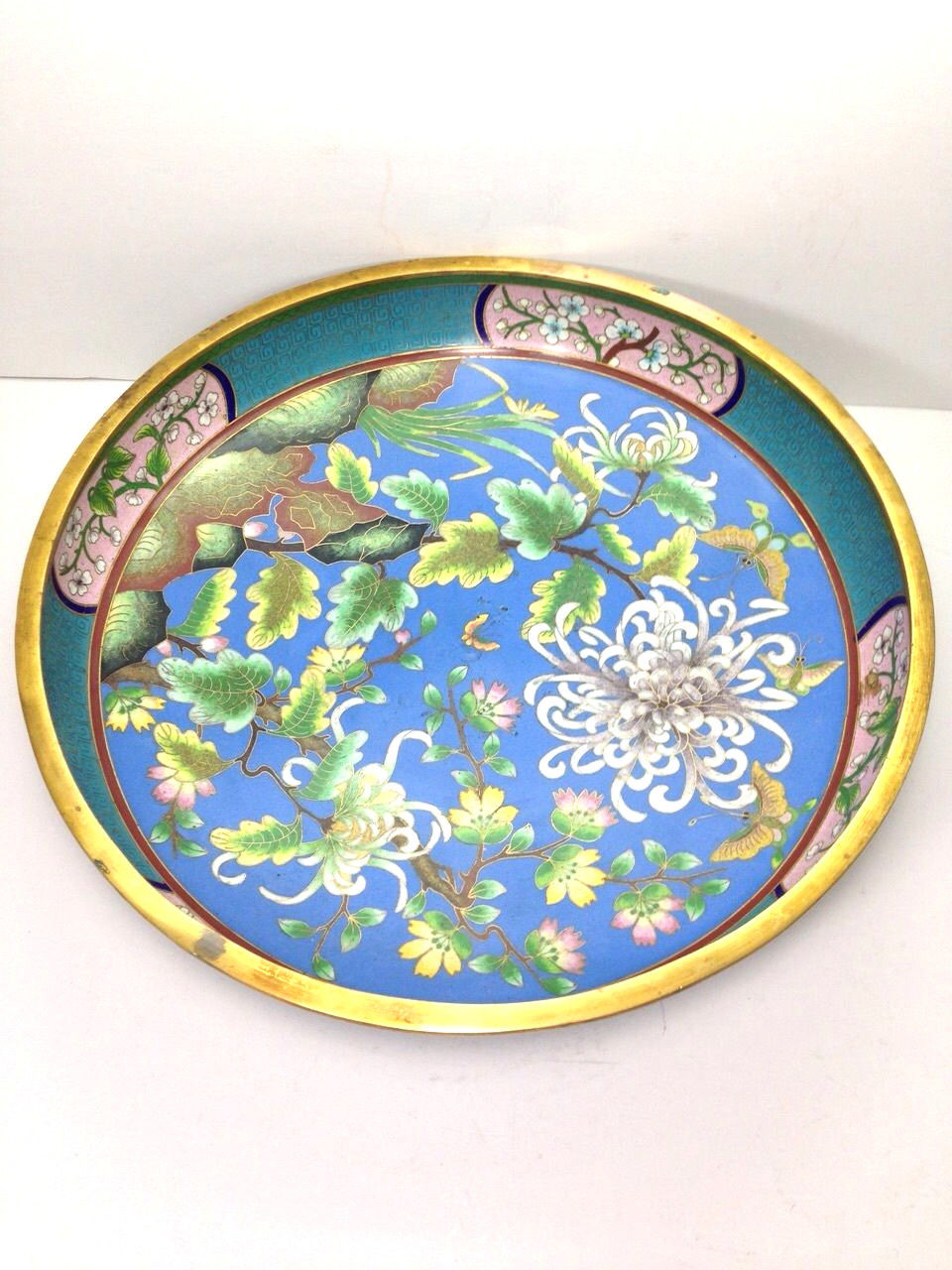
eBay vendor cinnabarlacquerking inherited a warehouse of unopened boxes of Chinese lacquer and cloisonne from his grandfather's business estate.  His understanding is that his grandfather imported these items to Greece during the 1960s for sale in his art and antiquities galleries.  Two shallow bowls from this collection are interesting, indeed:
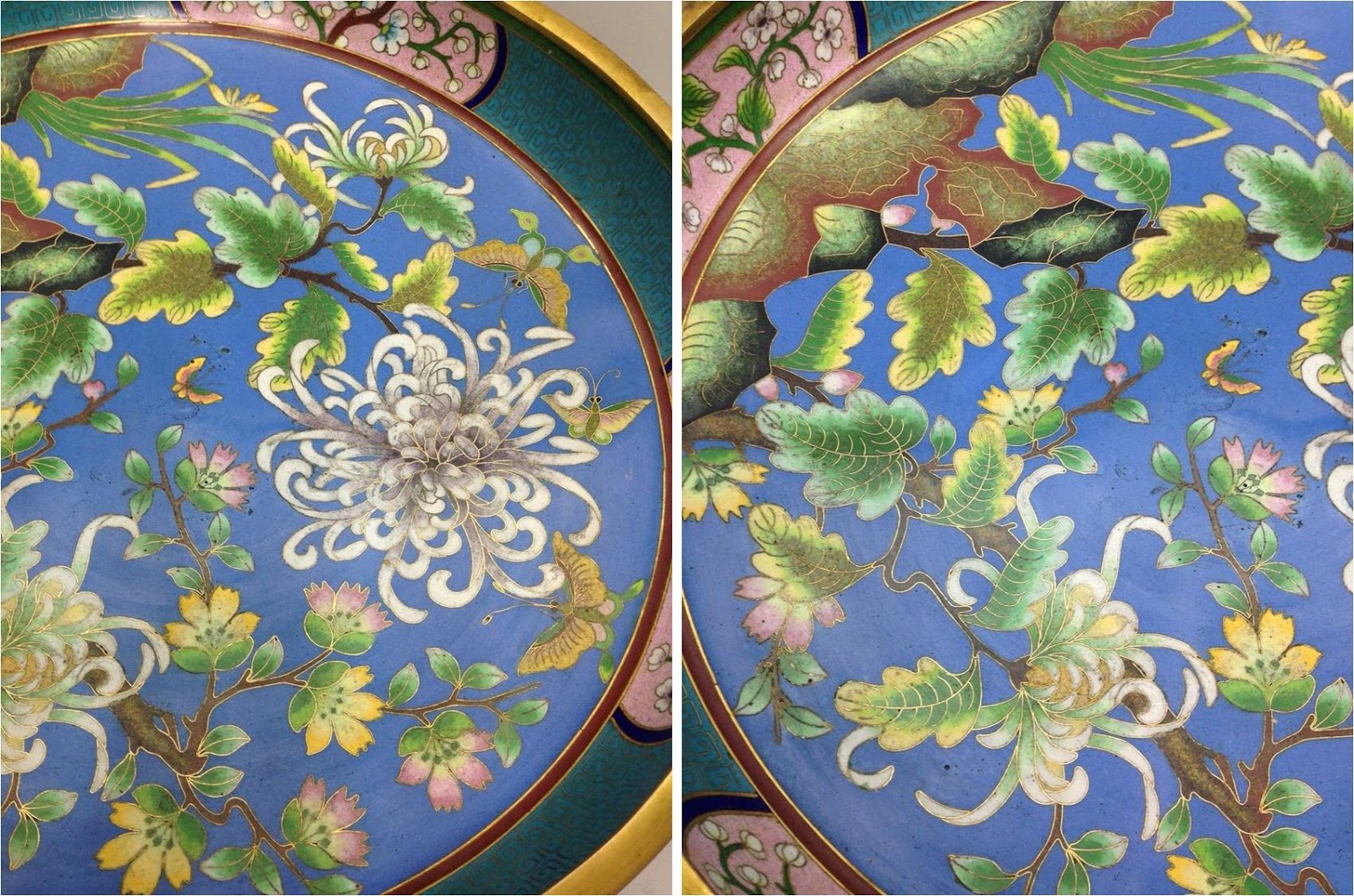
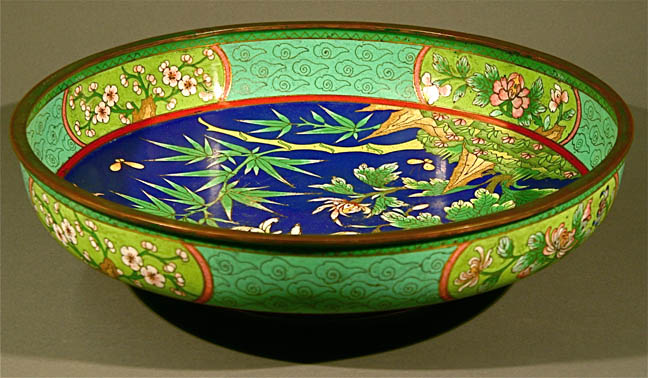
Features three of the "Four Gentlemen" representing the four seasons - Chrysanthemum, Orchid, Plum Blossom, Bamboo.


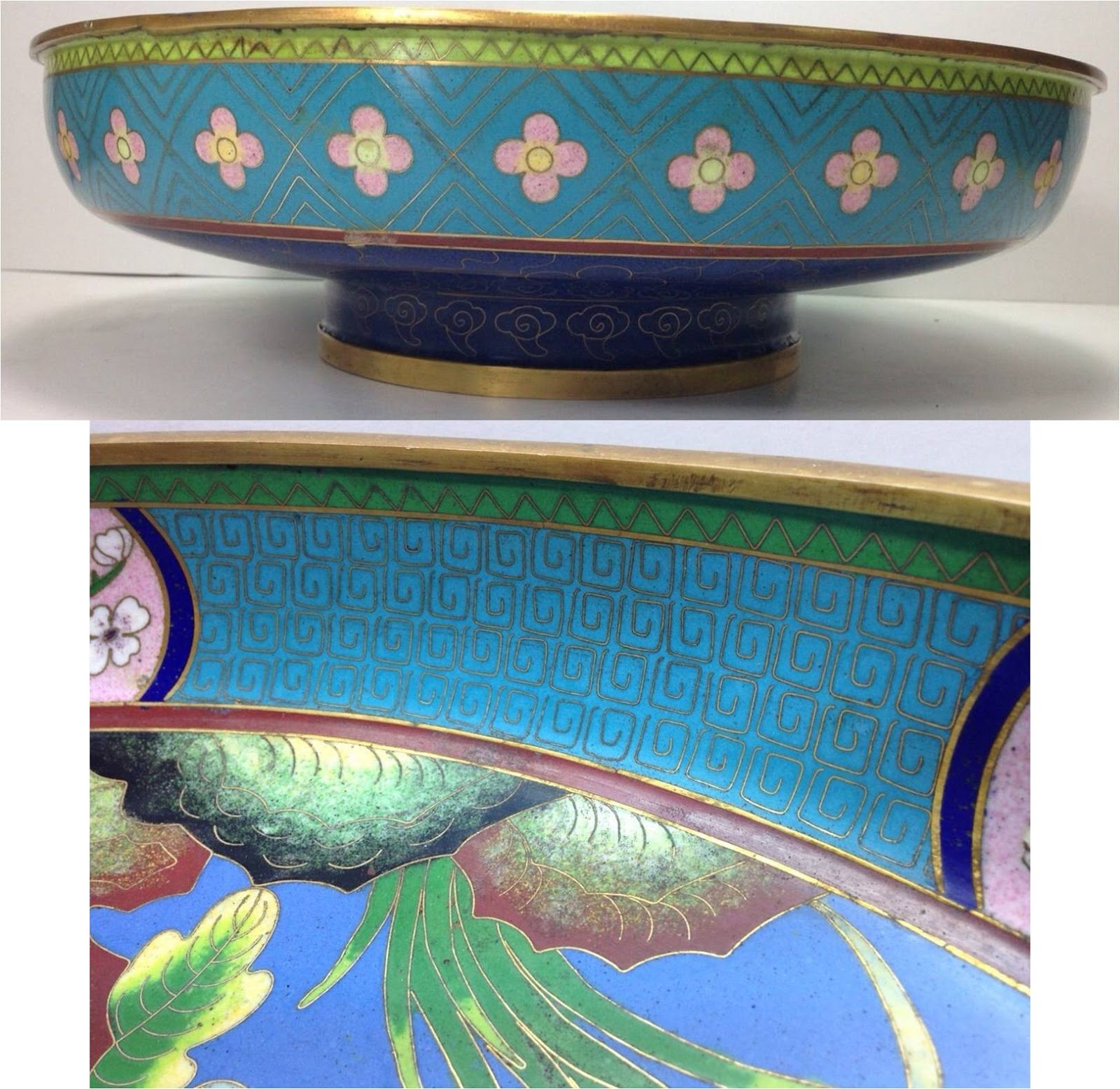
JingFa characteristics such as a graceful naturalistic rendering of the flowers, two-tone leaves with blended tonal graduation, pastel hues, rocks composed of jagged concentric wires.  However, the enamel colors are all traditional colors, albeit rendered in lighter tones, and the rocks feature sets of curved parallel lines characteristic of such rock motifs from all the way back to the 1880s-1900s. 

The background pattern of squared spirals seems to be a later adaptation of a traditional motif.  It appears often on contemporary Chinese cloisonne pieces.


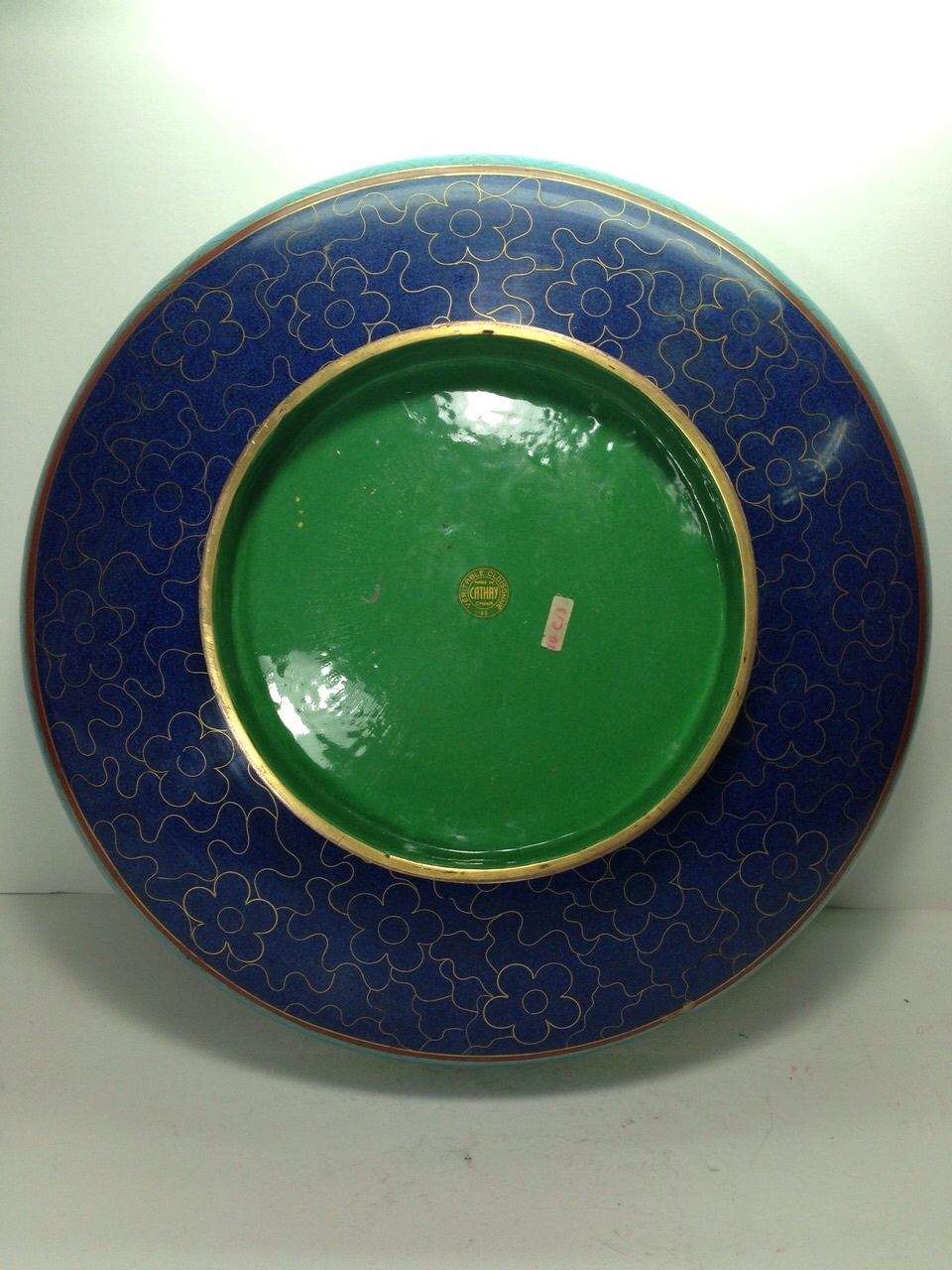
The label seems to read "Veritable Cloisonne, Product of Cathay China"

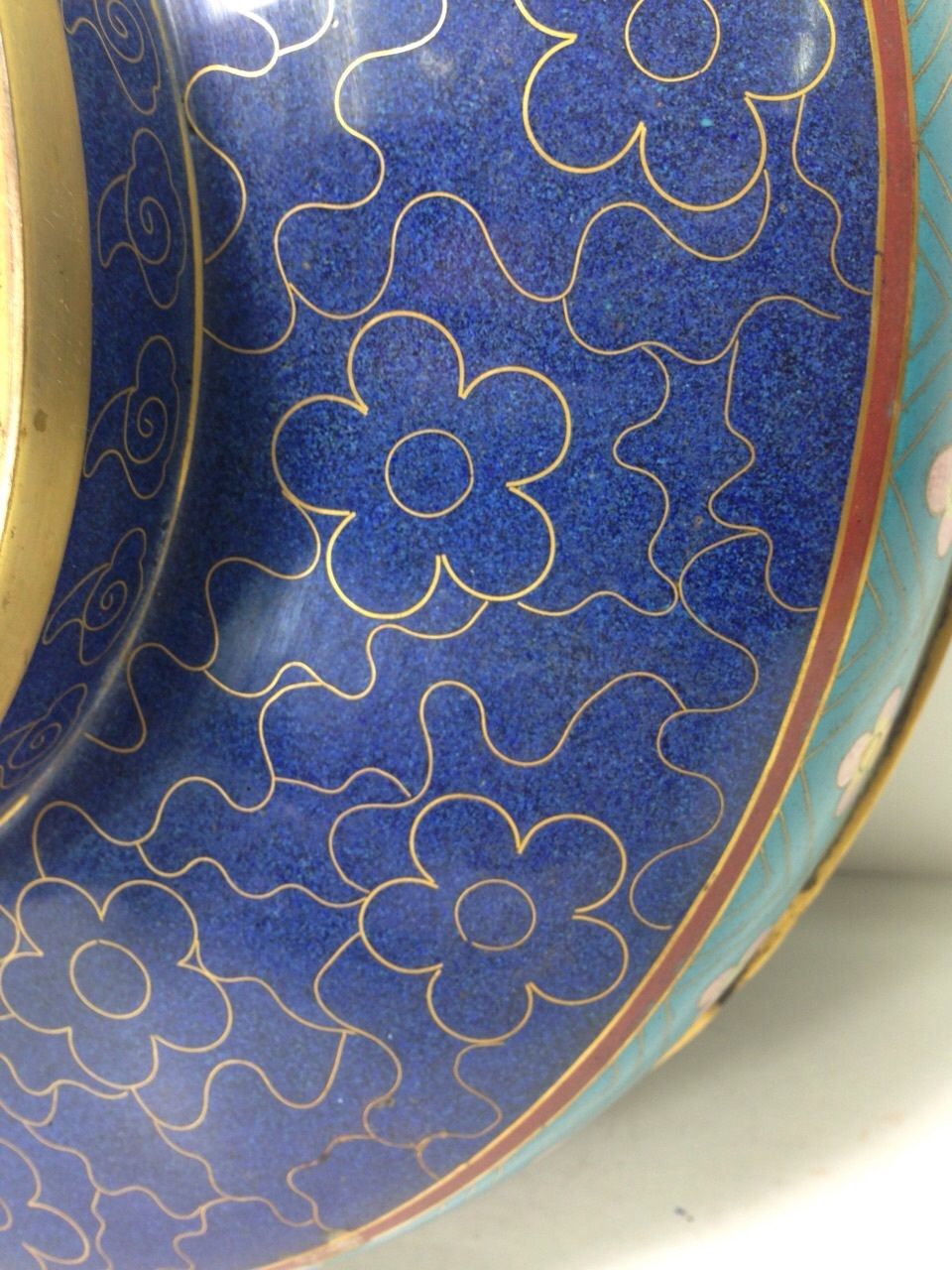
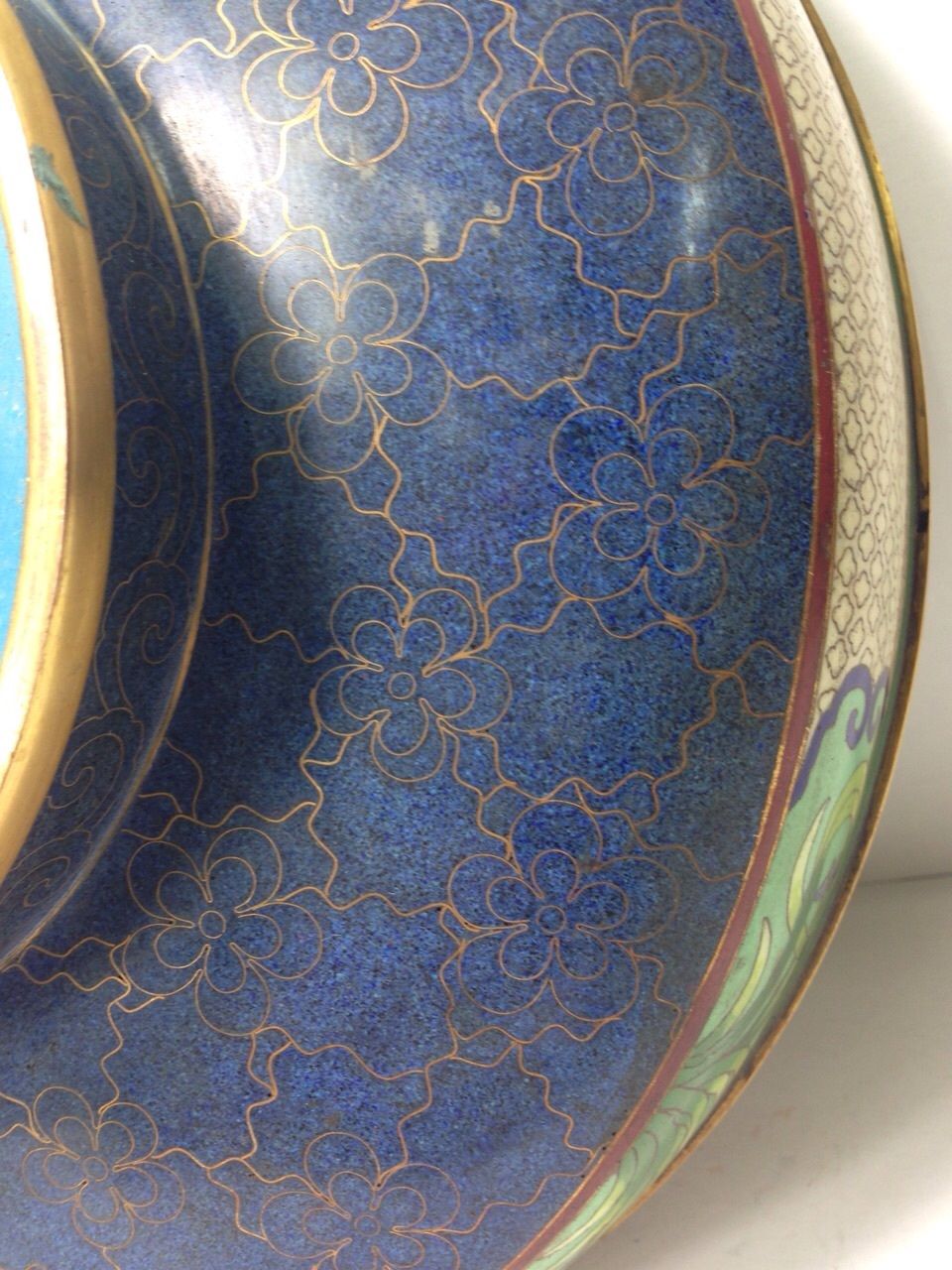
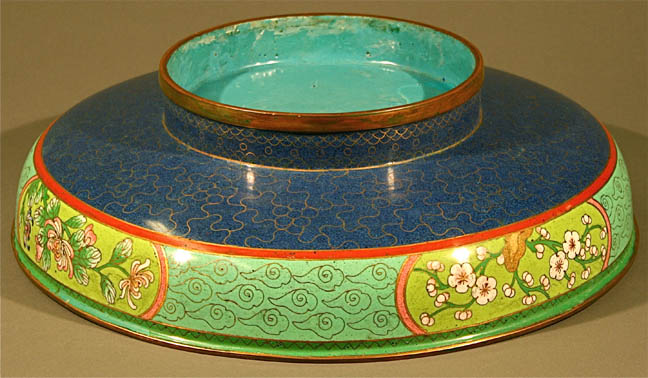
A distinctive floral pattern and granite blue color for the back enamel.

What's not to like about this extraordinary piece?  A folk-art landscape with lively Ming-style horses in an inventive painterly use of traditional enamels - tonal blending, not just crayon-coloring-book type use of enamel.


The background pattern of rounded cross shapes seems to be later than a similar but more sharp-edged diaper pattern likely used around the 1920s.  

Blossom buds wired in older 3-wire style.


A similar back enamel of flowers and wavy lines, granite blue enamel.
A bowl in similar style appeared in an online auction, the seller estimating it to be "late 19th - early 20th century:"
This time the bamboo member of the Four Gentlement is featured.  Less elaborate butterflies, leaf-shading not as tonally graduated, old-fashioned pointed rocks, "bamboo-shoot" pattern in undergrowth.  

Note the tailed clouds, somewhat simpler flower-and-wavy line granite blue back enamel.


Are these pieces the work of an older artist such as Jin Shiquan, adapting past motifs and patterns to new-found artistic freedom in the factory cooperative, or are they from 50 years earlier?
What do you make of this puzzling evidence? 

UPDATE: eBay vendor beril72 has on offer a set of six beautiful small dishes that display some similar characteristics to the larger bowls featured above:
An innovative combination of colorful old-fashioned floral motifs with geometric background patterns. The scroll with tiny leaves appears in prior decades, but the square spirals and the trefoil circles seem more modern.
Creamy turquoise blue and granite blue enamels.
UPDATE:  In an effort to make clearer some motifs I've referred to above:
Vase pair offered by eBay vendor sea-n-sand.  "This set was purchased in China during the early 1950s by a local professor. We purchased them from his estate in the late 1980s."  A more rounded and tightly arranged cross diaper compared to the earlier red jar below.


Small dish with rounded cross diaper whose owner purchased it in Moscow in the 1950s.


Jar likely to date from around the 1920s-30s with a cross background diaper.


A modern beast face jar with very precise scroll diaper.
An ancient late-Shang beast face (Taotie) bronze vessel in the Shanghai Museum.  The scroll background motif goes away back....