Wednesday, November 4, 2015

Puzzling Evidence - Chinese Cloisonne in the 1930s-1940s Under Japanese Occupation

A puzzling inscription on this cloisonne vase seems to have been solved by contributor "Super" at the Asian Arts Forum, who suggested,
"報社 means a newspaper publisher and 武徳 is the name of this newspaper publisher. If you would google 武徳報社, one would learn that after the Japanese had occupied Beijing, China in 1940, there was a cartoon publisher named 武徳報社 in Beijing, China, apparently under the direct supervision of the Japanese military, which had been publishing the "Beijing Cartoons" or "Beijing Manhua" 北京漫画 since 1940. ... All these made me believe that while the person to whom this vase was gifted was indeed a Japanese, probably somebody who had something to do with the "Beijian Manhua" magazine, however I believe the carvings were possibly being carved in Chinese and the vase was made in Beijiang, China at around 1946."
Suggested translation: "Gifted to Mr. Kudo, January 5 1946, Takenori Ho-sha [magazine publisher Beijing 1940s]."  The Japanese surrender in World War II occurred September 2, 1945.
The artistic evidence presented by this vase seems to support Super's analysis.
Below are 3 small Chinese cloisonne bottles or vases with a similar beige or mustard background enamel, one featuring a similar high-shouldered shape with clouds, another with a "crinkle cloud" background diaper like the vase under discussion.  Note how the pose of the dragon is similar in all.  All vases feature two identical dragons each, facing each other across a "flaming pearl of wisdom" motif.
These vases seem likely to date from around the 1930s-40s.The "CHINA" mark on the center vase only indicates the vase was produced after the 1890 McKinley Tariff Act for exports to the United States.  There likely could have been an additional paper label with the "Made In China" country of origin statement required after 1920.  

Other vases featuring dragons among swirling clouds show a notable consistency in the overall design composition, whether they were produced earlier or later in the decades between World War I and II (circa 1915-1945). 
1890-1910 -style on the left, zingier Deco-era red vase, vase with "crinkle clouds" background diaper, high-shouldered base with gray clouds.  Note how the dragons are similarly positioned around the different base shapes.  The vase on the left displays an old-fashioned design for rainbow clouds and rocky island among waves at base, whereas the other pieces are clearly trying to appeal to a different fashion.


In comparison, some examples of Japanese cloisonne featuring dragons, likely produced sometime between the 1890s-1920s:
Gray clouds and enamels, with fine tonal graduation.
Large scaly feet, the 3 claws depicted separate from toes.  Thicker body, bristly head with distinct eyebrows.  Long red flames or lightning bolts flickering around the body.  No rows of teeth, just a few fangs. 
Comparison of inscription vase with a Japanese pair.
The composition of the design on the inscribed vase is awkward, featuring dragons rising vertically from around the base, rather than coiling horizontally around the shoulder. The huge feet are so out of proportion! Likewise the small heads on thick bodies, which more resemble a python or anaconda.  Nor is the execution especially careful - for example, notice the breaks in the red jawline, which any competent artist would have at least matched up into a smooth curve.  The two dragons do not match - a Japanese design characteristic, whereas pairs of Chinese dragons are always nearly identical (possibly due to the cleverly efficient method of bending two wires at the same time to make identical motifs). The curving flame lines emerging from shoulders and body seem to be more typically Japanese, even if they're colored pink instead of red. The depiction of separate scales and claws on the feet also differs from the more typical Chinese method of toe and claw in a single wire line.

The vase with the inscription thus seems to show an attempt to graft a Japanese-style dragon into Chinese cloisonne, as if the artist were avoiding most of the Chinese dragon design canons and trying to come up with something from scratch. Why?

The biography of cloisonne master Jin Shiquan relates how he fled back to his home village when the Japanese occupied Beijing in 1937, fearing enslavement to labor camps in Japan or elsewhere.  So if master craftsmen and artists were fleeing, who was left to man the cloisonne workshops under Japanese supervision during the war years?

UPDATE: A boxed bottle vase pair with a base inscription that a correspondent translates as:

"The inscription on the base of the red vase reads:  供, 支那派遣軍總司令官  -  Gong, Zhi-na Pai-qian Jun Zong-si-ling -  “For provision to the ‘Shina’ Expeditionary Forces General Commander”

This inscription indicates the vase was made for the Japanese commander of military forces in China.  Zhina (支那), pronounced Shina in Japanese, was a derogatory term to the Chinese, and was employed because the Japanese wouldn’t use the normal Chinese names for China."


The online auction in which this set appeared described them as: 

"Pair Antique Chinese Cloisonne Presentation Vases 9''x4.5''. Coral red ground with blossoming lotus flowers on each side. Engraved calligraphy inscription on the bottom of each vases. One has dent on side. They come in fitted silk box with silk stands. 19th century, Qing dynasty."

What do you think?

UPDATE: Another inscribed Chinese cloisonne vase, which Asian Arts Forum participant Bill H kindly translated as:

"This reads down as "Mongolian Autonomous State Government" (Meng gu zi zhi bang zheng fu - 蒙古自治邦政府). The Inner Mongolian Autonomous Region was declared under Chinese communist control in 1947, a couple of years before the People's Republic of China was declared. I believe that this mark refers to Inner Mongolia, but you may have to do some research on the subject to verify that assumption."

When I did a search on  蒙古自治邦政府 what resulted was Mengjian, "an autonomous area in Inner Mongolia, existing as a puppet state of the Empire of Japan under nominal Chinese sovereignty."  Wikipedia

The style of the cloisonne seems very 1930s.  It's nicely made, with an unusual feature of a band of yellow enamel cloud motifs instead of the more typical floral motifs, as well as a simple field of these little clouds around the neck instead of a more elaborate lotus scroll. The artist took the time to work individual scales on the dragon's belly instead of a zigzag line.  The simpler design is a dignified composition, well fitted to the underlying shape of the vase.  Was this the intent, or was the artist merely using the clouds diapers to save time?

Does the inscription indeed refer to the puppet state, or to the later 1947 内蒙古自治区 Nei Mongol Autonomous Region?  What to make of the puzzling evidence of this vase?


For comparison, another vase that seems likely to be from these 1930s-40s decades displays a more typical floral pattern as part of the shoulder design.

Lotus scroll around neck.  Note also the chunky rim.
Another example of this vase shape with more old-fashioned detailed treatment of neck and collar, smaller and more finely proportioned rim.
Another old-fashioned vase with intricate details and fine proportions.
And for further comparison, a supremely elegant and intricate vase likely from an earlier decade.


Wednesday, October 21, 2015

Puzzling Evidence - Pink Cloisonne and the Chinese Eight Auspicious Symbols and Hundred Antiques or Hundred Treasures


This exploration of pink background enamel in Chinese cloisonne began with a plate displaying auspicious symbols, then examined a variety of works from Dr. Edward Gerber's collection in a distinctive design featuring the Hundred Treasures.  While the overall pattern of most of the Gerber collection pieces resembled a pair of jars with a Jingyuantang 静远堂 signature, a pair of basins were in a quite different design scheme.  A correspondent who now owns these basins suggested that they are likely from the 19th century.  
These are not small, measuring 15 1/2 inches or 38 cm in diameter.
Another correspondent has a black basin in this design, and a blue one turned up in an online auction.  The owner of the black basin describes it as "decorated in the Buddhist 'Eight Treasures' (babao) pattern with 'five Blessing' (wufu) bats amidst the clouds and 'Longevity' (shou) medallions.  The bottom is rounded, so definitely meant to sit in a hole in one of those old commodes or wash stands."


I did a photo comparison of the three basins, which shows differences in the small details that seems to demonstrate that the artists doing the wirework were copying from a master design, but not exactly.  For example, the pink basins feature an extra petal in the central medallion.  Modern cloisonne wires are glued together in sets of 8 to 12 and bent to precisely follow a printed copy of the design, so all versions are identical.  In contrast, older cloisonne craftsmen, such as Jin Shiquan, evidently worked directly in wire, likely over an underlying sketch, "drawing" with wire much as they might draw with an ink brush.  When making pairs, it seems likely to me that they might have simply bent two wires at the same time, thus matching up the motifs as they worked on each piece.  Thus the pieces in a design series might be quite similar, but they never display the exactitude of matching that modern cloisonne technicians achieve, because that wasn't an issue. The older artists doing the wirework might indeed have possessed the draftsmanship skills to draw the master design in the first place, so replicating motifs by eye alone would have been routine for them.  At any rate, these differences in the details might signify that these are not recent works from, say, the 1990s.
Another distinctive feature of the basins is their background diaper of kinky little Ming-style clouds (?).  I've only found two other examples of this exact diaper: a small bowl, and a set of stacked cylinder dishes featuring the Hundred Treasures motifs.  The bowl seems to have been done to imitate Ming style cloisonne.  The stacked dishes are similar to the pink stacked dishes formerly owned by Dr. Gerber and by Audrey Meadows; however, where the pink dishes feature interiors of plain green enamel, the blue dishes show this little kinky cloud motif.
Notice the similarity of the leafy green sprigs to those depicted on the basins.

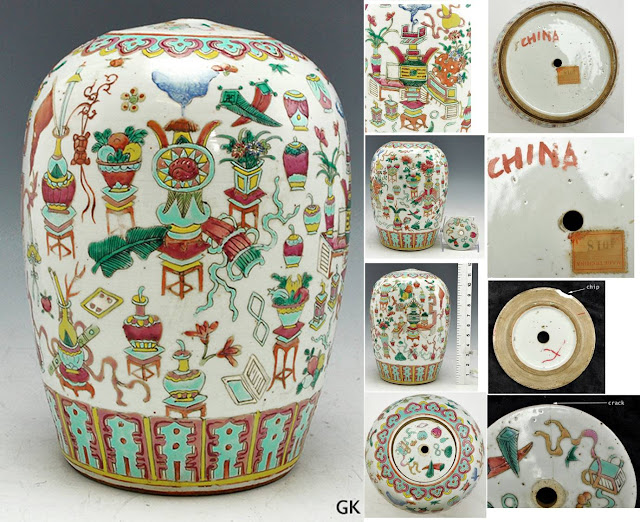
The Hundred Treasures motifs of the cloisonne vases and jars seem to be something that was fashionable in porcelain as well.  This white porcelain jar, sold at auction in 2012, shows a startling similarity to the pink, blue, and green cloisonne versions.  The "CHINA" mark splashed on the bottom indicates that it was applied to comply with United States export marking requirements of the 1890 McKinley Tariff Act, and the paper label might indicate that it was exported after 1921, when the tariff act was amended to require the words "Made In" as well as the name of the country of origin.

What is imitating what?

Examples of Hundred Treasures rouleau vases can be found from at least the 1700s, mostly in porcelain.
A comparison of a porcelain vase and cloisonne designs:

What to make of this puzzling evidence? Are the pink basins, perhaps like the pink Dragon's Gate plate that started this series of posts, indeed from around the late-19th century to 1912, (when the Qing dynasty ended)? Their traditional motifs, careful craftsmanship, and likely use in furniture seem made to appeal to wealthy Chinese.  The little bowl and stacked blue dishes sharing that kinky cloud pattern with the basins are quite nicely made as well.

The "Hundred Treasures" pieces, however, display a jazzier overall design that might well have appealed both to foreigners and to Chinese seeking to be trendy and modern.  Those spiked finials on the jars seem very Deco, and the porcelain jar was made into a lamp, something that was very fashionable in the 1920-30s as electricity in homes became more widespread.  So could these be works from the Republic era, dating from around World War I to perhaps the early 1930s?

What do you think?  I still wonder why so many of the Gerber collection pieces are still in their original pairs.

UPDATE: Another black basin turned up in a search of online auctions.  So that's a total of 5 basins so far, all sharing the same design and all in very nice condition.
Sold at auction in 2008

Comparison of two basins.  Auction basin is on left.

Monday, October 19, 2015

Puzzling Evidence - The Edward Gerber Collection and Pink Chinese Cloisonne

The previous post discussing pink background enamel in Chinese cloisonne mentioned the collection of Edward Gerber.  Doctor Gerber passed away in 2013; Clars Auction Gallery was responsible for the sale of items from his estate. 

Among the items up for auction was what seems to be a unique assemblage of Chinese cloisonne items with a bright pink background enamel and a resemblance to a pair of vases with a rare Jingyuantang (静远堂) signature that possibly date from before World War I.


While the Gerber pieces share a similar "hundred treasures" design, the bases of many of the items have an unusual and distinctive feature: rather than a circle inset into the base, they feature an enameled cap applied over the bottom edges.


There are many designs, from small soap dishes and tea sets to large jars and vase pairs.
The LiveAuctioneers.com database of past sales can be searched to view the Gerber auctions. Note the pair of stacked cylinder dishes toward the back of the top shelf.  More about a similar set below.  The small vase at bottom right displays a double happiness motif.
The vase displays a pattern at the base similar to one found on porcelains; the floral pattern is old-fashioned, and the double happiness characters seem to link it to the Jingyuantang vase; the "tiger" (?) handles and overall shape, rim, pale green turquoise enamel link it to the other examples in the collection (is it a mate to the vase bottom right previous picture?).  Again, the complete set of cups and cupholders seems unusual - how did these pieces stay together so long? Online auction.

A pair of warming dishes.


Vase Pair 1, with similar exteriors but slightly different interior enamel colors and different bases (one seems to show the traces of a wax stamp indicating approved export of a non-antique item).
Vase Pair 1 compared with similar Vase Pair 2
Vase 3 details
Vase Pair 2 and Vase 3 comparison.


Three views of pink jar
Blue turquoise jar pair from another auction, not the Gerber collection

Another non-Gerber jar, this time in a green turquoise
A non-Gerber jar photographed in daylight.
Comparison of Gerber jar with blue turquoise jar.
Comparison of the green turquoise jar with the pink jar with similar large vase motif.
Ginger jar from Ancientpoint.com, 2012

An old-fashioned perforated hat stand from a 2015 auction, similar but not identical to the Gerber pair pictured above.

Another hat stand pair.  Note the similarity of the twin fishes vase motif to that on the Jingyuantang vase pair at the start of this post.  The dotted base rim can be seen in other pieces above.
A  cylinder vase in the style of a hat stand.
A blue turquoise vase in hat stand-style.  According to Arthur & Grace Chu, orange enamel was a development of the 1970s, so this is perhaps a more recent production?
A similar set of stacked bowls can be seen in the Gerber collection.  According to the auction description,
"These bowls were from the Audrey Meadows estate. Her husband Robert Six, was CEO of Continental Airlines and this was a gift for his wife from the Hong Kong Government on approval of Continental Airlines initial flight to China."  Upon a bit of investigation, I discovered that during the 1970s Audrey worked with Robert to design the Continental cabin interiors and flight attendant uniforms.  She had the uniforms manufactured in Hong Kong. While Continental flew routes to Pacific islands during the Vietnam War, a route to Hong Kong was evidently only approved in the late 1970s or 1980 but never actually flown.  Robert Six died in 1981,and the company changed ownership.  Thus, it seems that these dishes must have been produced before 1980.

A teapot from another auction.
Another "treasures" vase from a 2015 auction.
A dish and small vase from other auctions.
What to make of this puzzling evidence?  How to account for the similarity between the Jingyuantang vase pair and other pieces?  
  • Are they all pre-World War II products from the same workshop? 1910s-1930s? Are some - or all - post-World War II reproductions?  1970s?
  • Where did Dr. Gerber purchase them - in Hong Kong or Taipei, before mainland China was opened to U.S. visitors in 1972?  In Beijing or Shanghai or Hong Kong during the 1970s or early 1980s? 
  • How did Dr. Gerber find so many of them, with pairs of items still intact?
And now for something completely different:
Continental Uniforms from the early 1970s. Audrey's designs?