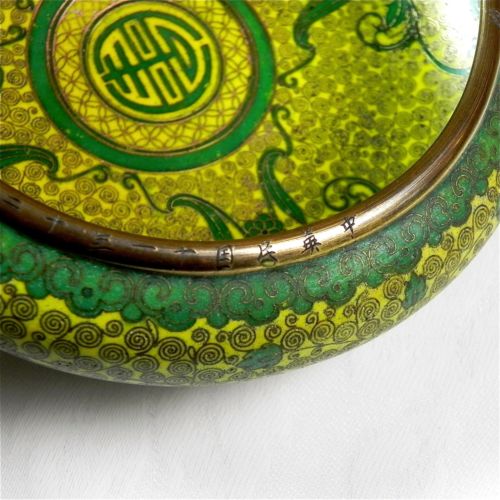
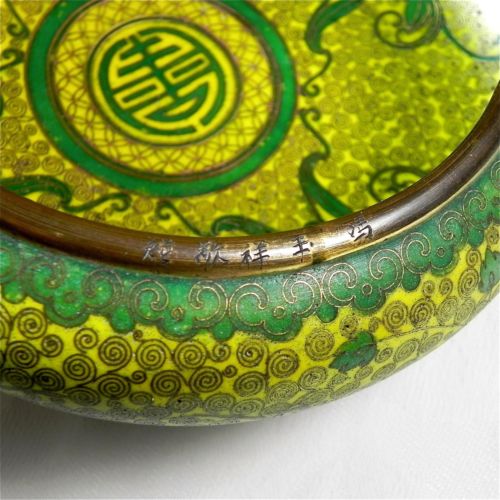
Recently I acquired a small box containing a rumpled paper
flyer from the “Teh Hsing Ch’eng” shop in what is now Beijing. The Chinese characters translate as “De Xing Cheng Fa Lang Zhu” - Dexing Cheng Enamel Workshop? [Later: Transliteration expert "rat" at the Asian Art forum corrected the last character to read as "zhuang" = shop. Makes better sense.] At the time the flyer was printed – 1935 –
the city was known as Peiping, as the Nationalist government had moved the
capital of China south to Nanjing in 1927, thus making the old name
Peking (Northern Capital) inappropriate.
 |
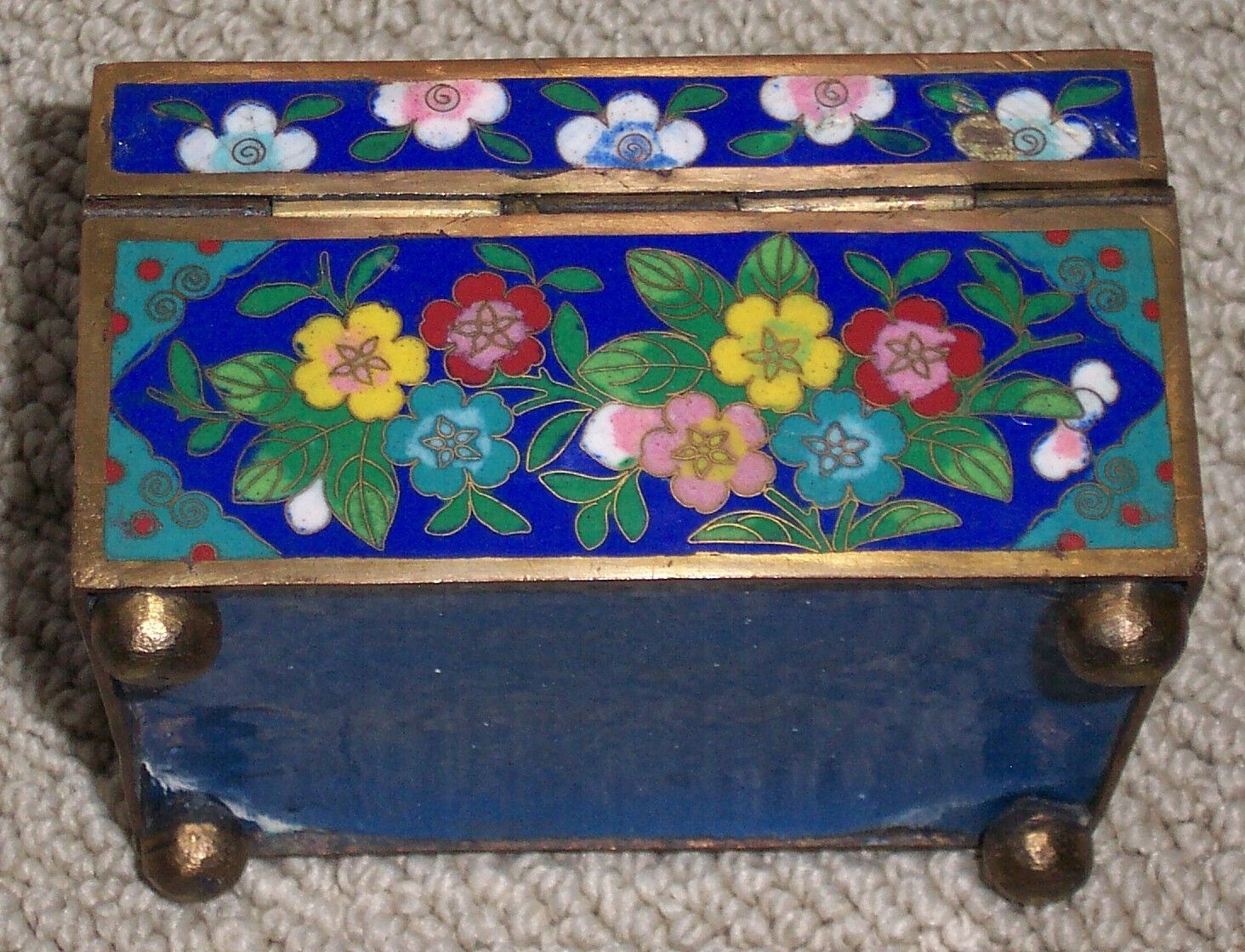
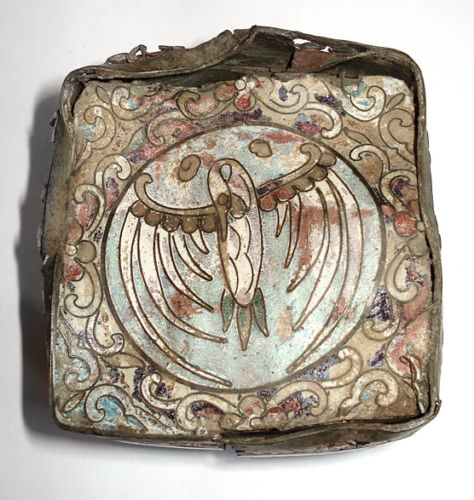
| Box with paper on left, comparing workmanship with another smaller box from the same collection, as well as a similar cigarette case from a different collector. The wirework on the small box and case is very fine and precise and the polish is impeccable, whereas the larger box displays pits in the enamel. |
|
 |
| The top side of the cigarette case features a fine dragon. |
The My Dad the US China Marine blog shows a picture
of a business card dated to 1945-47:
Hatamen Street ran alongside the eastern edge of the Legation Quarter, where foreign diplomats resided.
After steaming the paper to flatten it, the following text could
be read (missing text is indicated in red):
THE HISTORY OF
CHINESE CLOISSONNE AND OUR STORE
THE TEH HSING CH’ENG
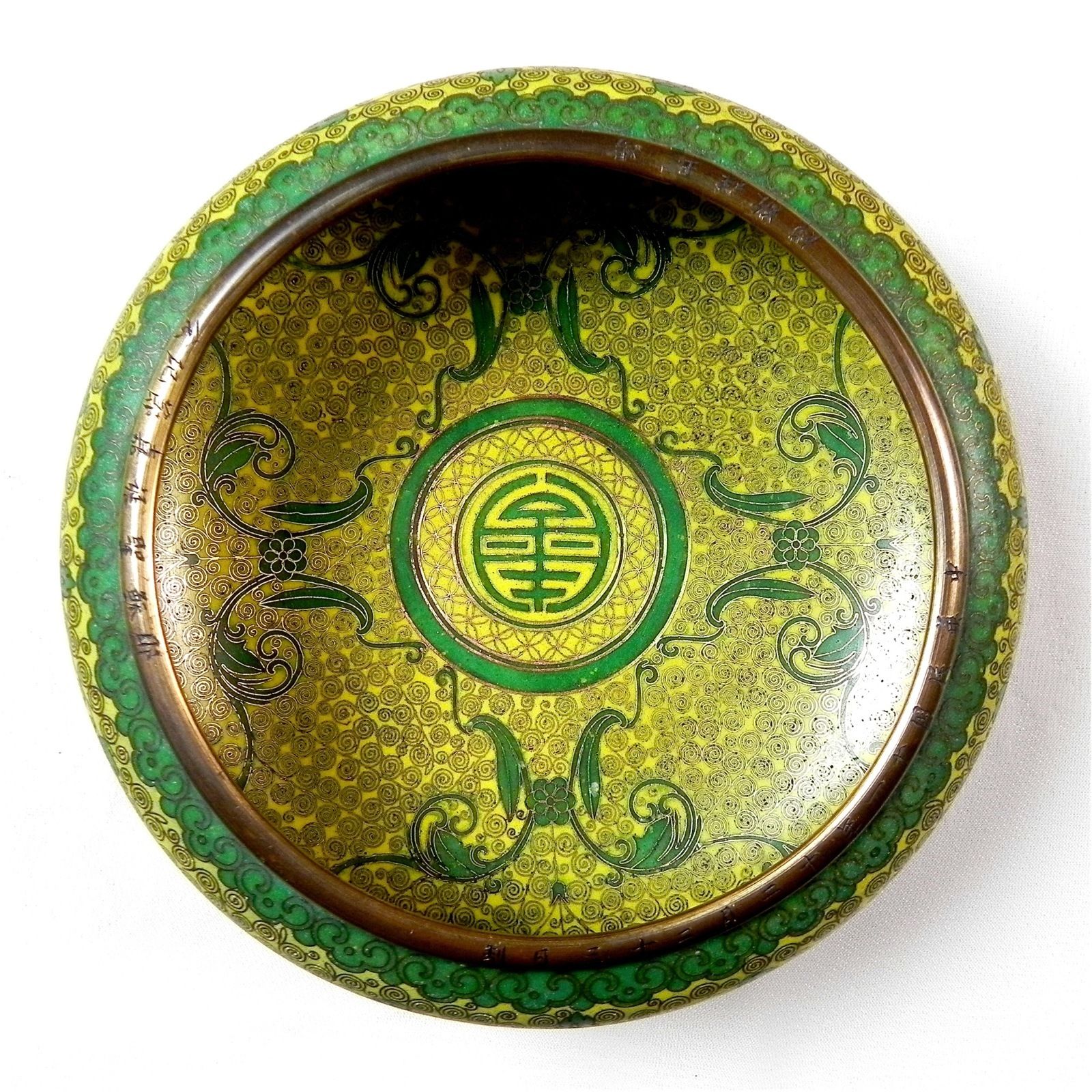
The cloisonné ware is known as one of the famous
Chinese art products. It involves a
variety of processes all of hand as follows:
(1) to have a brass plate made into the shape of desired ware, such as
vase, box, jar, etc. (2) To set on the
brass ware a lattice-work of silver or copper
wire in certain design. (3) To fill coloured enamel into the
lattice-work. (4) To bake the ware for
several times in kiln. (5) To polish it, when the ware is taken out
of the kiln. When these processes are
gone through, the result is an article of exceeding beauty.
The cloisonné ware was first produced about in
1449 during the reign of Emperor Ch’ing Tai of Ming Dynasty; hence the name “Ch’ing
Tai Lan.”
After 1810, with the death of the great Chien Lung
of Tsing Dynasty, the art was completely
lost to China.
About 1860, the lost art was found again by the
founder of our store, Mr. Chia, in the following manner:
Mr. Y___wa Chia, a native of Shantung and a maker
of [hat?] buttons for [high] officials in Peking, saw, by accident, some
[colored?] pieces of stone, which was left by a bankrupt artist to an old woman
[to dispose] of. Indeed, these
stone pieces were the material for making the [cloisonné?]
ware, but nobody knew about that. Mr. Chia
was struck by their beauty and bought
a few pieces of them more out of curiosity than anything else. Thereafter, on the poor woman’s request, he
bought all of the rest for a small price.
On returning home, he secluded himself in his workshop and began his
effort to delve into the secret of the making of the cloisonné ware. After a considerable time, he succeeded. As at that time, the cloisonné ware was very
rare on the market, Mr. Chia sold his product for a good price, especially to
the high officials who used to take them as the old curios of Ming Dynasty.
Upon his success, Mr. Chia founded our cloisonné
store, known as Teh Hsing Ch’eng, at Yang Mei Chu Hsieh Chieh, Peking, about
seventy-five years ago; and since then many of the European and American
customers have ordered the products with great satisfaction.
We manufacture the large and small pieces of
cloisonné ware, such as: vases, beads,
flower-jars, smoking sets, incense burners, etc. Besides obtaining different prizes from the
national and provincial exhibitions, we have also been awarded with gold and
silver medals, together with diplomas, from Kaloniale Tentoonstelling, Samarang
in 1914; Panama-Pacific International Exposition in 1915; Liege International
Exposition in 1930; etc.
Last year, our store, Teh Hsing Ch’eng, was
removed at 20 Hatamen Street, Peiping (Peking).
Your inspection at anytime is warmly welcome.
THE TEH HSING CH’ENG
July 1st, 1935. [number 20 struck out, “52”
written in ink alongside] 20 Hatamen Street,
Peiping
Printed the The Yu Lien
Press
A couple of things struck me in this account. First, the legend about the founder
re-inventing cloisonné in his workshop.
1860 saw the end of the Second Opium War, with the looting and burning
of the Summer Palace by the French and British. The display of
this war loot in Europe caused an intensification of interest in Chinese
cloisonné, as Susan Weber relates in her chapter in Beatrice Quette’s book, Cloisonne: Chinese Enamels from the Yuan,Ming, and Qing Dynasties:
The sacking of the
Summer Palace in Beijing in 1860 marked a major turning point in the collecting
of cloisonné in Europe. Prize pieces
were among the war booty that the French and British army forces divided
between them. The English portion of the
Summer Palace loot went to Queen Victoria and her generals, but by 1862 goods
plundered by individual officers were being sold throughout Europe. … Prices at any sale that included Summer
Palace objects were high, as collectors vied for pieces made for the imperial
court rather than for the Western export market. Many of these objects eventually became part
of British and French public collections, particularly the Victoria and Albert
Museum, the Lady Lever Art Gallery in Liverpool, and the Musee des Arts
decoratifs in Paris.
The Opium Wars and the Taiping Rebellion left the Qing
government in financial disarray, and the imperial cloisonné workshops were
closed. The flyer’s account might indeed
have been based upon workshop materials and unemployed artists turned out onto
the streets of Peking. Cloisonné enamels
do start out as lumps of colored glass, which need to be finely ground and
mixed with water to produce the enamel pastes.
Perhaps some unemployed craftsmen might have been hired to assist the
company founder in his efforts to re-discover the secrets of cloisonné
manufacture and invent new enamels?
Beatrice Quette recounts on page 28 of her book:
During the Guangxu
reign [1875-1909], there was a return to high-quality production, notably for
the foreign market. Enamel colors became
fresh, delicate, and varied, and thick layering made a comeback. The enamel powders used in this production
came from minerals collected in Boshan County in Shandong Province [Note: Boshan became, and still is, an
important glass production center].
Mixed colors were widely used, notably in skillfully rendered passages
of shading. … The layer of enamel is
thinner and the objects are lighter…
[and from page 16 in Quette’s book:]
During the last
quarter of the nineteenth century, marks began to identify names of
manufactories. The name Decheng is
stamped into the metal base of a vase from the George Walter Vincent Smith Art
Museum and the same name appears on a paper label glued onto the back of either
a disk or a circular plaque in the collection of the Phoenix Art Museum. This label, written in Chinese and French and
possibly made for an international exposition in Paris in either 1889 or 1900s,
gives the address of the Decheng Manufactory [Chinese characters] and warns
against imitations: “The only true manufactory, Teuo-Tcheng, is located in
Beijing outside the Tsien-men gate near the middle of the
Yan-mei-tchou-sie-kiai [note similarity to the flyer’s “Yang Mei Chu Hsieh
Chieh, Peking” address] road (north side).”
This suggests considerable concern about quality and forgeries and was
meant to authenticate the object’s origin.
What appears to be another example of this label showed up on this piece from an online auction:
The second thing that struck me is the boast about foisting off the workshop's products onto “high officials” as
Ming dynasty artifacts. Ironic,
considering that “only true manufactory” warning statement about imitations on
the 1889 labels.
Also striking is the gap between exhibition dates – many in
the 1900-10s, only one in the 1930s, and that one the Belgian Liege exhibition
which apparently wasn't much of a success.
The 1930s were an awful decade of economic depression and war
destruction. Presumably the older
cloisonné craftsmen from the late 19th century were by this time
retiring or dying off, and workshops likely were in trouble both in supply of
raw materials and craftsmen. In 1937 Japan
invaded and took over the city of Peiping.
The biography of cloisonné artist Jin Shiquan recounts how he fled back
to his village and had to abandon cloisonné work for 15 years until the
re-organization of the tattered Beijing workshops in the mid-1950s.
The flyer in the box is dated
1935, but when was the box actually made? Was it old stock from the 1920s, or
was the workshop still struggling to produce pieces for sale despite the havoc of the 1930s? There were other cloisonné objects gathered by
this collector that seem to date to the 1920-30s era – did the flyer accompany
this particular box at the time of purchase, or another piece or pieces? Also, might other pieces in the collection come from different workshops, such as Lao Tian Li's? We know the Lao Tian Li workshop was still operating in 1922, as Jin Shiquan started there as an apprentice at age 11.
One final question - because this blog is mostly an attempt
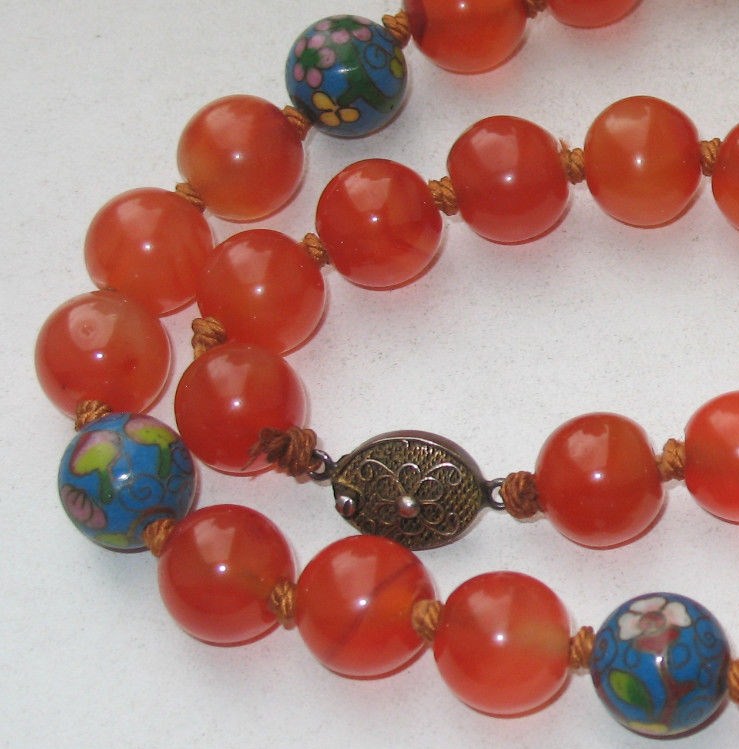
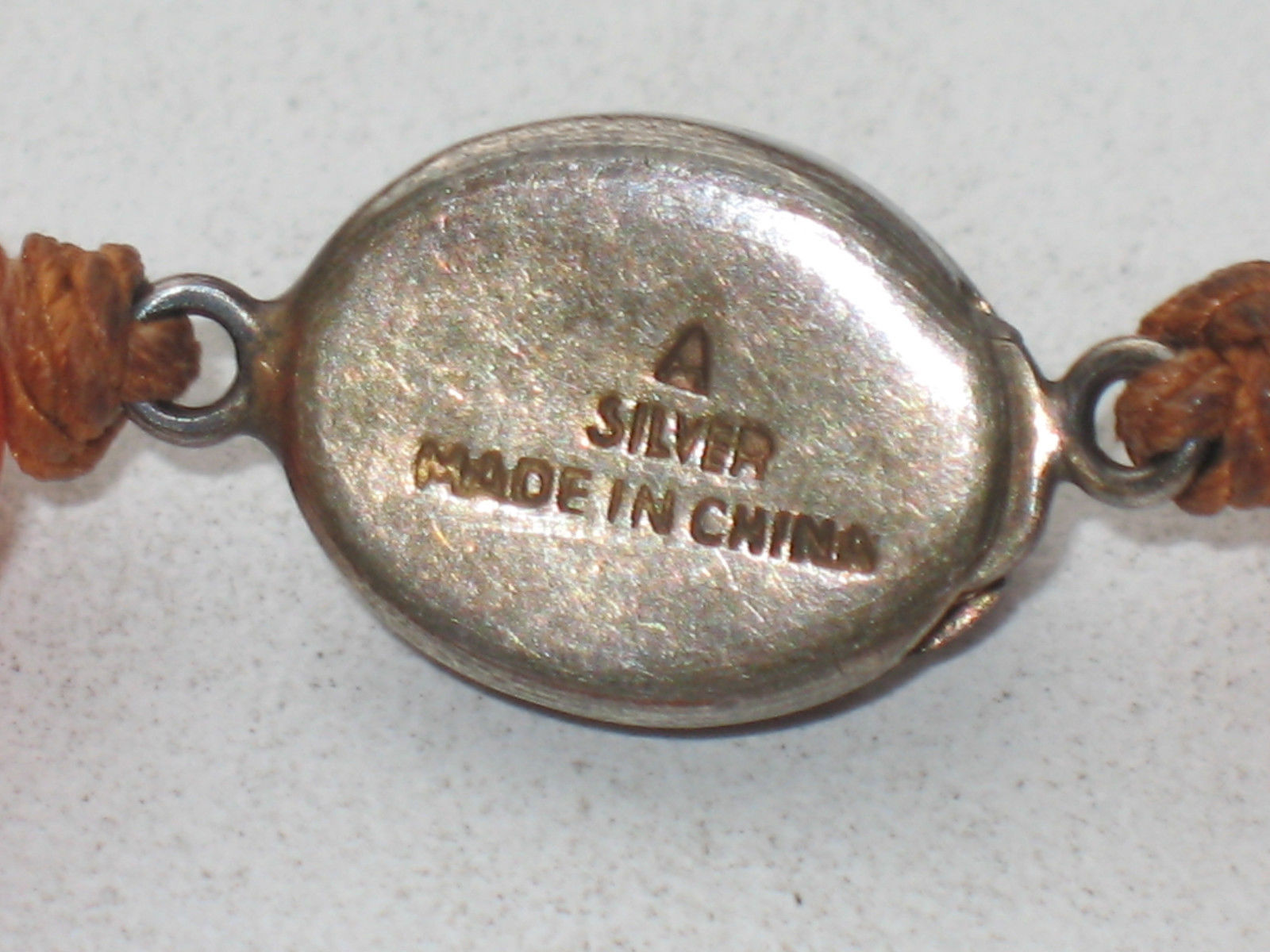
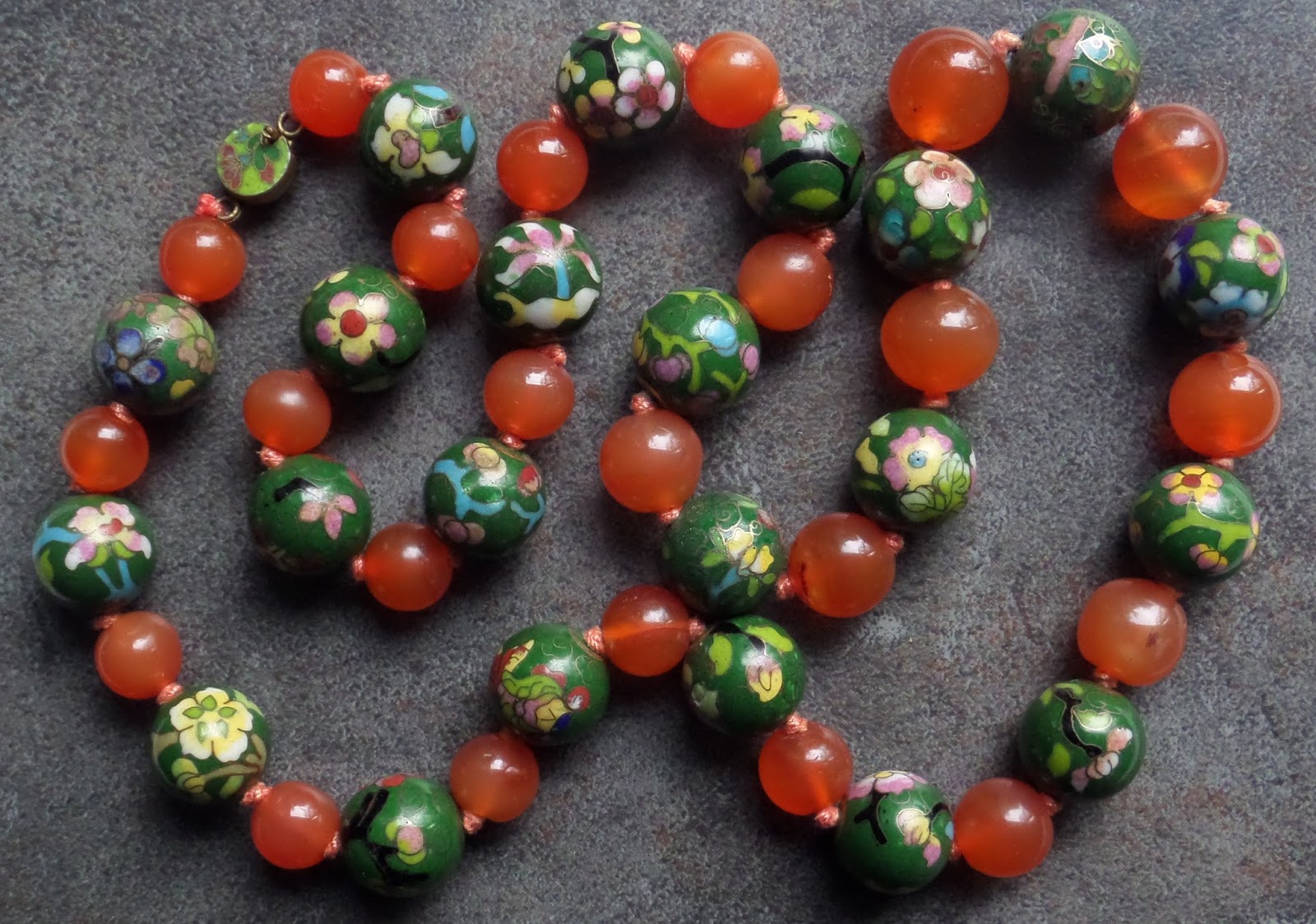
to resolve when the various types of Chinese cloisonné beads were made - consider the mention of “beads” in the flyer, and “jade beads” in the ad. Were cloisonné
beads sold? Or just jade beads?
Puzzling evidence.
UPDATE SEPTEMBER 2025: Informative research by Manuel Parada Lopez de Corselas:
"Decheng, Beitang and Tushanwan Cloisonné Workshops: A New Contribution on Chinese Christian Art"
Excerpt:
"The first cloisonné workshops opened in Beijing during the 19th century were Tianli, Tianruitang, Decheng, and Dexingcheng (Zhou 2022, pp. 188–89). Tianli (天利) was established towards the end of the Daoguang reign (1782–1850) or at the beginning of the Xianfeng reign (1850–1861), around 1845–1850, and it closed in 1900 (Zhou 2022, p. 47). It was owned by the Imperial Household Department of the Qing Dynasty, and it was located in the Ruyi Pavilion (如意館) of the Summer Palace. As such, it continued the imperial tradition but at a lower cost. Its purpose was to supply the court with the necessary objects and generate some income, although sales were discreetly conducted to avoid damaging the prestige of the royal household. The Tianruitang workshop (天瑞堂) was also established during the Xianfeng reign, but no marked objects from it have been found (Zhou 2022, p. 38). Decheng (德成) or Decheng Manufactory (德成琺瑯局), with its Quanxingcheng factory (全兴成), was founded by Jia Derun (1840–1900) 贾德润, courtesy name Yuhua 玉华, in 1860 and closed around 1935 (Zhou 2022, pp. 57–60). Dexingcheng (德兴成) was founded by Jia Yutang 贾玉堂, courtesy name Deze 德泽, the younger brother of the founder of the Decheng workshop. Initially, both workshops were connected until Dexingcheng became independent around 1890; this workshop closed around 1937 (Zhou 2022, pp. 77–78)."
Cite:
Zhou, Chunbing. 2022. Bureau of Enamel: Research and Collection of Famous Cloisonné Workshops in Modern China (珐琅局: 中国近代景泰蓝名作坊研究与收藏). Shanghai Shi: Shanghai Wen Hua Chu Ban She. [Google Scholar]
Note that there is disagreement with some of Zhou's analysis of workshop dates:
"This is an important reference book for studying late Qing Dynasty enamel, but it also contains many erroneous views, such as the view on "天利.
[1920s] was precisely the most glorious period of the Lao Tianli factory. The Lao Tianli workshop was founded in 1901. It reached its peak between 1923 and 1925, when they employed more than 300 workers and engaged in multiple lines of business, with cloisonné accounting for more than half of their production. At its height, the annual output value exceeded about 200,000. Thereafter, they began to decline. By around 1928, they employed only about 60 workers. In order to adapt to the market, they had to produce coarse and inexpensive cloisonné items, but this could not stop the factory’s deteriorating performance. By 1935, only a little more than ten people remained engaged in production. As late as 1947, Lao Tianli still existed. Although no records show that they were still engaged in production, it is possible that they continued to sell their stock in the hope of reviving once circumstances improved." --Private Expert Collector of Ming Cloisonne